

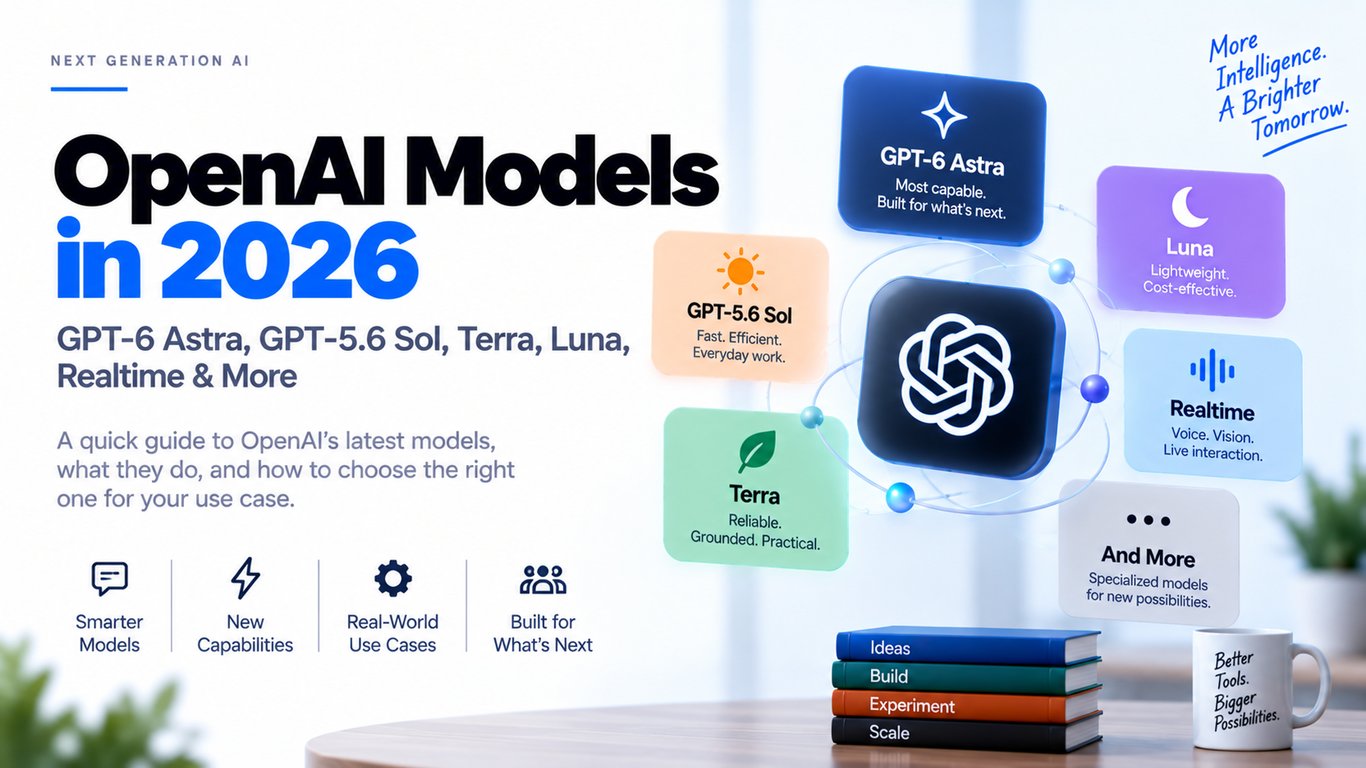
OpenAI’s model catalog changes quickly enough that a list written six months ago can already be misleading. The useful way to understand the lineup is not as one endless ladder of model names, but as a set of capability tiers and specialized model families for different workloads.
As of September 2026, OpenAI’s developer documentation recommends GPT-6 Astra for the hardest reasoning and coding work, GPT-5.6 Terra when you want a balance of intelligence and cost, and GPT-5.6 Luna for high-volume cost-sensitive workloads. GPT-5.6 Sol remains the flagship model in the GPT-5.6 family for complex professional work.
The important production lesson is simple:
> Do not send every request to the most expensive model. Choose the smallest model that reliably passes your workload’s evals, and use specialized models when the task is actually image, speech, realtime voice, transcription, or another narrow domain.
The current general-purpose lineup
OpenAI’s current API catalog exposes four major general-purpose choices developers should understand.
| Model | Best fit | Context window | Max output | Current API input/output price per 1M tokens* |
|---|---|---|---|---|
| GPT-6 Astra | Hardest end-to-end reasoning, coding, research, complex agents | 1.05M | 128K | $10 / $50 |
| GPT-5.6 Sol | Complex professional work with a lower cost than Astra | 1.05M | 128K | $4 / $20 |
| GPT-5.6 Terra | Balanced production default for intelligence and cost | 1.05M | 128K | $2 / $12 |
| GPT-5.6 Luna | High-volume, latency/cost-sensitive workloads | 1.05M | 128K | $0.20 / $1.20 |
*Pricing changes. Treat these as a September 2026 snapshot and verify the current OpenAI pricing page before making a cost commitment.
All four current general-purpose models support text and image input, text output, multilingual use, reasoning controls, and modern tool use through the Responses API.
GPT-6 Astra: the highest-capability general model
GPT-6 Astra is OpenAI’s current flagship API model for difficult end-to-end work.
Its model ID is:
gpt-6-astra
Astra is the model to evaluate first when the task genuinely benefits from maximum reasoning quality rather than maximum throughput.
Typical workloads include:
large codebase migrations
complex debugging
multi-step research
architecture analysis
hard scientific or technical reasoning
long-running agents
high-value professional workflows
Reasoning levels
Astra supports multiple reasoning-effort settings:
low
medium
high
xhigh
max
That means model choice and reasoning effort are two separate levers.
You may find that:
Astra medium
is enough for one workload while:
Astra max
is justified only for the hardest cases.
Do not automatically use maximum reasoning on every request. It can increase latency and cost without improving simple tasks.
Tools
OpenAI’s model catalog lists support for capabilities including:
- function calling
- web search
- file search
- computer use
For agent systems, tool reliability should be evaluated separately from pure answer quality.
A model can be strong at reasoning but still be a poor fit if your production workload depends on precise tool selection or structured arguments and another tier performs nearly as well at a lower cost.
GPT-5.6 Sol: complex work without jumping to Astra
GPT-5.6 Sol remains a serious flagship-class model.
Model ID:
gpt-5.6-sol
Alias:
gpt-5.6
Sol supports reasoning from none through max, giving teams more control over latency and intelligence than a single fixed operating mode.
Good fits
Sol is worth testing for:
- production coding agents
- complex document analysis
- professional research
- difficult tool-using workflows
- multimodal reasoning
- workloads where Astra quality is unnecessary or too expensive
The most important comparison is not “Astra vs Sol on a public benchmark.”
It is:
same production eval set
Astra
vs
Sol
vs
Terra
If Sol reaches essentially the same task-success rate for your workload, the cheaper model is usually the smarter architecture choice.
GPT-5.6 Terra: the practical balanced tier
Terra is OpenAI’s balance-of-capability-and-cost tier.
Model ID:
gpt-5.6-terra
It supports the same 1.05M context window and 128K maximum output as the other current GPT-5.6 general models, while costing substantially less than Sol.
Where Terra makes sense
Examples include:
customer-support agents
business document workflows
routine coding tasks
classification + reasoning
structured extraction
moderately complex tool use
large-scale internal assistants
A common production pattern is to make Terra the default route and escalate only the genuinely difficult cases.
For example:
request
   ↓
Terra
   ↓
passes confidence / validation gate?
   ├── yes → finish
   └── no  → retry/escalate to Sol or Astra
That can produce better system economics than sending every message to the strongest model.
GPT-5.6 Luna: high-volume intelligence
Luna is the lowest-cost model in the GPT-5.6 family.
Model ID:
gpt-5.6-luna
It still supports the same modern general-purpose API shape, including reasoning controls and the large context window, but is designed for high-volume workloads where economics and speed matter.
Strong use cases
Luna can be a good candidate for:
- classification
- lightweight extraction
- routing
- summarization
- simple transformations
- low-risk support flows
- inexpensive pre-processing before a stronger model
Small model does not mean “use without evals”
A cheap model can become expensive if it produces:
more retries
more human escalations
wrong tool calls
bad extractions
Measure cost per successful task, not only token price.
A capability router is often better than one global model
Instead of configuring one model for the entire product, route by workload.
Example:
simple intent classification  → Luna
normal business assistant     → Terra
complex professional task     → Sol
hardest long-horizon work     → Astra
This is especially useful when the same application handles very different task classes.
The router can be deterministic when the category is known.
image generation request → image model
speech transcription     → transcription model
Do not pay an LLM to route a request when ordinary application logic already knows the modality.
Context window is not memory
Astra and the GPT-5.6 family support very large context windows.
That is useful for:
- large documents
- codebases
- long conversations
- agent traces
But a million-token context window does not eliminate the need for:
- RAG
- selective context loading
- long-term memory
- compaction
- tool-result filtering
More context can create more noise.
A production system should still ask:
> What is the smallest high-signal context this request actually needs?
Long prompts can change pricing
OpenAI’s current model documentation notes that very large prompts can be priced differently once they cross specified context thresholds.
That means the theoretical maximum context window should not become the default prompt size.
Track:
input tokens
cached input
output tokens
tool usage
latency
successful-task rate
A long context that removes one retrieval call but doubles request cost may not be the better system.
Specialized model families matter
General-purpose reasoning models are only one part of the OpenAI API catalog.
If your task is specialized, a specialized model can be a cleaner fit.
Image generation and editing
OpenAI’s current model catalog includes image models such as:
GPT-Image-2.5 Sunburst
GPT-Image-2.5 Flare
Sunburst is positioned as the higher-capability image generation/editing model, while Flare targets faster everyday generation.
Use an image model when the output should actually be an image.
Do not ask a text model to simulate an image-generation pipeline in prose.
Realtime and voice
The API catalog includes realtime models for low-latency spoken interactions and streaming use cases.
Examples listed in the current catalog include:
GPT-Live 1
GPT-Realtime-2.1
GPT-Realtime-2.1 Mini
GPT-Realtime-Translate
These exist for workloads such as:
- voice agents
- realtime speech interaction
- streaming translation
- conversational audio systems
A realtime voice assistant has different requirements from a text chatbot:
turn latency
interruptions
streaming audio
speech quality
tool timing
Choose the model family based on those requirements, not because one general model scores higher on a text benchmark.
Speech and transcription
OpenAI also exposes task-specific speech models.
Current catalog examples include:
GPT-Transcribe
GPT-Live-Transcribe
GPT-Realtime-Whisper
GPT-4o Transcribe
GPT-4o Mini Transcribe
For speech-to-text, evaluate:
- word error rate on your domain
- accents/languages
- background noise
- realtime latency
- speaker/channel requirements
Again, the “best model” is workload-specific.
Specialized cyber and life-science models
OpenAI’s current catalog also lists specialized models such as:
- GPT-5.6 Cyber / Daybreak variants for authorized cybersecurity work
- GPT-Rosalind for approved life-science research organizations
These are specialized-access products, not normal defaults for a general SaaS application.
Do not build architecture around a restricted model unless your organization is actually eligible to use it.
GPT-6 Astra vs GPT-5.6 Sol: how should developers choose?
A good selection process is empirical.
Start with Astra when
- failure is expensive
- the task is genuinely difficult
- long-horizon reasoning matters
- the workload requires the strongest coding/research capability
Start with Sol when
- the task is complex but cost still matters
- you want strong professional capability at a lower price point
Start with Terra when
- you need a strong general production default
- request volume is high enough that cost matters materially
Start with Luna when
- the task is simple or highly repetitive
- throughput matters
- deterministic validators can catch mistakes
Then test.
Do not choose by one benchmark
Public evaluations are useful for understanding model families, but production tasks are more specific.
A coding agent may depend on:
repo search
shell use
patch quality
test execution
long-session consistency
A support agent may depend on:
retrieval fidelity
tool calling
policy adherence
escalation behavior
A document workflow may depend on:
structured output accuracy
citation fidelity
large-PDF handling
Build evals around those tasks.
Pin model IDs and regression-test upgrades
Model aliases are convenient, but production systems should track exactly what they are running.
Store at least:
model ID
reasoning effort
prompt version
tool-catalog version
retrieval configuration
When upgrading:
old config → eval suite
new config → same eval suite
compare
canary
roll out
A model upgrade is a production change, not just a dependency bump.
A practical model-selection architecture
Incoming request
      │
      ▼
Classify workload deterministically where possible
      │
      ├── simple/high-volume → Luna
      ├── general work      → Terra
      ├── complex work      → Sol
      ├── hardest work      → Astra
      ├── image             → image model
      ├── realtime voice    → realtime model
      └── transcription     → speech model
      │
      ▼
Run task
      │
      ▼
Validate outcome
      │
      ├── pass → return
      └── fail/low confidence → stronger route or human review
The best architecture uses model intelligence selectively instead of treating “largest available model” as a universal configuration.
Production checklist
Before choosing an OpenAI model, verify:
- The task category is clear
- Real workload evals exist
- Reasoning effort is tuned rather than always maxed
- Tool calling is tested separately from prose quality
- Large-context usage is measured for cost and latency
- Specialized model families are used for specialized modalities
- Cost is measured per successful task
- Model IDs/config are versioned
- Upgrades run through regression evals
- Stronger models are used only when they materially improve outcomes
Final takeaway
OpenAI’s 2026 model lineup is easier to understand when you stop looking for one universal winner.
Use GPT-6 Astra for the hardest end-to-end work. Use GPT-5.6 Sol for complex professional workloads where you want a lower cost than Astra. Use Terra as a strong balanced production tier. Use Luna when high-volume economics matter.
Then step outside the general-purpose family when the problem is actually image generation, realtime voice, transcription, cybersecurity, or another specialized domain.
> Choose models by task success, latency, cost, and modality—not by model name prestige.
That principle will survive the next model release too.
Official references

Discussion (0)