

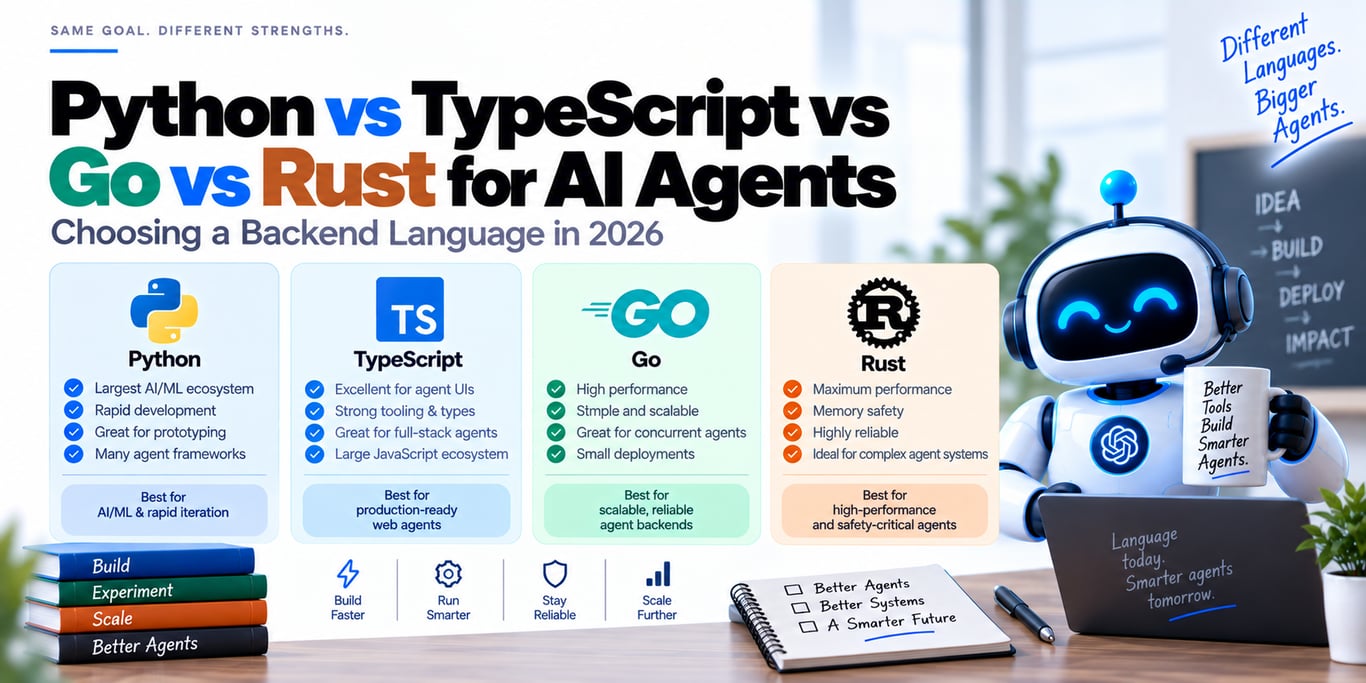
“AI means Python” is no longer a useful architecture rule.
Python still has the deepest AI and data ecosystem, but modern agent applications are increasingly ordinary production backends wrapped around model APIs, tools, durable state, queues, authorization, streaming, and observability. That changes how you should choose a language.
A TypeScript SaaS team may be faster building its agent in TypeScript than adding a separate Python service. A Go platform team may prefer one static binary with strong concurrency and predictable operations. Rust may be the right choice for a sandbox, inference gateway, or security-sensitive runtime even if the agent orchestration itself lives elsewhere.
The useful question is not:
> “Which programming language is best for AI?”
It is:
> Which language best matches the layer you are building, the libraries you actually need, and the team that must operate it in production?
In 2026, Python, TypeScript, Go, and Rust all have credible roles in AI-agent systems—and mature products often use more than one.
Start by identifying the layer
An “AI backend” can mean very different software.
Agent orchestration
model calls
tool selection
RAG
memory
handoffs
workflow state
Product backend
authentication
multi-tenancy
billing
REST/GraphQL APIs
WebSockets/SSE
business logic
AI infrastructure
provider gateway
sandbox execution
model serving
vector/search infrastructure
queues/workers
observability
Data/ML work
training
fine-tuning
evaluation notebooks
dataset preparation
embedding pipelines
research
The best language for one layer may be a poor choice for another.
Quick comparison
| Language | Strongest fit | Main advantage | Main trade-off |
|---|---|---|---|
| Python | AI/ML, research, RAG experimentation, agent frameworks | Largest AI ecosystem and fastest access to new ML tooling | Runtime/type/packaging ergonomics can require more discipline in large services |
| TypeScript | SaaS/product agents, web backends, browser/realtime experiences | One typed language across frontend, backend, schemas, and agent logic | CPU-heavy/inference infrastructure usually belongs elsewhere |
| Go | Agent runtimes, gateways, concurrent services, cloud infrastructure | Concurrency, simple deployment, static binaries, predictable operations | Smaller high-level AI/ML ecosystem than Python |
| Rust | Sandboxes, security-sensitive runtimes, high-performance infrastructure | Memory safety, control, performance, strong systems abstractions | Higher development complexity and fewer turnkey agent libraries |
This is not a ranking. It is a responsibility map.
Python: still the default AI experimentation language
Python remains the easiest place to access the broadest range of AI tooling.
That includes:
- model SDKs
- embedding libraries
- data processing
- ML frameworks
- evaluation tooling
- notebooks
- vector/search clients
- agent frameworks
OpenAI’s current Agents SDK has a production Python implementation, and Google’s ADK also maintains a first-class Python toolkit.
Where Python is hard to beat
Python is a strong choice when the work is closely tied to:
model research
fine-tuning
PyTorch / ML libraries
rapid RAG experimentation
data science
custom evaluation pipelines
scientific computing
If a team is actively testing embedding models, rerankers, fine-tuning datasets, and evaluation code, Python usually minimizes friction.
Agent development is also natural in Python
A large part of the agent ecosystem started in Python, so examples and integrations often appear there first.
A typical Python agent service can be extremely productive:
FastAPI
+ provider SDK
+ agent framework
+ PostgreSQL
+ background worker
For many products, that is enough.
Python’s weaknesses are usually software-engineering issues, not AI issues
Python’s dynamic nature is not inherently a production problem, but large codebases need discipline.
Useful practices include:
type hints
Pydantic/dataclasses
strict linting/type checking
clear package boundaries
async I/O where appropriate
process isolation for CPU-heavy work
The biggest mistake is assuming Python lets you skip normal backend engineering because the application is “AI.”
You still need:
- timeouts
- retries
- idempotency
- observability
- deployment discipline
- authorization
- tests
TypeScript: often the best fit for AI inside a SaaS product
TypeScript has become a first-class agent language rather than merely a browser language.
OpenAI maintains an official TypeScript Agents SDK with tools, handoffs, sessions, MCP integration, tracing, sandbox agents, and realtime agents. Google also maintains a TypeScript ADK implementation.
That matters because many startups already have:
Next.js frontend
Node.js backend
TypeScript shared packages
Zod schemas
PostgreSQL
Adding the agent layer in the same language can be operationally simpler than creating a separate Python stack for no concrete reason.
Shared types are a real advantage
Suppose the agent produces:
{
  "action": "refund",
  "invoice_id": "INV-42",
  "reason": "duplicate_charge"
}
In a TypeScript application, the same schema can often be shared across:
API validation
agent structured output
tool arguments
backend logic
frontend rendering
tests
Using Zod or another runtime schema system means the model contract and application contract can stay close together.
That can reduce interface drift in product-heavy systems.
TypeScript is especially strong for realtime/product interfaces
Agent products often need:
- SSE streaming
- WebSockets
- browser integrations
- server actions/APIs
- realtime voice
- dashboard state
Node.js/TypeScript fits those workloads naturally.
If the application is primarily a web product calling hosted model APIs, the lack of Python ML libraries may not matter at all.
The model runs at the provider. Your backend mostly orchestrates I/O.
Do not choose TypeScript for work that is actually ML infrastructure
If you need to train models, deeply manipulate tensors, or work with research libraries that only exist in Python, forcing everything into TypeScript creates unnecessary friction.
A common architecture is:
TypeScript product backend
        │
        ├── model APIs
        └── Python ML/data service when actually required
One product does not require one language.
Go: increasingly attractive for agent runtimes and infrastructure
Go is a strong fit when the AI component behaves more like a backend platform than a research notebook.
Google’s ADK has an official Go implementation, and the 2026-07-28 MCP release lists Go among the protocol’s Tier 1 SDKs alongside TypeScript, Python, and C#.
That means Go is no longer an unusual choice for modern agent/tool infrastructure.
Go’s strengths map well to agent runtimes
Agent runtimes perform a lot of concurrent I/O:
stream model response
call several tools
wait on network APIs
manage sessions
run workers
process queues
stream events to clients
Go’s goroutines and channels are a natural fit for this kind of orchestration.
Operational simplicity is Go’s biggest advantage
A Go service often deploys as one compiled binary.
That can simplify:
container images
startup time
dependency packaging
cross-compilation
resource usage
production debugging
For self-hosted software—especially software users install on their own VPS—this can be a major advantage.
A single binary with explicit config may be easier to support than a runtime with hundreds of Python packages or Node dependencies.
Go is excellent for the control plane around models
Examples include:
AI gateway
agent runtime
MCP server
multi-tenant execution service
queue worker
provider router
usage accounting
sandbox controller
These systems often care more about concurrency, reliability, resource budgets, and operational predictability than access to experimental ML libraries.
That is where Go shines.
Go’s trade-off: fewer “copy this notebook” AI integrations
Python still has more high-level examples, ML libraries, and experimental tools.
In Go, teams may need to implement more orchestration themselves or use provider APIs directly.
That is not necessarily bad.
For a production runtime, fewer abstractions can make behavior easier to understand.
But if your core value is experimenting with new model-training techniques every week, Python is usually the faster environment.
Rust: ideal when the problem becomes systems engineering
Rust is rarely the easiest language for a simple chatbot.
It becomes compelling when the agent system needs strong control over:
- memory safety
- sandboxing
- concurrency
- low latency
- resource use
- native integration
- high-performance parsers/search/indexes
Rust’s type and ownership system can eliminate classes of memory-safety bugs that matter in security-sensitive infrastructure.
Where Rust fits especially well
Examples include:
sandbox runtime
local coding-agent executor
high-performance inference server
vector/search engine
secure tool host
WASM runtime
proxy/gateway
filesystem-heavy agent tooling
If an agent is executing untrusted or model-generated operations, the surrounding isolation layer is a systems-security problem. Rust can be an excellent implementation language for that layer.
Rust’s agent ecosystem is improving, but it is not as broad
The current MCP ecosystem illustrates the difference well.
The 2026-07-28 MCP release lists:
Tier 1:
TypeScript
Python
Go
C#

Rust:
new-spec support in beta
Rust is clearly viable, but teams should expect a smaller set of high-level agent abstractions compared with Python or TypeScript.
Choose Rust because its systems properties solve your problem—not because rewriting a normal API service in Rust sounds impressive.
What about Java and Kotlin?
Enterprise teams should not ignore the JVM.
Google’s ADK ecosystem also has Java and Kotlin implementations, making it possible to add modern agent functionality inside existing JVM organizations instead of creating a Python island.
Java/Kotlin can be strong when you already have:
Spring services
enterprise identity
mature JVM observability
large internal libraries
regulated backend platforms
The best migration may be no language migration at all.
The provider API does not care what language your business logic uses
Most hosted LLM systems are accessed through HTTP APIs.
This means model capability is usually independent of application language.
You can call the same reasoning model from:
Python
TypeScript
Go
Rust
Java
C#
The important question is SDK/tooling maturity and how much orchestration the provider library handles for you.
Do not confuse “model written in Python internally” with “your SaaS must use Python.”
Tool calling is ordinary backend code
An AI tool such as:
get_invoice(invoice_id)
is still a normal function boundary.
Its implementation may:
query PostgreSQL
call Stripe
check RBAC
emit an audit event
Use the language that already owns that domain.
If billing is a Go service, do not duplicate billing logic in Python just because an agent calls it.
Expose the operation through an API/MCP/tool boundary.
Polyglot agent architecture can be cleaner than one-language purity
A serious AI product might reasonably look like:
Next.js / TypeScript
→ dashboard + product API

Go
→ agent runtime + provider gateway + workers

Python
→ offline evals + model experiments + data pipelines

Rust
→ isolated command sandbox
This is not automatically overengineering if each language owns a distinct responsibility.
It becomes overengineering when the same business logic is duplicated across all four.
Keep boundaries language-neutral
If multiple languages exist, communicate through stable contracts:
HTTP/JSON
Protobuf/gRPC
events/queues
MCP
A2A
Avoid designs where one service imports another language’s internal data model through generated hacks or shared database writes.
The service boundary should outlive the language choice.
Do not move business logic into the agent framework
Suppose your application already has a Node.js rule:
refunds above threshold require approval
Do not reimplement the rule inside a Python agent prompt.
The agent should call the existing domain operation, and the backend should enforce the invariant.
This makes future language or model changes much easier.
Concurrency requirements matter
Agent applications frequently wait on external systems.
Python
asyncio can handle large I/O workloads effectively, especially with async-compatible frameworks and clients.
TypeScript/Node.js
The event loop is naturally strong for network-heavy workflows.
Go
Goroutines provide a simple model for concurrent agent/tool workloads and worker pools.
Rust
Async runtimes such as Tokio can offer excellent control and efficiency, with more implementation complexity.
For hosted LLM calls, network latency often dominates language runtime differences.
Do not optimize microseconds while the model request takes seconds.
CPU-bound work changes the decision
If your service performs heavy local:
embedding inference
OCR
parsing
image processing
vector indexing
model serving
runtime characteristics matter more.
You might move those workloads into:
optimized Python/CUDA libraries
Rust/Go native service
specialized inference server
rather than burdening the orchestration process.
Separate orchestration from compute-heavy execution when needed.
Type safety matters at AI boundaries
LLM outputs are untrusted external input from your application’s perspective.
Static typing does not validate JSON at runtime by itself.
Regardless of language, combine types with runtime schema validation.
Examples:
Python → Pydantic / JSON Schema
TypeScript → Zod / JSON Schema
Go → structs + explicit validation
Rust → Serde + validation
A model returning a string where your database expects an integer should be rejected before it becomes a business operation.
Streaming support is now table stakes
Most user-facing AI systems need incremental output.
All four ecosystems have mature HTTP/SSE/WebSocket options.
Your architecture should support:
client disconnect
cancellation
timeout
backpressure
partial events
final usage accounting
The harder part is usually protocol semantics, not the programming language.
Package ecosystem vs dependency surface
More libraries are not always better.
Python and npm ecosystems give you enormous integration choice, but production teams should control dependency risk.
Go and Rust tend to encourage more explicit compiled dependency graphs.
For every agent framework, ask:
Do we need this framework?
Can the provider SDK + a small loop solve it?
Who maintains this dependency?
Can we upgrade models/providers without rewriting business logic?
A lightweight internal runtime can be easier to maintain than stacking five orchestration frameworks.
How to choose for a startup
Existing TypeScript SaaS
Start with TypeScript unless you have a concrete Python-only need.
Next.js/Node backend
+ official provider/agent SDK
+ existing DB/tools
AI/ML-heavy startup
Python is often the most productive core language.
training + retrieval research + evaluation + API
Self-hosted agent platform
Go can be extremely attractive.
single binary
concurrency
lower operational overhead
cross-platform deployments
Security/performance infrastructure startup
Rust may justify the engineering investment.
sandbox
runtime
inference
security boundary
How to choose for an enterprise
The answer is usually influenced more by existing systems than by AI fashion.
If your organization already has:
Java services
mature authentication
observability
team expertise
adding one agent service does not justify rewriting the backend in Python.
Use an agent SDK available in the existing language or isolate the AI-specific component behind a service boundary.
Migration cost is part of architecture quality.
A practical decision matrix
| Requirement | Strong candidate |
|---|---|
| Fast AI/ML experimentation | Python |
| Training/fine-tuning/data science | Python |
| Existing Node/Next.js SaaS | TypeScript |
| Browser/realtime product integration | TypeScript |
| Agent runtime / gateway / workers | Go |
| Self-hosted single-binary service | Go |
| Security-sensitive sandbox/runtime | Rust |
| High-performance systems component | Rust |
| Existing enterprise JVM platform | Java/Kotlin |
| Mixed product + ML platform | Polyglot with clear boundaries |
The table is a starting point, not a mandate.
Common mistakes
“AI means we need Python”
Only if Python solves a real ecosystem requirement.
Rewriting a working backend for model access
LLM APIs are network services. Call them from the stack you already operate well.
Choosing Go/Rust for performance before measuring anything
Model/network latency often dominates ordinary orchestration runtime cost.
Putting every layer in one language for ideological purity
Use separate languages when the boundary is clean and the benefits are real.
Creating five duplicated SDK wrappers
Centralize stable provider/tool contracts rather than duplicating business logic.
Choosing a framework before the language/runtime architecture
First decide where state, tools, execution, and policies live.
Production checklist
Before choosing the language for an AI service, verify:
- The service’s actual responsibility is clear
- Existing team expertise is considered
- Required SDKs/libraries are mature enough
- Hosted-model API latency is separated from runtime performance concerns
- Structured outputs/tool inputs have runtime validation
- Concurrency model fits expected tool/provider traffic
- Deployment and self-hosting requirements are understood
- Business logic stays in its canonical service/domain
- Polyglot boundaries use explicit APIs/events/protocols
- Model/provider upgrades do not require language migration
- A new language is introduced only when its benefit is concrete
Final takeaway
There is no special “AI programming language.”
Python remains the strongest default for ML-heavy work and rapid AI experimentation. TypeScript is an excellent choice when agents are part of a web/SaaS product. Go is increasingly compelling for production runtimes, gateways, workers, and self-hosted infrastructure. Rust is strongest when the AI problem becomes a systems, performance, or security problem. Java and Kotlin remain completely valid choices in enterprise environments.
> Choose the language for the software layer you are building—not for the model you happen to be calling.
A clean tool/API boundary will survive model upgrades, framework churn, and even future language changes far better than rewriting your stack around whatever AI library is fashionable this year.
References and further reading

Discussion (0)