

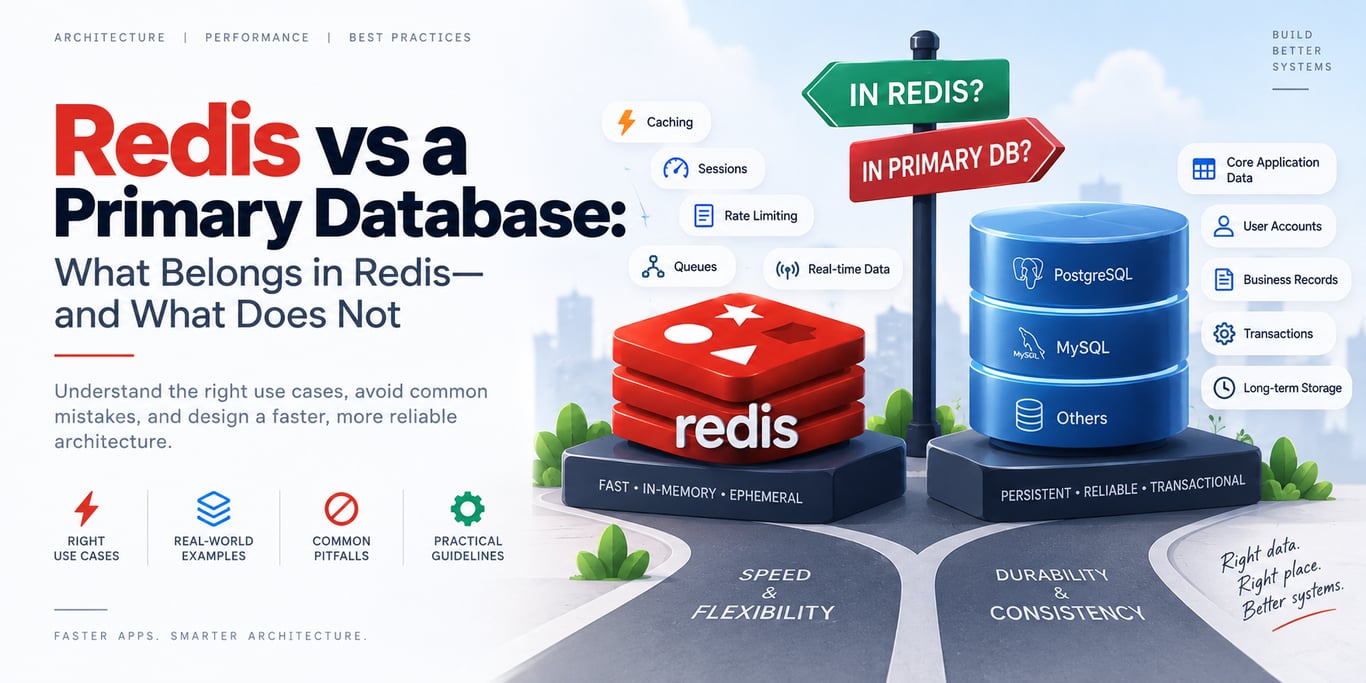
Redis vs a Primary Database: What Belongs in Redis—and What Does Not
Redis is a database, but it solves different problems from a typical relational system of record. This comparison shows what belongs in Redis, what should stay in PostgreSQL/MySQL, and when using both is the cleanest architecture.
Redis
Showing 13 of 23 articlesRedis Database Query Caching: Cache-Aside, Invalidation, and Stampede Control
Build a correct Redis query cache with cache-aside, deterministic keys, TTL-based staleness, write invalidation, stampede protection, negative caching, and safe failure behavior.
Redis Architecture Explained: Event Loop, Memory, Persistence, and Replication
Understand Redis from the inside: its event-driven request path, mostly single-threaded command execution, in-memory data structures, pipelining, persistence, replication, Cluster, and the latency trade-offs that follow.
Redis Queues Explained: Lists vs Streams vs Pub/Sub
A practical comparison of Redis Lists, Streams, and Pub/Sub for queues and messaging: delivery semantics, crash recovery, acknowledgments, replay, delayed work, and when each primitive fits.
Redis Use Cases: Where It Fits, Which Data Type to Use, and Where It Does Not
A practical map of Redis use cases—from caching, sessions, rate limits and leaderboards to Streams, geospatial, vectors and agent memory—with the right data structure and the cases where Redis is the wrong tool.
API Caching in Production: Cache-Control, ETags, CDNs, and Redis
Design API caching across browsers, CDNs, gateways, and Redis with correct Cache-Control directives, ETags, cache keys, invalidation, privacy boundaries, and stampede protection.
Redis Rate Limiting in Production: Fixed Window, Sliding Window, and Token Bucket
A production guide to Redis rate limiting: fixed and sliding windows, token buckets, atomic Lua/Functions, Redis 8.8 INCREX, HTTP 429 behavior, Cluster key design, eviction risks, and fail-open/fail-closed choices.
Redis Performance Optimization: Pipelining, Slow Commands, Hot Keys, Big Keys, and Memory
A practical Redis performance guide covering long-lived connections, pipelining, command complexity, SLOWLOG/latency diagnosis, big keys, hot keys, memory/eviction behavior, and the metrics that reveal real bottlenecks.

What Is Redis? An In-Memory Data Store, Cache, Database, and Streaming Engine
Redis is an in-memory data-structure server used as a cache, suitable database, message broker, streaming engine, and search/vector layer. Learn its core data types, TTLs, persistence, replication, Cluster, and where Redis fits beside a relational database.

Running Redis as a Cache: maxmemory, Eviction Policies, TTLs, and Monitoring
Operate Redis as a bounded cache by choosing maxmemory and the right LRU/LFU/LRM or volatile eviction policy, separating TTL from eviction, and monitoring thrashing, memory, hits, misses, and evictions.

Redis for API Protection: Idempotency, Replay Defense, Revocation, and Abuse Controls
A Redis-focused API protection guide covering idempotency, replay nonces, JWT/session revocation, temporary abuse flags, sensitive-flow controls, atomic updates, TTLs, failure policy, and protection-state durability.

Redis for Beginners: Keys, Data Types, TTLs, and When to Use It
A beginner-friendly introduction to Redis covering keys, strings, hashes, sets, sorted sets, TTLs, common commands, practical use cases, and the mistakes new developers should avoid.

Redis Authentication Done Right: ACL Users, Least Privilege, TLS, and Rotation
Secure Redis connections with named ACL users, least-privilege command and key access, TLS, safe credential rotation, policy testing, and ACL monitoring.