

Choosing an agent framework is not the same thing as choosing a model.
A model provides intelligence. A framework decides how that intelligence is wired into tools, state, handoffs, retries, approvals, traces, and the rest of your application.
That distinction matters because the wrong framework can create more complexity than it removes. A simple tool-using assistant does not need a distributed multi-agent runtime. A multi-hour workflow with resumable state should not be held together by one in-memory loop. And a team that already knows exactly which step comes next does not need an LLM to orchestrate every branch.
There is also no single “best” framework in 2026. The useful question is:
> Which framework gives you the control and production features your workload actually needs without forcing unnecessary abstractions into the architecture?
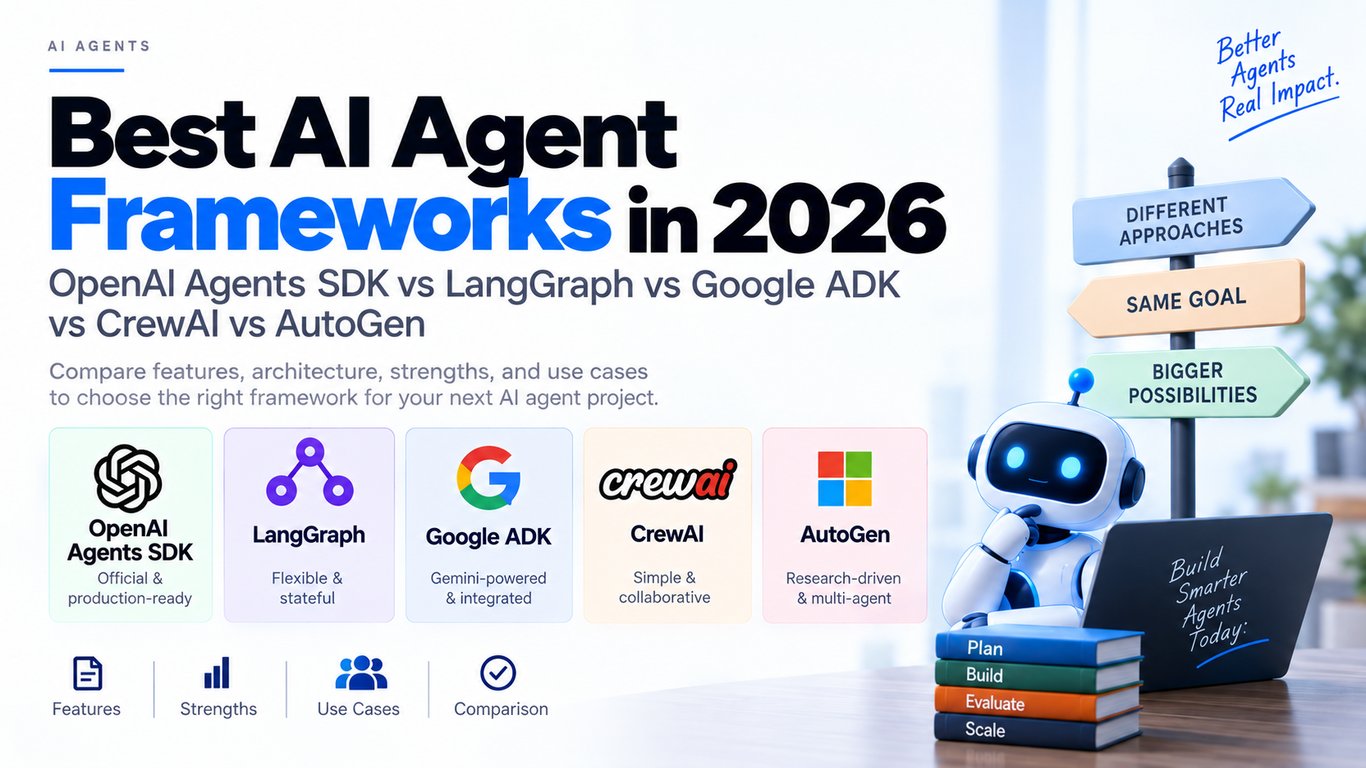
This guide compares five of the most important options today: OpenAI Agents SDK, LangGraph, Google Agent Development Kit (ADK), CrewAI, and Microsoft AutoGen.
What an agent framework should actually solve
Before comparing libraries, separate the problems a framework may solve.
A production agent commonly needs some combination of:
model calls
   ↓
tool selection and execution
   ↓
state / session persistence
   ↓
agent or subagent delegation
   ↓
human approval
   ↓
retries / failure handling
   ↓
tracing and evaluation
   ↓
resume / long-running execution
Different frameworks operate at different layers.
Some are lightweight orchestration SDKs. Some are durable workflow runtimes. Some are opinionated around agent teams. Others expose a lower-level distributed-agent runtime.
If your application already has durable workflow infrastructure, queues, authorization, and observability, you may want only a thin agent loop rather than another platform inside your platform.
Quick comparison
| Framework | Strongest fit | Control level | Multi-agent | Durable/stateful workflows | Main trade-off |
|---|---|---|---|---|---|
| OpenAI Agents SDK | Lightweight production agents, tools, handoffs, sandbox agents | Medium | Strong | Sessions + runtime features | Most natural when OpenAI is central to the stack |
| LangGraph | Explicit long-running state machines and mixed deterministic/agentic workflows | High | Strong | Excellent | More architecture and state modeling to own |
| Google ADK | Multi-language agent development and Google/Gemini ecosystem | Medium–High | Strong | Strong platform/runtime support | Larger platform surface than a tiny agent loop |
| CrewAI | Role-oriented teams plus event-driven business flows | Medium | Strong | Flows provide stateful orchestration | “Crew” abstractions can be unnecessary for simple tasks |
| AutoGen | Advanced multi-agent research and event-driven/distributed systems | High | Excellent | Core runtime is built for scalable agent systems | More complexity than most ordinary product agents need |
The table is a starting point, not a ranking.
1. OpenAI Agents SDK: a small set of production primitives
OpenAI's Agents SDK is deliberately small.
Its core concept is an agent configured with instructions and tools, plus runtime features such as:
- agents as tools
- handoffs
- guardrails
- structured outputs
- sessions
- human-in-the-loop execution
- tracing
- MCP tools
- sandbox agents
The SDK uses the Responses API for OpenAI models, but adds an orchestration runtime around it. The runtime can manage turns, tool execution, guardrails, handoffs, and sessions instead of forcing you to build that loop manually.
Where it fits well
Use the Agents SDK when your system looks like:
request
  ↓
agent
  ↓
use tools as needed
  ↓
maybe delegate to specialist
  ↓
return result
or:
manager agent
  ├── research specialist
  ├── data specialist
  └── sandbox coding specialist
It is especially attractive when you want an OpenAI-centered stack without adding a graph DSL or a heavy orchestration layer.
Agents as tools vs handoffs
The distinction is useful.
Agents as tools keep one manager responsible for the final response:
User
 ↓
Manager
 ├→ Research Agent → result back
 └→ Database Agent → result back
 ↓
Manager synthesizes
Handoffs transfer control to another specialist:
User
 ↓
Triage Agent
 ↓ handoff
Billing Agent
 ↓
continues conversation
That is a cleaner model than building an unrestricted peer-to-peer agent mesh.
Guardrails and side effects
The SDK has input, output, and tool guardrails. This is useful, but production systems should still enforce authorization and business invariants in deterministic application code.
A guardrail can reject bad arguments. Your billing service should still independently verify that the authenticated user is allowed to refund that invoice.
When to use the Responses API directly instead
If your workflow is short and you want to own:
loop
tool dispatch
state
retry policy
then using the Responses API directly can be simpler.
A framework should remove work. If you already wrote the runtime you want, do not add a runtime simply because one exists.
2. LangGraph: explicit state and durable orchestration
LangGraph is a lower-level orchestration framework for long-running, stateful agents.
Its strongest idea is that the workflow is represented explicitly through state, nodes, and transitions rather than being hidden entirely inside a model conversation.
That is useful when your system contains both deterministic and model-driven steps.
Example:
START
  ↓
authenticate
  ↓
retrieve account state
  ↓
LLM classify issue
  ↓
┌───────────────┬────────────────┐
billing path    support path     fraud path
  ↓                 ↓                ↓
validation       tools             human review
  └───────────────┴────────────────┘
                  ↓
                 END
The graph can persist state, pause, resume, stream events, and support human intervention.
Why durability matters
Suppose an agent:
- runs for 45 minutes
- calls 30 tools
- pauses for human approval
- process restarts while waiting
An in-memory while loop is the wrong execution model.
Durable execution lets the workflow resume from a checkpoint instead of rebuilding state from a transcript.
LangGraph is a good fit when
- workflows last a long time
- state transitions matter
- deterministic and agentic steps are mixed
- human approval can pause execution
- explicit branches make the system easier to audit
- recovery after failure matters
The cost of explicitness
You must actually design the graph and state model.
That is valuable when the workflow deserves it, but overkill for:
user asks question
→ model calls one or two tools
→ answer
Do not turn every assistant into a graph just because graphs are controllable.
3. Google ADK: multi-language agent engineering
Google's Agent Development Kit has grown into a broad agent development ecosystem rather than a Gemini-only helper library.
Current ADK documentation spans:
- Python
- JavaScript
- Go
- Java
- Kotlin
and includes agent construction, multi-agent patterns, tool integration, evaluation workflows, runtime/deployment guidance, and platform integrations.
This is particularly interesting for organizations that do not want their agent architecture restricted to Python.
Good fit
ADK is worth evaluating when:
- Gemini is an important provider
- the organization wants multiple implementation languages
- teams want a standardized agent development lifecycle
- evaluation and deployment are part of the same ecosystem
- agents may run on Google Cloud / managed agent infrastructure
Do not confuse framework portability with model portability
A framework may technically support different models while some of its best-integrated features are strongest with its native ecosystem.
Evaluate the exact combination you plan to operate:
framework
+ model provider
+ tools
+ deployment target
+ tracing/eval stack
rather than comparing framework names in isolation.
4. CrewAI: Crews for autonomy, Flows for control
CrewAI is built around a metaphor that maps naturally to business workflows: agents have roles and collaborate as a Crew.
The more important production concept is Flows.
CrewAI's own guidance treats Flows as the structured, stateful control layer and Crews as autonomous teams that can be called for complex work.
That produces a healthy architecture:
Flow
  ↓
deterministic step
  ↓
Crew performs open-ended research
  ↓
result returns to Flow
  ↓
validate
  ↓
next deterministic step
Why that separation is useful
A common mistake in multi-agent systems is turning the entire business process into agents talking to each other.
Flows let you keep known control logic in code while using a Crew only where autonomy creates value.
CrewAI fits well when
- the product maps naturally to role-oriented collaboration
- you want explicit business workflows around agent teams
- nontrivial research/analysis subtasks benefit from multiple specialists
- you want event-driven stateful orchestration without inventing it from scratch
When not to use a Crew
If a task is:
classify ticket
→ call API
→ format response
three named agents are likely worse than one function and one model call.
Multi-agent complexity should be earned by the task.
5. Microsoft AutoGen: high-level AgentChat and low-level Core
AutoGen has two layers that are useful to distinguish.
AgentChat
AgentChat is the high-level API. It provides agents and predefined team patterns and is the recommended starting point for typical multi-agent applications.
AutoGen Core
Core is lower level and built around an event-driven runtime.
Microsoft positions it for scenarios such as:
- scalable multi-agent systems
- distributed agents
- asynchronous messaging
- custom runtimes
- complex coordination research
The runtime model is closer to actor/event-driven distributed systems than a simple chain abstraction.
When AutoGen is compelling
AutoGen is worth considering when the interesting part of your project is genuinely the multi-agent system itself.
Examples:
large research systems
agent networks with asynchronous messages
distributed agent workers
custom experimental coordination protocols
multi-language distributed agents
For a straightforward product assistant, AutoGen Core can be more infrastructure than you need.
Framework vs runtime vs harness
These words often get mixed together.
A useful separation is:
Framework
Developer abstractions for defining agents, tools, graphs, handoffs, or teams.
Runtime
The execution machinery that manages state, turns, queues, checkpoints, cancellation, retries, or workers.
Harness
The wider environment around the model:
context
instructions
tools
filesystem/sandbox
permissions
verification
memory
observability
A framework may provide pieces of all three, but your product architecture should not depend on the names being interchangeable.
Do you even need an agent framework?
Sometimes no.
A minimal agent loop is conceptually simple:
while steps < max_steps:
    response = model(context, tools)

    if response.is_final:
        return response

    result = execute_tool(response.tool_call)
    context.append(result)
If your requirements are:
- one model
- five tools
- short runs
- no human pause/resume
- no multi-agent orchestration
- existing tracing and storage
then a thin internal loop may be the most maintainable solution.
Framework adoption has a cost:
framework concepts
version upgrades
provider adapters
state abstractions
serialization contracts
runtime assumptions
Do not pay that cost without receiving real value.
How to choose: a decision framework
Choose OpenAI Agents SDK when
- OpenAI models are central
- you want a small set of agent primitives
- tools, handoffs, sessions, tracing, MCP, and sandboxing are important
- you do not need an explicit graph for every state transition
Choose LangGraph when
- explicit state transitions are a feature
- workflows are long-running
- you need pause/resume and durable checkpoints
- deterministic and model-controlled branches coexist
- you want low-level orchestration control
Choose Google ADK when
- multi-language support matters
- Gemini/Google Cloud integration is important
- you want an integrated development/evaluation/deployment ecosystem
- agent teams are part of the application model
Choose CrewAI when
- role-based specialist teams match the product
- you want deterministic Flows surrounding autonomous Crews
- business-process orchestration is central
Choose AutoGen when
- advanced multi-agent behavior is the main technical problem
- event-driven/distributed agents are required
- research flexibility matters more than minimal abstraction
Evaluate frameworks with one real workflow
Do not decide from tutorial code.
Implement the same representative workflow in the two strongest candidates.
For example:
User asks for production incident investigation
  ↓
retrieve deployment + metrics
  ↓
agent investigates with bounded tools
  ↓
pause before remediation
  ↓
human approves
  ↓
execute action
  ↓
verify outcome
Measure:
- implementation complexity
- task success
- trace/debug quality
- state persistence
- recovery after restart
- tool authorization ergonomics
- testability
- model/provider portability
- latency and token overhead
That comparison is worth more than a feature checklist.
Avoid the “common denominator” trap
Teams sometimes create a large internal abstraction so every framework and provider looks identical.
That sounds portable but can hide the capabilities you adopted the framework for:
durable checkpoints
handoffs
provider-native tools
strict structured outputs
context compaction
sandbox sessions
Abstract stable business boundaries, not every framework primitive.
Good boundaries include:
application tool contracts
business state
permission policy
eval cases
provider-independent domain events
Those are likely to survive framework changes.
Keep business truth outside the framework
Regardless of framework, do not let agent state become the authoritative source for business data.
Keep canonical state where it belongs:
orders       → transactional database
payments     → billing system
permissions  → authorization system
documents    → document store
agent run    → agent/workflow state store
A framework should orchestrate work around your systems, not become an accidental second database.
Production checklist
Before adopting an agent framework, verify:
- A simpler direct model/tool loop is insufficient
- The framework solves a concrete runtime or orchestration problem
- Tool authorization remains enforceable outside the model
- Long-running state can survive process failure if required
- Human approval can pause and resume safely
- Important mutations can be idempotent and verified
- Traces expose model calls, tool calls, handoffs, and failures
- Eval cases can run in CI/offline testing
- Provider/model changes do not require rewriting business logic
- Framework state is separate from canonical business state
- Multi-agent patterns are used only when separation adds value
- Dependency/version upgrades are operationally manageable
Final takeaway
The best agent framework is not the one with the longest feature list.
It is the smallest layer that gives your application the orchestration semantics it actually needs.
Use OpenAI Agents SDK when you want a lightweight production runtime with strong native agent primitives. Use LangGraph when explicit durable state and control flow are central. Use Google ADK when multi-language development and the Google agent ecosystem fit your platform. Use CrewAI when role-based agent teams belong inside structured business Flows. Use AutoGen when advanced event-driven multi-agent coordination is genuinely the problem you are solving.
And if a short model/tool loop already works, keep it.
> Do not choose an agent framework to make the architecture look agentic. Choose one only when it makes the system simpler to operate, test, recover, and evolve.
Official references

Discussion (0)