

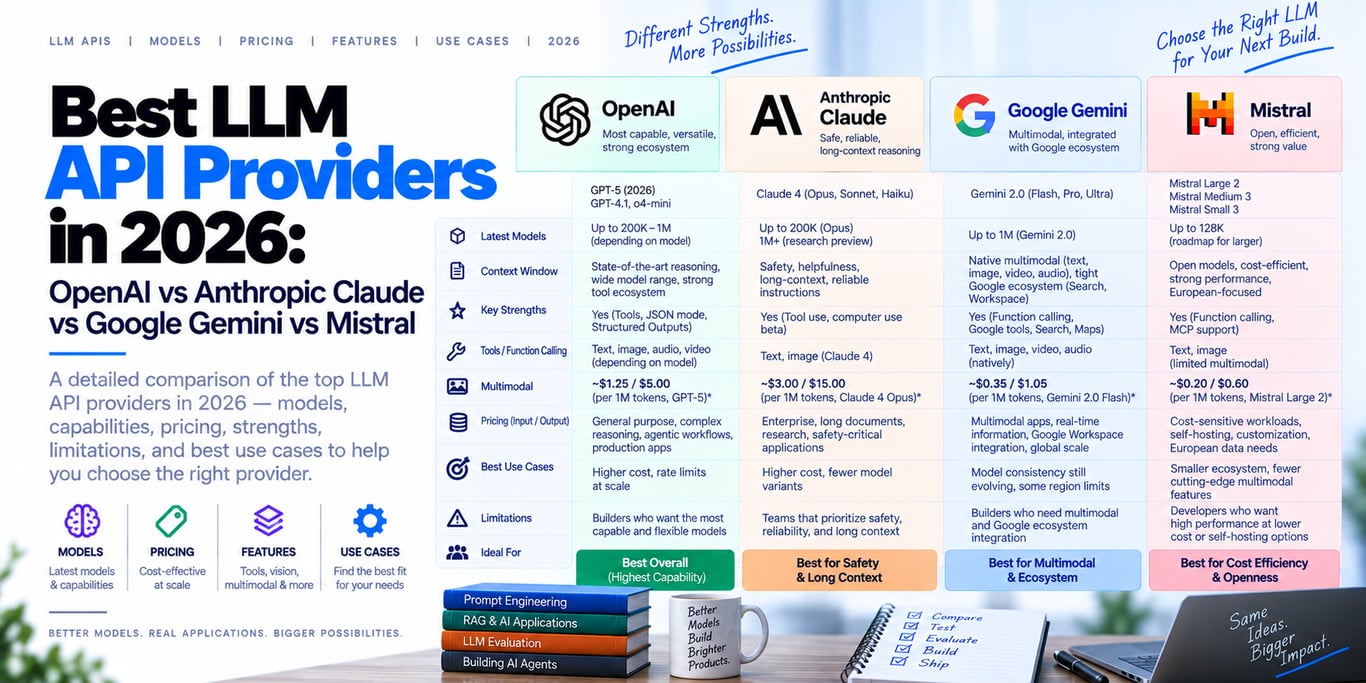
Choosing an LLM provider affects much more than answer quality.
It changes which models you can use, how tool calling works, what multimodal inputs are available, how long-running context is handled, which structured-output guarantees exist, how model versions are retired, what latency you can expect, and how much provider-specific infrastructure leaks into your application.
That is why “which API has the smartest model?” is the wrong production question.
A better one is:
> Which provider gives this workload the best combination of task success, latency, cost, tooling, stability, and operational control?
In 2026, the strongest mainstream choices include OpenAI, Anthropic, Google, and Mistral. Groq is also useful to understand because it represents a different category: a high-speed inference platform for supported models rather than primarily a frontier-model lab.
Model provider vs inference provider
The terms are often mixed together.
Model provider
Develops and serves its own models.
Examples:
OpenAI
Anthropic
Google
Mistral
Inference provider
Specializes in serving models—sometimes models developed by other companies—through optimized infrastructure.
Examples include providers such as Groq.
This distinction matters because your decision may be:
Which model is best?
or:
Where should I run this model?
Those are different architecture decisions.
Quick comparison
| Provider | Strong fit | Current platform strengths | Main architecture question |
|---|---|---|---|
| OpenAI | Reasoning, coding, agents, integrated tools | Responses API, tools, structured outputs, Agents SDK, large-context frontier models | Do you want deep OpenAI-native agent capabilities? |
| Anthropic Claude | Long-horizon reasoning, coding, tool-using agents | Strong Claude model lineup, 1M context on top models, client/server tools, caching, MCP | Do Claude's reasoning/tool behaviors win your evals? |
| Google Gemini | Multimodal, long context, Google ecosystem, high-throughput Flash workloads | 1M context, text/image/video/audio/PDF input, search/file/code tools, structured outputs | Does native multimodality or Google integration matter? |
| Mistral | Open/commercial flexibility, enterprise deployment, efficient models | Open-weight + commercial models, multimodal, agents/tooling, deployment flexibility | Do you value model/deployment openness and European vendor options? |
| Groq | Low-latency inference for supported models | OpenAI-compatible API, fast inference, tool use, structured outputs on selected models | Is speed on an available open model more important than owning a frontier model family? |
No provider wins every row.
1. OpenAI: integrated models, tools, and agent infrastructure
OpenAI's current API lineup centers on the GPT-5.6 family.
The official model guide recommends:
- GPT-5.6 Sol for complex reasoning and coding
- GPT-5.6 Terra when balancing intelligence and cost
- GPT-5.6 Luna for cost-sensitive, high-volume work
The important production story is not only the model list. It is the surrounding platform.
OpenAI's Responses API is designed around modern agent workloads and can combine model generation with tools and structured outputs. The Agents SDK adds a higher-level runtime for tool execution, sessions, handoffs, guardrails, tracing, human interaction, and sandbox agents.
Strong fit
OpenAI is attractive when your system benefits from:
strong general reasoning
coding
native tool use
structured outputs
agent orchestration
large context
sandboxed specialist workflows
Architecture trade-off
The deeper you use provider-native features, the more value you get—but the harder a fully transparent provider swap can become.
For example, this:
text in → text out
is easy to abstract.
This:
Responses API
+ hosted tools
+ agent handoffs
+ sandbox sessions
+ provider-specific reasoning settings
is not meaningfully portable through a generic generateText() wrapper without losing capabilities.
That is not automatically bad. It just needs to be deliberate.
2. Anthropic Claude: long-context and agentic work
Anthropic's current Claude lineup includes:
- Claude Fable 5.1
- Claude Opus 5
- Claude Sonnet 5
- Claude Haiku 4.5
Anthropic positions Fable for demanding reasoning and long-horizon agentic work, Opus for complex agentic coding and enterprise work, Sonnet as the speed/intelligence balance, and Haiku as the fastest current family member.
The current top Claude models support very large context windows, and Anthropic's platform has become increasingly agent-oriented.
Tooling
Claude supports both:
Client tools — your application executes the function and returns the result.
Server tools — Anthropic executes tools such as web search, web fetch, code execution, or tool search on its infrastructure.
Claude also supports strict tool schemas and MCP integration.
Prompt caching
Long prompts and stable prefixes can benefit from prompt caching, which matters when your application repeatedly sends large instructions, tool catalogs, or document context.
Strong fit
Anthropic is worth evaluating when:
- long-horizon reasoning matters
- coding/agent tasks dominate
- the application has large stable context
- strong tool behavior is important
- MCP and tool ecosystems matter
As always, provider marketing is less useful than your own evals.
3. Google Gemini: multimodal-first and very large context
Google's current Gemini API includes Gemini 3.8 Flash, a stable production model released in September 2026.
Its documented capabilities include input across:
text
images
video
audio
PDFs
with a roughly one-million-token input context window and support for capabilities such as:
- function calling
- structured outputs
- code execution
- file search
- search grounding
- URL context
- thinking controls
That breadth makes Gemini especially interesting for products where “LLM request” is not just text chat.
Good fits
Examples include:
large document analysis
video understanding
audio + document workflows
multimodal support agents
Google-search-grounded applications
high-throughput agentic workloads
Model lifecycle matters
Google publishes deprecation schedules for Gemini models.
This is operationally important: never hard-code a preview model ID into a production system without a migration plan.
The same principle applies to every provider, but explicit lifecycle tracking should be part of your LLM platform regardless of vendor.
4. Mistral: open and commercial options under one ecosystem
Mistral's model catalog in 2026 spans both open-weight and commercial models.
Current highlighted models include products such as:
- Mistral Medium 3.5
- Mistral Small 4
- Mistral Large 3
- smaller Ministral variants
- specialized OCR and audio models
Some releases use permissive licenses such as Apache 2.0, while others use different commercial or modified licenses.
That gives Mistral an interesting position: you can evaluate hosted API models while also considering self-hosting/open-weight deployment for parts of the stack.
Good fits
Mistral can be attractive for:
European enterprise requirements
open-weight deployment options
hybrid hosted/self-hosted architectures
multimodal applications
coding/agentic workloads
organizations that want more control over deployment
Always check the exact model license
Do not write:
Mistral = open source
in an architecture document.
Write:
exact model ID
exact license
exact deployment method
Model families change faster than legal assumptions.
5. Groq: speed-oriented inference for supported models
Groq's API is designed to be largely compatible with OpenAI client libraries.
You can often point an OpenAI-style client at Groq's base URL and run supported models with a familiar request pattern.
Groq also supports capabilities such as:
- tool calling
- reasoning controls on supported models
- structured outputs on selected models
- Responses-style APIs
Its value proposition is different from a frontier lab: inference performance.
That can be useful when a supported open model already passes your quality threshold and latency is the bottleneck.
Caveat: compatibility is not identity
“OpenAI-compatible API” does not mean every OpenAI field or behavior exists.
Provider compatibility layers often expose a useful common subset while differing in:
model capabilities
structured-output constraints
tool behavior
reasoning settings
streaming details
error semantics
Test the exact features your application uses.
What should you actually compare?
Do not compare providers using one benchmark number.
A useful production scorecard includes several dimensions.
1. Task success
Build eval cases from your real workloads.
Examples:
repository bug fix
support-ticket resolution
financial-document extraction
agent tool-use sequence
long report synthesis
multimodal analysis
Then test provider/model combinations against the same dataset.
2. Tool calling
Measure:
- correct tool selection
- argument correctness
- unnecessary tool calls
- parallel tool behavior
- recovery after errors
A model that writes beautiful text but repeatedly chooses the wrong production tool is not your best agent model.
3. Structured outputs
Check whether the provider/model can reliably satisfy the schemas your application needs.
Provider-native constrained/strict outputs can simplify downstream code, but capabilities vary across models.
4. Multimodality
Do you need:
image input
PDF understanding
video
audio
voice/realtime
Do not pay for a platform optimized around capabilities your product never uses.
5. Context behavior
Large context windows are useful, but raw maximum token count is not enough.
Measure how the model performs with your actual:
- long documents
- tool histories
- codebases
- conversation traces
6. Latency
Measure:
time to first token
total completion latency
tool round-trip latency
p95/p99 under concurrency
Average demo latency is not a production metric.
7. Cost
Prices move quickly.
Instead of hardcoding one table into architecture decisions, calculate cost from current provider pricing against your workload:
input tokens
output tokens
cached tokens
tool charges
batch discounts
request volume
8. Data and compliance requirements
Consider:
- regions
- retention controls
- enterprise agreements
- private connectivity
- audit requirements
- provider-specific data policies
Those can outweigh small model-quality differences.
Use a provider abstraction—but not an imaginary universal API
A useful internal boundary might look like:
ProviderClient
  ├── generate
  ├── stream
  ├── tool calls
  ├── structured output
  └── usage metadata
But do not pretend capabilities are identical.
The abstraction should expose capabilities, not hide them.
Example:
{
  "model": "...",
  "supports": {
    "vision": true,
    "strict_structured_output": true,
    "native_web_search": false,
    "reasoning_effort": true
  }
}
Then routing can reject invalid combinations before a request reaches the provider.
Multi-provider routing is not automatically better
It sounds attractive:
OpenAI primary
→ Claude fallback
→ Gemini fallback
→ Mistral fallback
But a fallback is only useful if it produces semantically compatible behavior.
Providers may differ in:
- tool-call schemas
- reasoning controls
- safety behavior
- context handling
- output structure
If a financial workflow expects strict tool behavior, “send it to any other model when provider A fails” may not be safe.
Better approach
Define validated routes:
support_chat:
  primary = model A
  fallback = model B tested on same evals

coding_agent:
  primary = model C
  fallback = none unless workspace/tool semantics compatible
Fallbacks should be tested workload by workload.
Provider outages and model failures are different
Your system should distinguish:
provider unavailable
model overloaded
rate limit
invalid request
unsupported feature
content/policy refusal
model produced invalid output
Do not treat every failure as a signal to retry another provider.
A validation error will likely fail again. A transient 503 may justify a fallback.
Pin model versions where reproducibility matters
Aliases such as “latest” are convenient, but model behavior can change.
For regulated or sensitive workflows, keep track of:
provider
model ID / snapshot
prompt version
tool catalog version
eval version
Before migrating models:
old model → eval suite
new model → same eval suite
compare
canary
roll out
Model upgrades are software changes.
A practical selection workflow
Step 1 — Define the workload
Write down what the model actually has to do.
Step 2 — Pick two or three serious candidates
Do not benchmark twenty providers forever.
Step 3 — Run real evals
Use production-like tasks and tool flows.
Step 4 — Measure latency and cost under concurrency
One-request notebook demos are not enough.
Step 5 — Test failure behavior
Include:
timeout
rate limit
tool error
invalid structured output
long context
provider outage
Step 6 — Choose per workload
It is perfectly reasonable for one company to use:
provider A → coding agent
provider B → customer chat
provider C → video analysis
self-hosted model → cheap classification
Standardize infrastructure where useful, not model choice for its own sake.
Common mistakes
Choosing from leaderboard position alone
Benchmarks rarely reproduce your exact tool schemas, documents, latency requirements, or users.
Building provider lock-in accidentally
Using native capabilities is fine. Make the dependency explicit.
Building portability at all costs
A generic abstraction that removes every native capability can make all providers equally mediocre.
Assuming context size equals memory
Long context does not replace retrieval, durable memory, or context selection.
Ignoring model deprecations
Every provider evolves. Lifecycle management belongs in production architecture.
Comparing only token price
Total cost also includes failed tasks, retries, engineering work, latency, and infrastructure.
Production checklist
Before standardizing on an LLM provider, verify:
- Real workload evals exist
- Tool-use behavior is measured
- Structured-output requirements are tested
- Required multimodal inputs are supported
- Long-context behavior is tested, not assumed
- p95/p99 latency is measured
- Current cost is modeled against actual traffic
- Provider data/compliance requirements are acceptable
- Model version lifecycle is monitored
- Fallback models pass the same critical evals
- Application logic is not accidentally coupled to one SDK everywhere
- Provider-specific capabilities remain available where they create value
Final takeaway
The right LLM provider is workload-specific.
OpenAI offers a tightly integrated model-and-agent platform. Anthropic's Claude family is particularly strong for long-horizon reasoning, coding, and tool use. Gemini is compelling for multimodal and large-context workloads with deep Google integration. Mistral provides an interesting combination of hosted, open-weight, and deployment flexibility. Groq is worth evaluating when a supported model meets your quality bar and inference speed is the priority.
Do not choose one because it won this month's benchmark.
> Build a small provider layer, preserve access to useful native capabilities, and let repeatable evals—not brand loyalty—decide which model serves each production workload.
Official references

Discussion (0)