

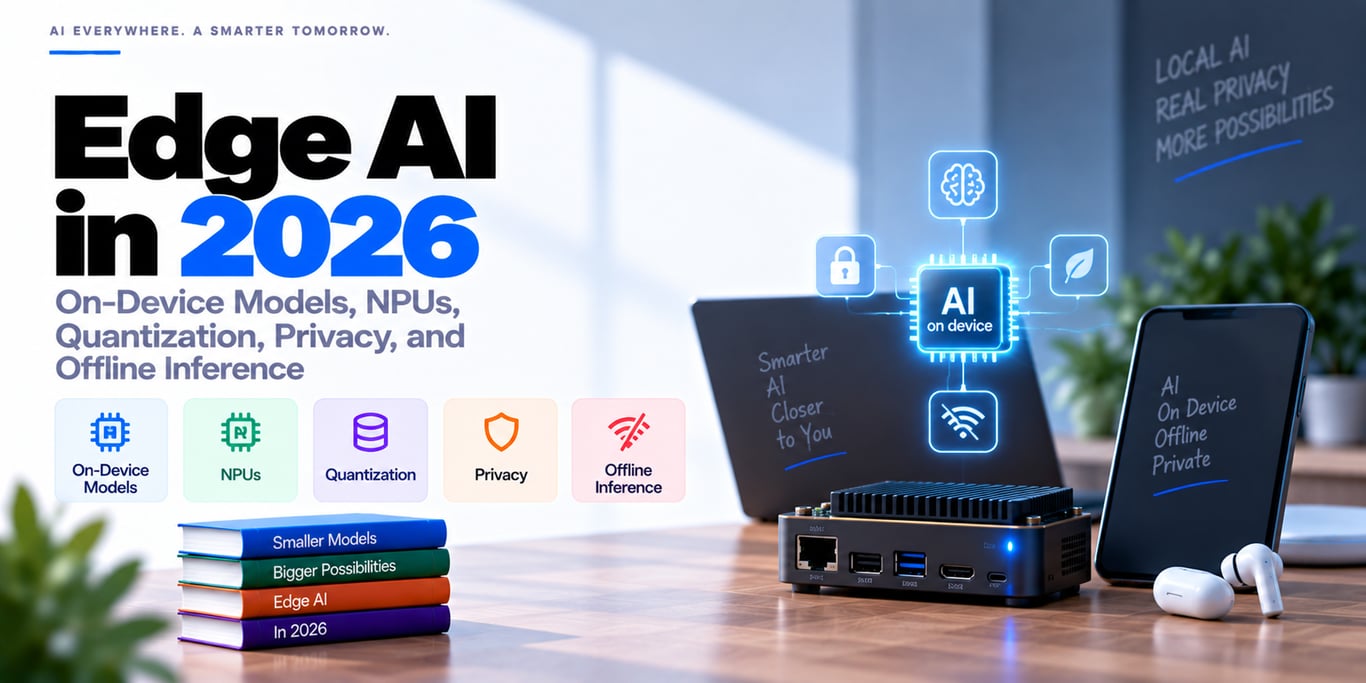
Edge AI means running machine-learning inference close to where data is created instead of sending every request to a cloud model.
That can mean:
phone
laptop
camera
robot
factory gateway
vehicle
embedded device
The attraction is easy to understand: lower latency, offline operation, better privacy, and lower network dependence. But edge deployment also creates hard constraints around memory, model size, battery, thermals, hardware compatibility, and update strategy.
In 2026, the category has moved far beyond tiny classifiers. Apple exposes on-device machine learning through Core ML and device Foundation Models, Google supports mobile and embedded inference through AI Edge/LiteRT, and NVIDIA's current Jetson stack is explicitly built for robotics and generative/agentic workloads at the edge.
The useful question is not:
> “Can this model run on-device?”
It is:
> Can it run with acceptable quality, latency, memory, power use, privacy, and lifecycle cost on the exact hardware your users have?
Cloud AI vs edge AI
A cloud architecture looks like:
Device
  ↓ network
Cloud API / GPU
  ↓
Result
An edge architecture looks like:
Device
  ↓
Local runtime
  ↓
CPU / GPU / NPU
  ↓
Result
Many production systems use both.
Why run AI on-device?
Lower latency
There is no internet round trip.
Useful for:
voice interaction
camera processing
robotics
real-time translation
UI assistance
Offline capability
The feature can keep working without connectivity.
Privacy
Sensitive data may never need to leave the device.
Apple explicitly highlights this benefit in Core ML: running models locally removes the network requirement and helps keep user data private.
Lower cloud inference cost
At high volume, local inference can reduce per-request API or GPU-serving cost.
Edge does not automatically mean private
An app can run the model locally and still upload:
prompts
telemetry
embeddings
outputs
to a backend.
Privacy depends on the complete data flow, not only inference location.
Document exactly what leaves the device.
Hardware accelerators changed the economics
Modern devices increasingly include specialized AI hardware:
Apple Neural Engine
mobile NPUs
Jetson GPU accelerators
integrated laptop NPUs
These processors can execute neural-network operations far more efficiently than a general-purpose CPU.
Google's LiteRT documentation describes NPU delegates specifically as a way to accelerate inference and reduce energy use compared with CPU/GPU execution on supported Android hardware.
CPU, GPU, and NPU are different deployment targets
CPU
Advantages:
widest compatibility
simple fallback
Trade-off:
lower throughput for large models
higher energy use for some workloads
GPU
Good for highly parallel matrix operations.
NPU / Neural Engine
Purpose-built for neural inference and usually optimized for power efficiency.
The fastest backend depends on the model and device.
Do not assume “NPU available” means every model/operator runs optimally on it.
Model size is the first hard constraint
A cloud server may have tens or hundreds of gigabytes of accelerator memory.
A phone does not.
Model memory includes more than the weight file:
weights
KV cache
activations
runtime buffers
tokenizer / metadata
A model that technically loads but leaves no memory for the rest of the app is not production-ready.
Quantization is one of the key edge techniques
Quantization stores or computes model values at lower precision.
Conceptually:
FP16 / BF16
→ INT8
→ INT4 / FP4-style formats
Potential benefits:
- smaller model
- lower memory bandwidth
- faster inference
- lower energy use
Trade-off:
- quality can degrade
- hardware support varies
- some layers are more sensitive than others
Quantization must be evaluated on the actual task
Do not assume a smaller quantized model preserves quality because one benchmark looks good.
Evaluate:
accuracy/task success
latency
memory
battery/power
thermal behavior
NVIDIA's 2026 Jetson work demonstrates how low-precision formats and decoding optimizations can significantly improve edge LLM throughput, but it also shows that optimal configuration is model-dependent.
Small models can outperform large models operationally
A 3B model that answers in 300ms may create a better product than a 30B model that takes 8 seconds and drains the battery.
Edge architecture optimizes a system objective:
quality
× latency
× memory
× power
× hardware reach
not raw benchmark intelligence alone.
Distillation is another path
A smaller model can be trained to reproduce useful behavior from a larger teacher model.
This can create compact models specialized for:
classification
command routing
summarization
structured extraction
For edge products, specialization can be more valuable than general intelligence.
Fine-tuning can make small models more useful
A general model may be weak at your narrow product task.
Fine-tuning a compact model can improve:
specific commands
product vocabulary
structured actions
classification
Google currently documents mobile-action fine-tuning workflows for small Gemma variants that can be converted and deployed on-device through LiteRT-based tooling.
Local function calling is powerful
Imagine a phone assistant with a small local model.
Instead of generating long prose, it can map language to structured actions:
“Start a 12 minute timer”
→
{"tool":"create_timer","minutes":12}
This is an excellent edge use case because the task is narrow, latency-sensitive, and privacy-friendly.
Apple: Core ML and device-native AI
Core ML is Apple's runtime for integrating machine-learning models into apps.
Apple says Core ML can use:
CPU
GPU
Neural Engine
while optimizing memory footprint and power usage.
Models can also be converted from common training ecosystems into Core ML format.
For Apple-platform apps, this gives developers a native deployment path without operating a custom inference server.
Google: LiteRT and mobile LLM inference
Google AI Edge provides deployment tooling for Android, iOS, web, and embedded environments.
Google's current Gemma documentation lists LiteRT-LM as a high-performance on-device LLM path with CPU/GPU/NPU acceleration where supported.
For mobile developers, Google also documents Gemma deployment through MediaPipe/LiteRT tooling.
NVIDIA Jetson: edge AI for physical systems
Jetson targets higher-power edge environments such as:
robots
industrial systems
smart cameras
autonomous machines
JetPack 7 is NVIDIA's current stack for Jetson platforms and is explicitly positioned for robotics and generative/agentic edge workloads.
Compared with phone deployment, Jetson-class devices can support substantially larger models and richer sensor pipelines.
Edge AI is especially useful for sensor data
Sending raw camera or audio streams to the cloud can be expensive and privacy-sensitive.
Edge inference can transform raw data locally:
camera
→ object detection
→ send only events/metadata
Instead of:
camera
→ upload full video continuously
This reduces bandwidth and data exposure.
Hybrid edge + cloud is often the best architecture
A practical pattern is:
simple/local task
→ edge model

hard/high-value task
→ cloud model
Example:
local model detects intent
      ↓
can answer locally?
   ├── yes → local response
   └── no  → cloud escalation
This gives low latency for common tasks while preserving access to frontier intelligence when needed.
Route based on capability, not confidence alone
A small model may be confidently wrong.
Better routing signals include:
task category
required tool
input size
modality
policy
explicit user choice
For example, long research requests can be sent directly to cloud infrastructure rather than asking the local model to self-assess perfectly.
Offline-first architecture needs local state
If the feature must work offline, supporting data must also be available locally.
Examples:
model file
tokenizer
local document index
user settings
An on-device model that still requires a network-only vector database is not truly offline.
Local RAG is possible
A device can maintain a small local search index over:
notes
documents
app content
Pipeline:
query
→ local retrieval
→ local model
→ response
This can create highly private personal assistants.
The hard part is storage size, indexing cost, synchronization, and deletion—not just inference.
Model updates are a product problem
Cloud models can be upgraded centrally.
Edge models may be distributed across millions of devices.
You need an update strategy for:
model version
runtime compatibility
rollback
partial rollout
download size
Do not bundle a 4 GB model update into every app release without considering delivery cost.
Separate app version from model version
Track independently:
app_version
model_version
runtime_version
quantization_profile
This lets you diagnose device-specific regressions and roll back model updates without changing unrelated application code.
Hardware fragmentation is real
Android and embedded ecosystems contain many chipsets.
A model that performs well on one flagship device may fall back to CPU on another.
Build a device capability matrix:
supported accelerator
available RAM
model variant
expected latency
fallback path
Test on actual target hardware.
Thermal throttling can break benchmarks
A five-second benchmark on a cold device does not represent sustained workload.
Long inference may heat the device and reduce clock speeds.
Measure:
cold latency
sustained latency
power use
temperature
battery impact
especially for continuous camera/audio applications.
First-token latency and decode speed both matter for LLMs
For local text generation, measure:
time to first token
tokens per second
end-to-end completion time
A model with high decode throughput can still feel slow if prompt processing takes too long.
Context size has a memory cost
LLM context affects the KV cache.
Large context windows can consume significant memory on-device.
Do not copy cloud architectures that send tens of thousands of tokens into every request.
Edge context should be aggressively relevant and compact.
Security is different on user devices
A cloud service controls its servers.
On-device models and weights may be accessible to users or attackers with device access.
Do not assume proprietary model weights or embedded secrets remain confidential simply because they ship inside an app package.
Never hard-code privileged server credentials into the model or mobile app.
Local AI still needs permission boundaries
A device agent may access:
photos
contacts
microphone
files
location
Use the OS permission model and request only necessary access.
The model should not bypass application permission checks.
Evaluate edge models differently from cloud models
A strong edge eval includes:
Quality
Does the compact/quantized model complete the actual task?
Performance
p50/p95 latency
tokens/sec
Resources
peak RAM
model size
CPU/GPU/NPU utilization
Energy
battery drain
power draw
Device coverage
What percentage of the user base can run it well?
Do not optimize one flagship device only
Test at least:
high-end device
mid-range target
minimum supported hardware
If the model only performs well on your developer's newest phone, the architecture is incomplete.
When edge AI is a great fit
Use edge inference when:
- low latency matters
- data is privacy-sensitive
- offline operation matters
- task is bounded enough for local models
- device hardware is capable
- cloud cost at scale is meaningful
Examples:
keyboard/writing assistance
camera intelligence
voice commands
translation
local summarization
robotics
industrial vision
When cloud AI is better
Cloud inference remains better when:
- frontier reasoning quality is essential
- model is too large for target devices
- tasks use huge context
- central updates are critical
- workload is infrequent enough that cloud cost is low
There is no prize for forcing everything onto the device.
Production checklist
Before shipping edge AI, verify:
- Target hardware matrix is defined
- Model quality is evaluated after quantization
- Peak RAM and model download size are measured
- Cold and sustained latency are tested
- Battery/power impact is measured
- CPU/GPU/NPU fallback behavior is known
- Context size fits device memory budget
- Offline dependencies really exist locally
- Model/runtime versions are tracked separately from app version
- Rollout and rollback strategy exists
- Device permissions follow least privilege
- No privileged secrets ship inside the model/app
- Hybrid cloud fallback is considered for hard tasks
- Minimum supported hardware is tested, not only flagship devices
Final takeaway
Edge AI is no longer limited to tiny vision models. Phones, laptops, embedded systems, and robotics platforms can now run increasingly capable language and multimodal models locally.
But edge deployment is a constrained systems-engineering problem.
> Choose the smallest model that achieves the product outcome on the actual target hardware, then optimize quality, latency, memory, energy, privacy, and updateability together.
The winning architecture is often hybrid: local intelligence for fast/private/common work and cloud intelligence for tasks that genuinely need larger models.
Official references

Discussion (0)