

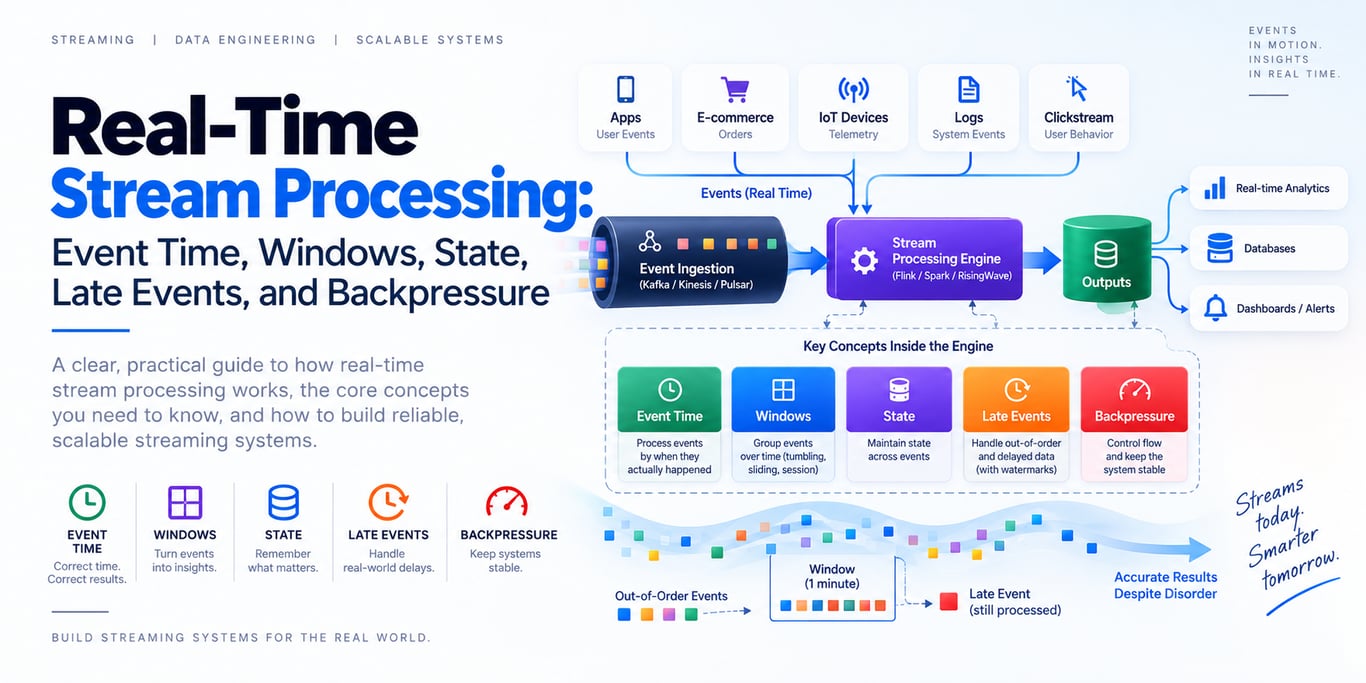
Real-time processing means continuously handling events as they arrive instead of waiting for a large scheduled batch. The difficult parts are time, state, ordering, recovery, and overload.
Event Time vs Processing Time
Event time is when the event actually happened at the source. Processing time is when your application happens to process it.
They differ whenever networks, retries, offline devices, or queue backlogs delay an event.
For business windows such as “orders in each 5-minute interval,” event time is often the correct semantic.
Windows Turn Infinite Streams Into Useful Groups
Common stream operations aggregate events into time windows:
requests per minute
sales per 5 minutes
unique devices per hour
Kafka Streams supports windowed aggregations and grace periods for out-of-order events.
Late and Out-of-Order Events Are Normal
A real system cannot assume events arrive in creation order. Define what happens when a late event belongs to a window that was already emitted:
- update the result
- allow a grace period
- route it separately
- ignore it when business rules permit
Make this a product/data decision, not an accidental framework default.
Stateful Processing Needs Recovery
Joins, counters, windows, and deduplication need state. Modern stream processors maintain/checkpoint state so another worker can recover after failure.
Kafka Streams provides fault-tolerant local state backed by Kafka; systems such as Flink use checkpointing for recoverable stateful pipelines.
Understand the Scope of “Exactly Once”
Kafka Streams can provide exactly-once semantics for Kafka input offsets, Kafka output, and its managed state when configured appropriately.
That does not automatically make an external payment API, email provider, or arbitrary database write exactly once. External side effects still need idempotency or a coordinated design.
Backpressure Is a First-Class Signal
If downstream processing is slower than input, lag and buffered data grow. Monitor:
input rate
processing rate
consumer lag
checkpoint/state health
late-event rate
p95 processing latency
Scale or optimize the bottleneck; do not let queues grow forever.
Final Takeaway
Real-time stream processing is about more than low latency. Design event-time semantics, windows, late-data policy, recoverable state, delivery guarantees, and backpressure explicitly so fast processing remains correct during delays and failures.
References

Discussion (0)