

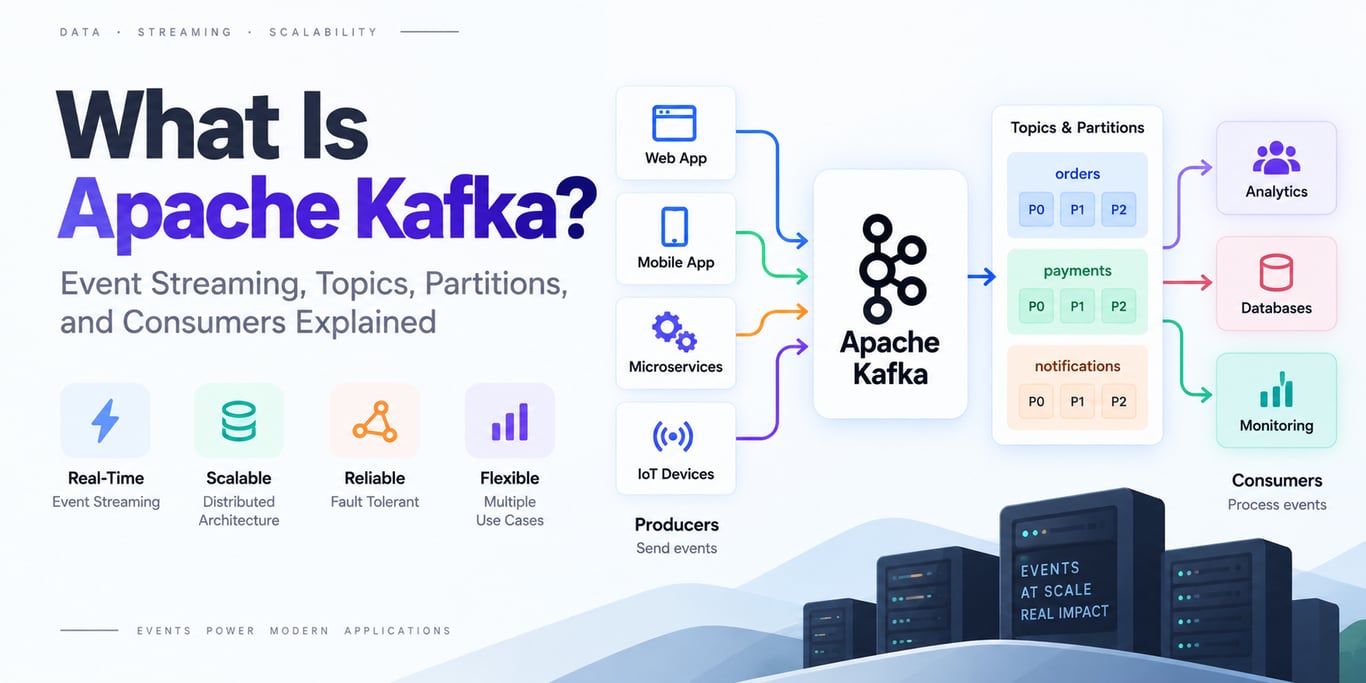
What Is Apache Kafka? Event Streaming, Topics, Partitions, and Consumers Explained
A beginner-friendly explanation of Apache Kafka covering events, producers, topics, partitions, consumers and consumer groups, offsets, retention/replay, brokers, and where Kafka fits compared with a traditional queue.
Kafka & Messaging
Showing 13 of 23 articlesAmazon SQS in Production: Standard vs FIFO, Visibility Timeouts, DLQs, and Worker Scaling
A practical Amazon SQS guide covering Standard vs FIFO queues, visibility timeouts, idempotent consumers, long polling, dead-letter queues/redrive, batch APIs, backlog-age monitoring, and worker autoscaling.
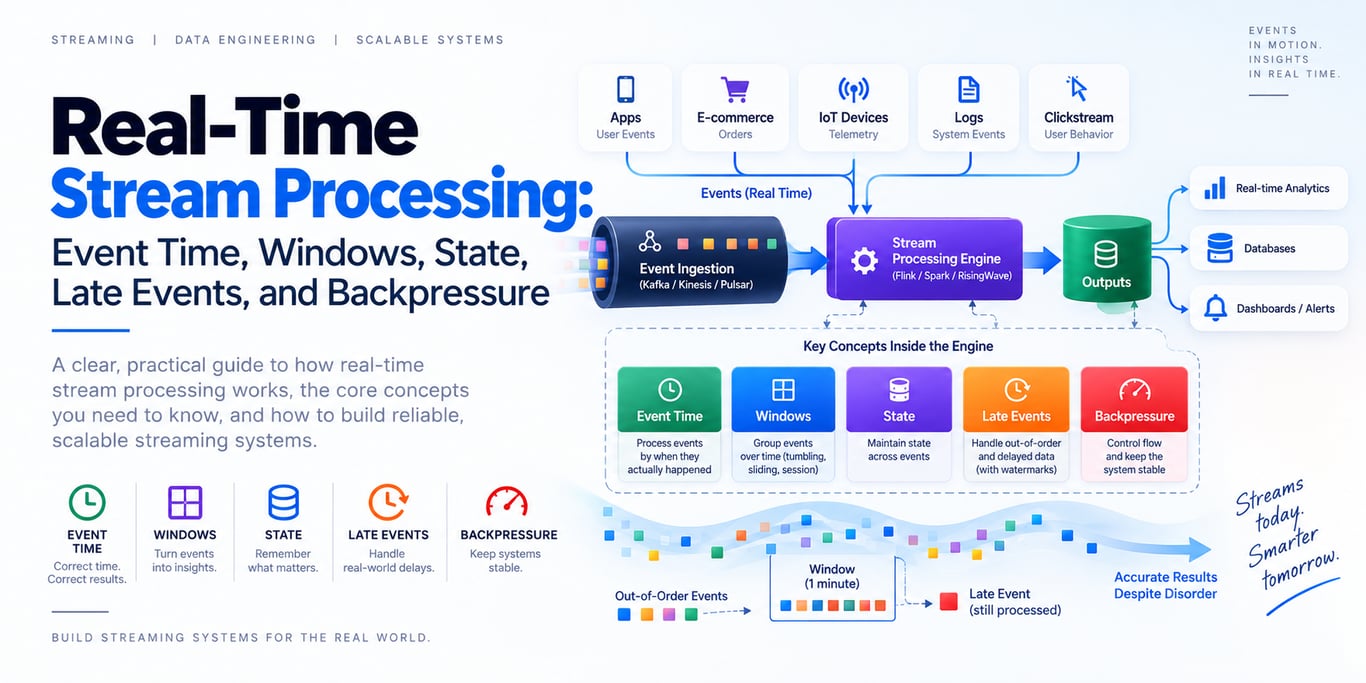
Real-Time Stream Processing: Event Time, Windows, State, Late Events, and Backpressure
A practical real-time stream-processing guide covering event time vs processing time, windows, late/out-of-order events, stateful processing and recovery, exactly-once scope, consumer lag, and backpressure.
Kafka Topics Explained: Naming, Partitions, Retention, Compaction, and Ownership
A practical Kafka-topic guide covering topic naming and ownership, explicit provisioning, partitions and ordering, replication, delete retention vs log compaction, schema evolution, and access control.
Why Apache Kafka Is Used: Durable Events, Replay, Independent Consumers, and High Throughput
A clear explanation of why Apache Kafka is used: durable event retention and replay, independent consumer groups, partitioned throughput, replication, Kafka Connect integrations, and realtime stream processing.

Event-Driven Architecture Explained: Pub/Sub, Event Streams, Choreography, and Trade-Offs
A practical event-driven architecture guide covering event buses, pub/sub vs durable event streams, choreography vs orchestration, eventual consistency, event contracts, idempotency, and when asynchronous architecture is worth using.

Kafka for Microservices: Topics, Consumer Groups, Idempotency, Outbox, and Event Contracts
A practical Kafka-for-microservices guide covering domain events, partition keys, consumer groups, idempotent processing, transactional outbox/CDC, schema evolution, consumer lag, and where Kafka is worth the operational cost.

Event Streaming Explained: Retained Logs, Replay, Partitions, and Independent Consumers
A clear event-streaming guide covering durable append-only logs, partitions, independent consumers, replay, retention, ordering scope, event streaming vs pub/sub, and the distinction between streaming and stream processing.
Apache Kafka Architecture in 2026: KRaft Controllers, Brokers, Partitions, Replication, and ISR
A current Kafka 4.3 architecture guide covering KRaft-only metadata management, controller quorums, brokers, topic partitions, leaders/followers, ISR, min.insync.replicas, rack awareness, and metadata/data-plane monitoring.
Apache Kafka Explained Simply: Topics, Partitions, Producers, Consumers, and Offsets
A beginner-friendly Apache Kafka explanation covering events, topics, partitions, producers, consumer groups, offsets, brokers, retention/replay, ordering, replication, and where Kafka fits.
RabbitMQ Explained Simply: Exchanges, Queues, Bindings, Consumers, and Acknowledgements
A beginner-friendly RabbitMQ explanation covering publishers, exchanges, direct/topic/fanout routing, bindings, queues, consumers, acknowledgements, prefetch, queue types, ordering, and redelivery.

Kafka Producers and Consumers: Acks, Batching, Consumer Groups, Offsets, and Rebalances
A practical Kafka client guide covering producer keys, acknowledgements, idempotence, batching/compression, consumer groups, offset commits, rebalances, graceful shutdown, consumer lag, and delivery trade-offs.
RabbitMQ in Production: Quorum Queues, Publisher Confirms, Prefetch, and Monitoring
A production RabbitMQ guide covering quorum queues, publisher confirms, manual consumer acknowledgements, prefetch, long-lived connections/channels, TLS and permissions, disk/memory protection, and queue/node monitoring.