

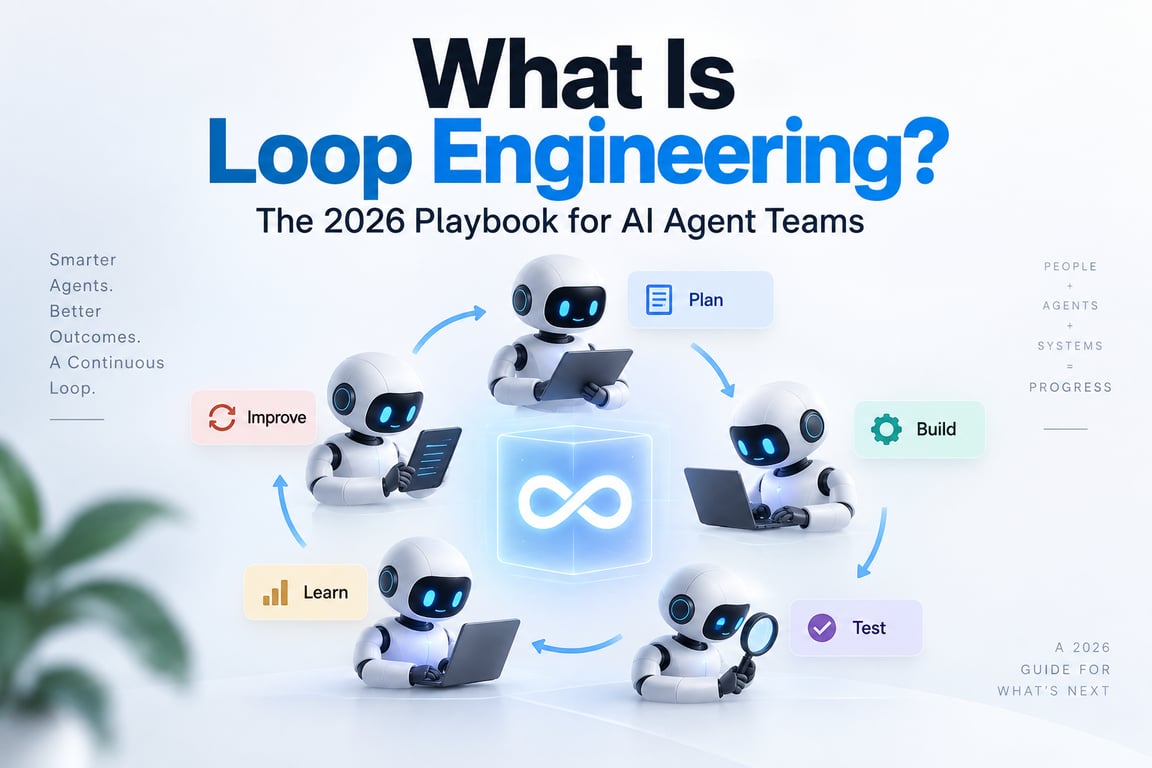
Prompt engineering improved the instruction. Loop engineering designs what happens after the first answer. Instead of manually prompting an AI agent at every step, a loop engineer creates a bounded system that can discover work, act through tools, inspect evidence, correct mistakes and stop—or escalate—when a defined condition is reached.
That distinction is why loop engineering has become one of the most discussed ideas in agentic AI in 2026. The term is new, but its foundations are familiar: feedback loops, test-driven development, workflow orchestration, least-privilege access, observability and human accountability. What is changing is the unit of engineering. The model is no longer the whole product; the repeatable, verifiable loop around the model is.
What is loop engineering?
Loop engineering is the practice of designing controlled, repeatable workflows that guide AI agents toward a goal through cycles of action, observation and adjustment. A production-quality loop gives the agent the right context and tools, records state between attempts, evaluates real outcomes, limits time and cost, and defines exactly when to stop, retry or ask a human.
In its simplest form, an AI agent loop looks like this:
-
Goal: Define the desired outcome and measurable completion criteria.
-
Action: Let the agent choose and perform the next permitted step.
-
Observation: Collect evidence from tools, tests, APIs or the environment.
-
Adjustment: Use that evidence to continue, revise the plan, retry, stop or escalate.
The cycle repeats only while progress remains possible and the run stays inside its permissions, budget and safety boundaries. This is not an ordinary programming for loop, and it is not permission for an agent to run forever. It is an engineered control system for probabilistic workers.
Why loop engineering is trending in 2026
AI models have become better at long-horizon, tool-using work, while coding products increasingly provide the surrounding primitives needed to operate them: scheduled automations, isolated workspaces, reusable skills, connectors, subagents and persistent state. In June 2026, Addy Osmani described loop engineering as replacing yourself as the person who repeatedly prompts the agent and instead designing the system that finds work, delegates it, checks it and remembers what comes next. IBM published its own definition in July 2026, describing loop engineering as an emerging agentic engineering practice for iterative, minimally supervised workflows.
The important signal is not the arrival of another label. It is a shift in where engineering leverage now lives:
-
A better model can improve one run.
-
A better prompt can improve one response.
-
Better context can improve one decision window.
-
A better harness can improve one agent's ability to act.
-
A better loop can improve every run, including how work is discovered, verified, recovered and stopped.
That final layer matters when agents work for minutes or hours, touch real systems, run repeatedly, or collaborate as a team. Reliability can no longer depend on a person noticing every mistake in real time.
Prompt engineering vs. context, harness and loop engineering
  Discipline

  Primary question

  What it optimizes

  Prompt engineering

  What should the model do in this interaction?

  Instructions, constraints and response quality

  Context engineering

  What information should the model see right now?

  Relevant facts, files, history and token usage

  Harness engineering

  What can the agent access and execute?

  Tools, permissions, runtime, sandboxing and recovery

  Loop engineering

  How does repeated work progress safely to a verified outcome?

  Triggers, state, feedback, evaluation, budgets and stop decisions

  Multi-agent orchestration

  Which specialist should perform or verify each part?

  Delegation, handoffs, parallelism and role separation
These disciplines are complementary. Loop engineering does not make prompting obsolete. Every loop still contains instructions, context and a harness. It simply treats them as components inside a larger lifecycle.
The seven components of a reliable AI agent loop
1. A bounded goal and explicit success criteria
“Improve the application” is not a loop-ready goal. “Fix the reported checkout error without changing unrelated behavior; stop when the reproducing test and required regression suite pass” is much closer. A strong goal names the scope, constraints, evidence and terminal state.
For ambiguous work, the correct terminal state may be needs clarification, not done. A loop becomes safer when it can end honestly without forcing a result.
2. A trigger and work-discovery rule
A loop needs a reason to run. The trigger might be a schedule, a failed CI job, a new support ticket, a pull request event or a human request. Discovery must also be bounded: which repositories, queues, branches, customers or records are in scope? Without that boundary, an automation can continuously find more work and never converge.
3. Curated context and durable instructions
More context is not automatically better. Each cycle should receive the smallest set of current facts needed for the next decision: the goal, relevant files or records, applicable policies, previous attempts and fresh evidence. Stable project knowledge belongs in durable instructions or skills; transient run state belongs in a task record or memory store.
This separation prevents two expensive problems: repeatedly rediscovering the project and carrying an ever-growing transcript full of stale or irrelevant details.
4. Tools, permissions and an execution harness
An agent becomes operational when it can use tools: read files, run tests, query approved data, call APIs, open tickets or update a pull request. Tool access also creates risk. Each loop should receive only the permissions required for its current task, with sensitive or irreversible actions placed behind stronger checks or human approval.
A robust harness supplies isolation, timeouts, retries, structured tool inputs, error reporting and auditable traces. The model proposes actions; deterministic code must enforce identity, authorization, tenant boundaries and policy.
5. Persistent state—the loop's spine
Long-running work cannot rely on conversational memory alone. The loop needs an external record of what it attempted, what changed, which evidence was collected, what remains open and why the previous run stopped. This “spine” can be a task database, issue tracker, workflow record or versioned project file.
Good state is concise and machine-readable. It should support idempotency, so restarting after a timeout does not repeat a payment, create duplicate tickets or apply the same change twice.
6. Independent verification and feedback
An agent saying “done” is a claim, not evidence. Verification should inspect the environment's outcome: tests passed, a record exists, an API returned the expected state, a policy check succeeded or a human approved the artifact. Anthropic's guidance on agent evaluations makes the same distinction between a transcript—what the agent said and did—and the outcome that actually exists in the environment.
Use deterministic checks whenever possible. For software work, unit tests, integration tests, static analysis and state inspection are stronger than asking the same model whether its own solution looks correct. Where judgment is unavoidable, use a clear rubric, multiple evaluation signals and periodic human calibration.
7. Stop, retry, budget and escalation rules
Every production loop needs named terminal states, such as verified, blocked, needs human review, budget exhausted and failed safely. It also needs hard limits on turns, wall-clock time, tokens, API spend, tool calls and repeated identical failures.
A useful stopping rule is evidence-based: stop because the required checks passed, not because the agent feels confident. A useful escalation includes a compact evidence packet—what was tried, what failed, current state and the smallest decision a human must make.
What does a loop engineer do?
A loop engineer designs, tests and operates the lifecycle around AI agents. The title is still emerging and is not yet a universally standardized job role. In practice, the work overlaps AI agent engineering, platform engineering, DevOps, reliability engineering, security and product operations.
A loop engineer typically:
-
translates business intent into measurable goals and terminal states;
-
chooses what should remain deterministic and what the model may decide;
-
designs tool schemas, permissions, sandboxes and approval boundaries;
-
creates context-loading, memory and state-compaction strategies;
-
builds evals and outcome-based verification;
-
separates maker and checker roles when independent review adds value;
-
sets retry, fallback, cost and escalation policies;
-
traces runs and investigates failure patterns;
-
measures whether the loop improves real business outcomes; and
-
owns the decision about how much autonomy the system has earned.
The deepest skill is not writing clever prompts. It is designing reliable feedback. A strong loop engineer asks: What evidence would convince us this task is actually complete, and what prevents the system from gaming that evidence?
AI agent teams: when multiple agents improve the loop
Loop engineering and multi-agent systems are related but not identical. A good loop may use one agent. Multiple agents are justified when responsibilities genuinely differ, work can be isolated, or independent verification is worth the additional cost.
A practical agent team might include:
-
Explorer: gathers relevant code, data, constraints and prior incidents.
-
Planner: proposes a scoped approach and identifies risks.
-
Maker: performs the implementation or produces the artifact.
-
Checker: evaluates the result against the goal and evidence rules.
-
Controller: tracks state, budgets and terminal conditions.
The maker/checker split is especially valuable. The checker should not merely repeat the maker's reasoning; it should inspect independent signals such as tests, state changes, policy rules or a separate review rubric. Even then, high-impact production decisions still need accountable human ownership.
More agents are not automatically better. They increase latency, token usage, coordination overhead and the chance of inconsistent assumptions. Start with a single agent plus deterministic verification. Add specialists only where the separation solves a measured failure mode.
A concrete loop engineering example: repairing a CI failure
Consider a daily loop that handles safe, well-scoped CI failures:
-
A failed required check triggers the loop.
-
The discovery step reads the failing log, related test, recent commits and repository instructions.
-
The controller rejects tasks outside the allowed repository or change scope.
-
An isolated workspace is created for the attempt.
-
The maker reproduces the failure before changing code.
-
The maker applies the smallest relevant fix.
-
Deterministic verification reruns the failing check and required regression tests.
-
A checker reviews the diff for requirement coverage, security and attempts to weaken tests.
-
If evidence passes, the loop prepares a pull request with the test results; it does not silently deploy.
-
If the same failure repeats, the budget expires or the change touches a protected area, the loop stops and escalates with evidence.
The prompt is only one small part. Reliability comes from reproducing the failure, isolating the work, restricting permissions, verifying the outcome, detecting shortcuts and defining the production boundary.
How to design your first production loop
-
Choose a narrow, reversible workflow. Good first candidates include issue triage, test-failure analysis, documentation checks or draft generation. Avoid high-stakes autonomous actions.
-
Write the contract. Specify the trigger, scope, inputs, permitted tools, outputs, evidence, budgets and terminal states.
-
Create a baseline. Measure how the task performs today—quality, time, cost and common errors—before automating it.
-
Keep policy deterministic. Enforce authentication, authorization, data boundaries and irreversible-action rules outside the prompt.
-
Build outcome-based evals. Test real end states, not polished explanations. Include normal, edge and adversarial cases.
-
Run in shadow mode. Let the loop recommend actions without executing them, then compare recommendations with human decisions.
-
Grant autonomy gradually. Start with read-only access, then reversible writes, then narrowly scoped approval-free actions only after evidence supports them.
-
Monitor and review. Preserve traces, sample outputs and update eval suites when new failure modes appear.
OpenAI's current application-development guidance recommends robust evals for correctness and reliability, guardrails for unsafe or unpredictable behavior, and feedback loops that surface weaknesses over time. Those practices map directly onto reliable loop engineering.
Metrics that tell you whether the loop actually works
Do not judge a loop by how autonomous it looks. Judge it by verified outcomes and operational cost:
-
Verified success rate: percentage of runs that satisfy all required outcome checks.
-
False-done rate: runs marked complete that fail independent validation.
-
Escalation precision: whether the loop asks humans only when their judgment is genuinely needed.
-
Recovery rate: percentage of transient failures resolved without unsafe repetition.
-
Regression or defect-escape rate: problems introduced or missed by the loop.
-
Median time to verified outcome: not merely time to the first response.
-
Cost per verified outcome: model, tool, infrastructure and review cost combined.
-
Human review load: time and attention required to safely accept the work.
Track these metrics by task type and risk level. A loop that is excellent at documentation cleanup may be unsuitable for authentication changes or financial operations.
Common loop engineering failure modes
Vague goals
If success is subjective or unbounded, the agent will keep expanding the task or stop on confidence rather than evidence. Convert the goal into observable acceptance criteria.
Self-graded completion
The same model creates the work and declares it correct. Replace self-confidence with deterministic outcome checks or independent evaluation.
Infinite retries and runaway cost
The loop repeats without learning from failure. Add retry limits, failure fingerprints, progress checks, cost ceilings and explicit escalation.
Stale or bloated context
Old plans and irrelevant transcripts crowd out current evidence. Rebuild context from authoritative state and compact history into a concise progress record.
Overpowered tools
A broadly privileged agent turns a reasoning error into a real incident. Use least privilege, allowlists, isolation and approvals for consequential actions.
State without idempotency
A restarted workflow repeats side effects. Give writes stable operation identifiers and verify current state before acting.
Premature multi-agent complexity
Several agents debate a task that one agent and a test could solve faster. Add roles only when isolation, specialization or independent checking has a clear benefit.
Human review as a rubber stamp
Approval is not meaningful when the reviewer sees no evidence. Present the goal, changes, test results, unresolved risks and rollback path in a compact review packet.
The human still owns the outer loop
Loop engineering moves humans away from micromanaging every model turn, but it does not remove accountability. Addy Osmani's July 2026 “Own the Outer Loop” framing is useful: agents can run the inner cycle of investigation, implementation, verification and repetition; engineers decide the constraints, evidence standard, production boundary and final verdict.
This distinction protects against three growing risks:
-
Comprehension debt: the system changes faster than the team understands it.
-
Intent debt: the reasons behind constraints and design choices disappear.
-
Cognitive surrender: people accept agent output without independent judgment.
A trustworthy loop therefore makes work legible. It records why actions occurred, what evidence supports the outcome, what uncertainty remains and who owns the final decision.
When should you not use loop engineering?
Do not build an autonomous loop for a one-off task that a clear prompt and quick human check can solve. Avoid it when success cannot be measured, the environment cannot be safely isolated, errors are irreversible, required data is unreliable, or the review cost exceeds the saved effort.
Loop engineering earns its complexity when work is recurring, tool-based, testable and valuable enough to automate—but bounded enough to control.
Frequently asked questions
Is loop engineering the same as prompt chaining?
No. Prompt chains usually follow a predefined sequence. A loop uses observations from the environment to decide whether to continue, retry, change direction, stop or escalate.
Is loop engineering only for coding agents?
No. The same pattern can support research, support operations, compliance checks, data-quality workflows and content maintenance. The verification method and autonomy level must match the domain's risk.
Does loop engineering replace prompt engineering?
No. Prompts remain part of the loop. Loop engineering adds lifecycle control around prompts: state, tools, evidence, budgets, recovery and terminal decisions.
Do I need an AI agent team?
Usually not at first. Begin with one capable agent, limited tools and deterministic checks. Add a specialist or independent checker only when it improves a measured weakness.
What is the most important loop engineering principle?
Define “done” using evidence from the real outcome. The agent's confidence, eloquence or number of steps is not proof of success.
Final takeaway
Loop engineering is the discipline of turning agent capability into a repeatable, bounded and verifiable operating system for work. Its value does not come from letting AI run unattended for as long as possible. It comes from designing feedback, permissions, memory, evaluation and stop rules so the system can make useful progress while remaining observable and accountable.
The winning mindset for 2026 is simple: build the loop, measure the outcome and keep human judgment at the boundary that matters.
Research sources
-
Addy Osmani — Loop Engineering, published June 7, 2026.
-
Addy Osmani — Own the Outer Loop, published July 15, 2026.
-
IBM — What Is Loop Engineering?, published July 17, 2026.
-
Anthropic — Demystifying Evals for AI Agents, published January 9, 2026.
-
OpenAI — AI Application Development: Concept to Production, accessed July 31, 2026.
BUILDING AN AI PRODUCT?
Talk to Lofingo about custom autonomous AI agents, enterprise workflow automation, and scalable software systems.
EXPLORE AI SERVICES →