

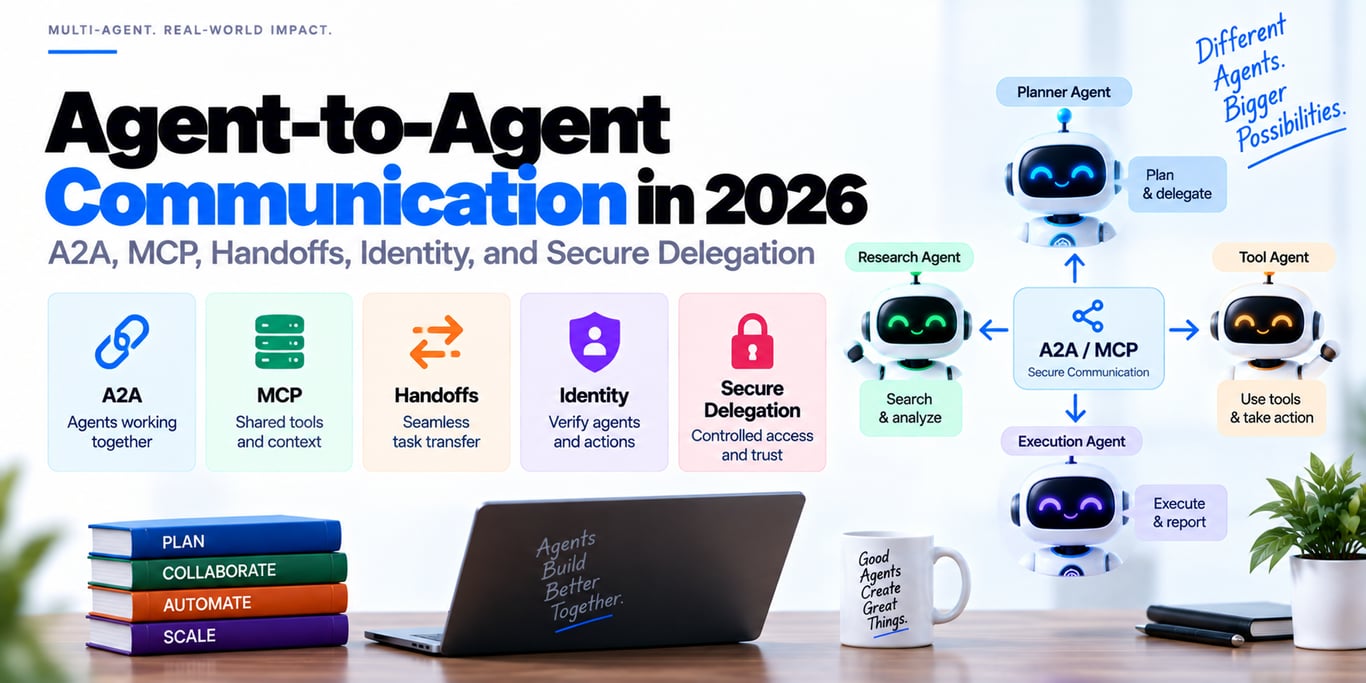
When one AI agent can solve the whole task, agent-to-agent communication is unnecessary complexity.
It becomes valuable when responsibility crosses a real boundary: another agent owns a different domain, has different tools or permissions, runs in another system, belongs to another team, or needs to continue a long-running task independently.
That distinction matters because multi-agent systems often fail for a very ordinary reason: they treat another agent like a fancy function call when the real interaction needs identity, task ownership, state, negotiation, retries, authorization, and a clear answer to “who is responsible now?”
In 2026, two open standards make this architecture much clearer:
- A2A (Agent2Agent) for agent-to-agent collaboration
- MCP (Model Context Protocol) for connecting agents to tools, APIs, and resources
They solve different layers of the same system.
> MCP gives an agent capabilities. A2A lets independent agents collaborate.
Agent-to-agent communication is not just “call another LLM”
Imagine a SaaS support agent receives this request:
“My invoice is wrong after an enterprise contract change. Fix it and send me the corrected copy.”
A single agent may need information from:
Support domain
→ current ticket + conversation

Billing domain
→ invoice + payment state

Contracts domain
→ negotiated enterprise terms

Document service
→ corrected invoice generation
You could expose every internal API directly to one giant agent.
But if the billing team already operates a specialist billing agent with its own policy, data access, and workflows, delegation may be cleaner:
Support Agent
      │
      │ delegate billing investigation
      ▼
Billing Agent
      │
      ├── billing tools
      ├── finance policy
      └── invoice state
      │
      ▼
structured result / task state
      │
      ▼
Support Agent
Now the problem is not simply tool invocation.
The remote agent may:
- ask clarifying questions
- run several tools internally
- maintain state
- take minutes or hours
- return files or structured artifacts
- fail partially
- require approval
- be operated by another team or company
That is exactly the class of interaction A2A is designed for.
A2A and MCP solve different problems
The official A2A documentation describes the distinction clearly.
MCP: agent-to-tool
MCP standardizes how a model or agent connects to capabilities such as:
database queries
GitHub repositories
CRM APIs
search services
internal functions
file resources
A tool usually has a defined contract:
name
input schema
output
Conceptually:
Agent
  │
  ├── MCP → CRM tool
  ├── MCP → database tool
  └── MCP → GitHub tool
A2A: agent-to-agent
A2A is designed for independent agents that can reason and collaborate over broader tasks.
Conceptually:
Support Agent
      │
      └── A2A → Billing Agent
                    │
                    ├── MCP → payments API
                    └── MCP → invoice DB
The remote billing agent remains opaque. The support agent does not need direct access to its internal prompt, memory, tools, or implementation.
That is one of the most important architectural benefits.
A2A v1.0: a production interoperability layer
The A2A project reached v1.0 in 2026.
The protocol is designed to let independent agent systems:
- discover each other
- advertise capabilities
- authenticate
- exchange messages
- create and manage tasks
- exchange structured data, files, and other artifacts
- collaborate without exposing internal implementation details
It is framework-independent.
One agent might be built with:
Google ADK
another with:
LangGraph
another with:
custom Go runtime
and another with:
CrewAI
A2A exists above those implementation choices.
The Agent Card: capability discovery
Before delegating work, the caller needs to know what the remote agent can do.
A2A uses an Agent Card to advertise information about the agent.
Conceptually, it answers questions such as:
Who is this agent?
Where is it reachable?
What skills does it provide?
Which interaction modes does it support?
How should clients authenticate?
Which protocol versions are supported?
You can think of it as discovery metadata for an autonomous service.
The key difference from a tool schema is that the card describes agent capabilities, not every internal function.
A billing agent might advertise:
skills:
- investigate invoice discrepancy
- explain subscription charges
- prepare refund proposal
- generate corrected invoice
without exposing:
get_invoice_row()
query_contract_table()
run_reconciliation_job()
Those details remain internal.
Discovery should not imply trust
Finding an Agent Card does not mean the caller should trust the agent.
Treat discovery and authorization separately.
A production system should verify things such as:
Is this agent operated by an approved party?
Is its endpoint trusted?
Which tenant/user is delegating?
What data may be shared?
What actions may the remote agent perform?
An agent registry is not a security boundary by itself.
This is similar to service discovery in microservices: knowing where a service lives does not automatically grant permission to call it with sensitive data.
Messages, tasks, and artifacts are different concepts
Agent collaboration becomes easier to reason about when you separate conversational exchange from durable work.
Messages
Messages represent communication:
"Please investigate invoice INV-204."
or:
"I need the contract amendment date before I can continue."
Tasks
A task represents an ongoing unit of work.
task_id: billing-investigation-884
status: working
The task can evolve over time.
Artifacts
Artifacts represent outputs produced by the work.
Examples:
corrected_invoice.pdf
reconciliation_report.json
approval_summary.md
This distinction matters because long-running agent work should not be represented as one giant request/response pair.
Long-running delegation needs state
Suppose the support agent delegates a contract reconciliation task.
The remote agent may need to:
1. inspect invoice
2. fetch contract amendment
3. compare pricing rules
4. request missing information
5. wait for a finance approval
6. generate corrected invoice
That task may remain alive for minutes or hours.
The caller should track explicit states instead of inferring progress from chat text.
A useful internal representation might look like:
{
  "delegation_id": "del_482",
  "remote_agent": "billing-agent",
  "remote_task_id": "task_991",
  "status": "waiting_for_input",
  "created_at": "...",
  "deadline": "...",
  "owner": "support-run-77"
}
The local runtime—not the LLM—should own this mapping.
Explicit ownership prevents duplicate work
Multi-agent systems often duplicate tasks because ownership is vague.
Bad design:
Manager asks Agent A and Agent B to investigate the same issue.
Both later decide to execute the fix.
Now you have duplicate writes.
A better model defines:
work item
→ one current owner
→ optional read-only contributors
For example:
Billing Agent = owner of invoice correction
Support Agent = owner of customer communication
The agents can collaborate without both owning the same mutation.
Handoff vs delegation
These two patterns are often confused.
Delegation
The original agent keeps ownership and asks another agent for bounded work.
User
  ↓
Manager Agent
  ├── delegates research
  ├── delegates billing check
  └── synthesizes result
The worker returns a result.
Handoff
Responsibility transfers to another agent.
User
  ↓
Triage Agent
  ↓ handoff
Billing Agent
  ↓
continues the user-facing task
The design question is:
> Who should own the next part of the workflow?
If the caller still needs to combine several specialist outputs, use delegation.
If one specialist should now become responsible, use a handoff.
Agents should exchange contracts, not vague prose
This is a weak delegation message:
“Please look into this and tell me what you think.”
A stronger task packet includes:
objective
scope
relevant identity/context
constraints
expected deliverable
completion criteria
deadline/budget
For example:
{
  "objective": "determine whether invoice INV-204 is inconsistent with contract amendment CA-19",
  "scope": "billing and contract pricing only",
  "customer_id": "cus_42",
  "requested_output": {
    "status": "valid|invalid|needs_review",
    "reason": "string",
    "recommended_action": "string"
  },
  "deadline_seconds": 60
}
The receiving agent can still reason autonomously, but the collaboration boundary is precise.
Do not send the entire conversation by default
A remote specialist rarely needs everything the manager knows.
Bad handoff:
200 conversation messages
all tool logs
all unrelated user history
full internal system prompt
Better handoff:
user goal
relevant authenticated identity
relevant resource IDs
minimal task context
required constraints
This improves:
- privacy
- latency
- context quality
- security
- debuggability
Context minimization is especially important across organizational boundaries.
Identity must survive delegation
If a user asks Agent A to operate on their behalf, Agent B needs enough trusted identity context to enforce authorization correctly.
The remote agent should not receive only this:
"The user says they own account 123."
The system should propagate verifiable security context through normal application mechanisms.
Examples may include:
user/tenant identity
scoped token
signed authorization context
delegation ID
approved action scope
The exact mechanism depends on your architecture, but the rule is stable:
> Authorization must not depend on one model telling another model that access is allowed.
Delegated credentials should be scoped
Suppose the support agent needs the billing agent to inspect one invoice.
Do not pass credentials that grant access to the entire billing platform if the delegated task only needs:
read invoice INV-204
Use least privilege.
Useful scope dimensions include:
tenant
resource
action
expiration
audience
This limits damage if the remote agent or communication path behaves incorrectly.
A2A does not replace application authorization
A protocol can standardize communication.
It does not decide your business policy.
Your application still needs to enforce:
which agents are trusted
which users can delegate
which resources can cross boundaries
which actions require approval
which data may leave the tenant/system
Think of A2A as transport + collaboration semantics, not a complete enterprise security model.
MCP and A2A together form a useful stack
A production architecture may look like:
                        A2A
        ┌────────────────────────────────┐
        │                                │
        ▼                                ▼
 Support Agent                      Billing Agent
        │                                │
        │ MCP                            │ MCP
        ▼                                ▼
 Helpdesk tools                    Billing tools
 Knowledge base                    Payments API
 Customer profile                  Invoice DB
The support agent does not need direct billing credentials.
The billing agent does not need the support agent’s internal memory.
Each agent owns its capabilities, while A2A coordinates the higher-level task.
MCP’s 2026 architecture also became more scalable
The 2026-07-28 MCP specification introduced a more stateless protocol core and stronger production-oriented behavior.
That matters for agent architectures because MCP servers can now fit more naturally behind ordinary horizontally scaled HTTP infrastructure.
The broader design becomes:
A2A → horizontal collaboration across agents
MCP → vertical capability access inside each agent
This separation is cleaner than trying to force every remote agent interaction into a tool schema.
Do not wrap every agent as an MCP tool
Sometimes that is perfectly fine.
If a remote “agent” effectively performs one bounded stateless operation:
summarize_contract(document_id)
then exposing it as a tool may be simpler.
But if the remote system needs:
- multi-turn clarification
- stateful tasks
- asynchronous progress
- negotiation
- multiple output artifacts
- its own autonomous planning
then treating it as one tool invocation becomes an awkward abstraction.
That is where agent-level protocols become useful.
Multi-agent does not mean every agent talks to every agent
A fully connected mesh sounds flexible:
A ↔ B ↔ C ↔ D ↔ E
but creates serious problems:
- cycles
- unclear ownership
- duplicated work
- uncontrolled cost
- difficult authorization
- impossible-to-read traces
Prefer explicit topology.
Common patterns:
Manager → specialists

Triage → domain owner

Orchestrator → workers → orchestrator

Gateway → external partner agents
The communication graph should be understandable before the models run.
Bound delegation depth
Without limits, you can create this:
Agent A delegates to B
B delegates to C
C delegates to D
D delegates back to A
Your runtime should enforce limits such as:
max_delegation_depth
max_agents_per_run
max_parallel_delegations
max_total_tokens
max_wall_clock_time
Also consider task fingerprints so the system can detect repeated delegation of the same work.
Do not rely only on the model to notice loops.
Parallel delegation is useful only when work is independent
A manager can send independent subtasks in parallel:
                ┌→ Security Agent
Architecture ───┼→ Cost Agent
                └→ Database Agent
This can reduce total latency.
But if each worker depends on the same evolving state, parallel execution may create inconsistent conclusions or conflicting writes.
Good parallel delegation:
read-only research
independent reviews
separate modules
Risky parallel delegation:
multiple agents editing same record
multiple agents issuing same external action
Parallel writes require explicit ownership or isolation.
Remote agents should return structured outcomes
The caller should not need to parse a 4,000-word essay from every specialist.
Useful result structure:
{
  "status": "completed",
  "summary": "Invoice conflicts with amendment CA-19",
  "evidence": [
    {"type":"invoice","id":"INV-204"},
    {"type":"contract","id":"CA-19"}
  ],
  "recommended_action": "regenerate_invoice",
  "open_questions": []
}
A human-readable narrative can accompany it, but machines should have a stable contract for coordination.
Artifact provenance matters
If Agent B produces a file that Agent A later sends to the user, the system should know:
who created it
which task created it
which inputs were used
which version is current
whether it was validated
Do not treat every returned file as trusted merely because it came from another internal agent.
The same principle applies to subagent answers: internal does not automatically mean authoritative.
Agent results can contain prompt injection too
A remote agent may have processed untrusted webpages, documents, emails, or user-generated content.
Its result may therefore contain adversarial instructions.
The manager should treat remote-agent output as data from another execution boundary, not as higher-priority system policy.
Bad pattern:
subagent output inserted directly into manager system instructions
Better:
subagent result inserted as attributed evidence
Then tool authorization remains enforced separately.
Timeout and cancellation must propagate
If the user cancels the parent request, remote tasks should not continue burning resources indefinitely.
Your runtime should track parent/child relationships:
parent run cancelled
      ↓
cancel outstanding delegated tasks
      ↓
record final status
Likewise, deadline propagation is useful:
parent has 30 seconds left
→ do not delegate a new 10-minute research task
Budgets should flow down the delegation tree.
Retry agent communication carefully
Read-like requests may be safe to retry.
Delegated mutations may not be.
Suppose a billing agent receives:
execute corrected invoice generation
The request succeeds, but the response is lost.
The caller retries.
Now the remote system might generate two invoices.
Use operation IDs or idempotency semantics for side-effecting tasks.
Represent ambiguous outcomes explicitly:
confirmed_success
confirmed_failure
outcome_unknown
For outcome_unknown, query task state before retrying the action.
Observability should show the delegation tree
A useful trace should answer:
Who delegated to whom?
Why?
What task ID was created?
Which agent owned the task?
How long did it take?
Which tools did the remote agent use internally (if visible)?
What result came back?
Did the parent accept or reject it?
Conceptually:
Support Run
 ├─ local retrieval
 ├─ A2A → Billing Agent
 │     ├─ task created
 │     ├─ invoice investigation
 │     └─ task completed
 ├─ result validation
 └─ customer response
Without delegation-aware tracing, multi-agent debugging becomes guesswork.
Evaluate collaboration separately from specialist quality
You need several eval layers.
Routing
Did the manager choose the correct specialist?
Delegation contract
Did the receiving agent get enough information without unnecessary data?
Specialist task success
Did the remote agent perform its job correctly?
Coordination
Did agents duplicate work or loop?
Security
Did identity and authorization stay scoped correctly?
End-to-end outcome
Did the user’s actual goal get completed?
A brilliant specialist is useless if the manager delegates the wrong tasks to it.
A practical enterprise example
Imagine a procurement platform.
A user asks:
> “Find a compliant supplier for 500 industrial sensors and prepare the purchase package.”
A useful multi-agent architecture could be:
Procurement Agent
   │
   ├─ A2A → Supplier Discovery Agent
   │           └─ MCP → supplier directory
   │
   ├─ A2A → Compliance Agent
   │           └─ MCP → policy + sanctions sources
   │
   └─ A2A → Finance Agent
               └─ MCP → budget / approval tools
Each remote agent returns structured results.
The procurement agent remains responsible for synthesis and user communication.
Actual purchase execution still passes through deterministic approval and authorization checks.
The model network coordinates intelligence. The application remains the control plane.
When not to use agent-to-agent communication
Do not introduce A2A merely because multiple logical components exist.
Use a normal function/tool when:
- input/output is well-defined
- operation is stateless
- caller owns the whole workflow
- the remote capability does not need autonomous multi-turn work
Use ordinary service APIs when:
- the interaction is deterministic
- no model autonomy is needed
- it is normal backend-to-backend communication
Use agent-to-agent collaboration when:
- the remote system genuinely owns reasoning/workflow responsibility
- the task may be stateful or long-running
- agents are independently managed
- interoperability across frameworks/vendors matters
Production checklist
Before shipping agent-to-agent communication, verify:
- Each remote agent has a real responsibility boundary
- Capability discovery is separate from trust/authorization
- Identity survives delegation
- Credentials are scoped to task/resource/action
- Handoff vs delegation semantics are explicit
- One owner exists for every side-effecting work item
- Delegation depth and fan-out are bounded
- Parent cancellation/deadlines propagate
- Side-effecting tasks use idempotency or durable operation IDs
- Ambiguous outcomes are queryable before retries
- Remote outputs retain provenance
- Remote-agent content is treated as untrusted evidence
- Structured results exist for machine coordination
- Delegation trees are visible in traces
- Collaboration has dedicated evals
- A normal tool/service call was rejected only after proving it was insufficient
Final takeaway
Agent-to-agent communication is useful when responsibility—not just computation—moves across a boundary.
Use MCP when an agent needs tools and resources.
Use A2A when independent agents need to discover one another, delegate broader tasks, exchange stateful messages and artifacts, and collaborate without exposing their internals.
Keep identity, authorization, ownership, budgets, retries, and auditability in the application/runtime layer.
> Agents can negotiate and delegate. The system still needs to know who is responsible, what they are allowed to do, and whether the task actually finished.
That is what turns multi-agent communication from a demo into a production architecture.
References and further reading

Discussion (0)