

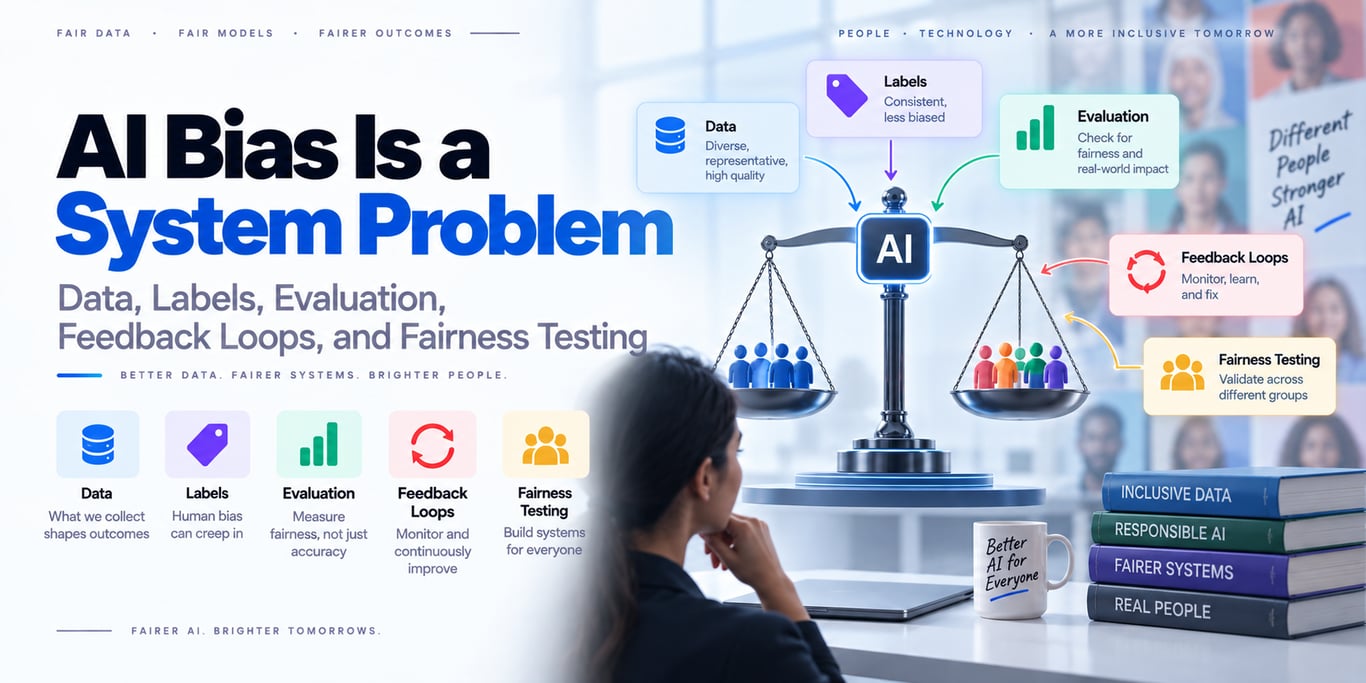
AI bias is often discussed as if it lives inside the model.
In production systems, bias can enter much earlier—and much later.
It can come from:
who is represented in the data
how labels were created
which objective is optimized
which users receive the system
how humans interpret the output
what feedback gets collected
NIST's work on AI bias makes this broader point explicitly. It separates bias into categories including systemic bias, computational/statistical bias, and human-cognitive bias.
That framing is useful because “fix the dataset” is not enough.
> Fairness is a property of the complete decision system, not a checkbox attached to model training.
Bias does not always mean malicious intent
A system can create systematically different outcomes even when nobody intended discrimination.
Example:
training data reflects past hiring patterns
→ model learns historical patterns
→ recommender prioritizes similar candidates
→ future hiring data reinforces the same pattern
The loop can reproduce existing structure automatically.
Intent and impact are different questions.
1. Systemic bias starts outside the dataset
NIST describes systemic bias as bias embedded in institutional or social systems.
Examples can include:
historical access differences
unequal measurement quality
organizational policy
selection processes
If a dataset records outcomes from a biased process, a perfectly trained model can learn that process accurately.
The model may be statistically faithful and still produce undesirable outcomes.
Ask what the label really represents
Suppose a company trains a model on:
successful_employee = promoted_within_2_years
That label may reflect:
performance
manager opportunity
team visibility
promotion policy
historical bias
The model learns the label—not the ideal concept in your head.
Label design is a product and governance decision.
2. Sampling bias changes who the model understands
If one population is underrepresented, overall accuracy can hide weak performance.
Example:
95% overall accuracy
may include:
group A → 97%
group B → 72%
The aggregate metric looks excellent.
The deployment reality is not.
Test meaningful subgroups
Where the use case makes it appropriate and lawful, evaluate performance across populations or contexts that may experience materially different outcomes.
The relevant groups depend on the system.
Examples may include:
geography
language
device type
age range
clinical site
Do not mechanically slice every dataset into dozens of categories without a reason.
Fairness evaluation should be tied to plausible harms.
Small subgroups create statistical uncertainty
A group with 20 samples can produce a dramatic-looking error-rate difference by chance.
Report:
sample size
confidence intervals / uncertainty
where appropriate.
Fairness dashboards without statistical context can be misleading.
3. Measurement bias can exist before training
Sensors, surveys, administrative systems, and human observation can measure the same concept differently across settings.
Examples:
camera performs worse under certain lighting
speech system receives noisier audio for some users
healthcare access changes which diagnoses are recorded
No training algorithm can recover information the upstream system never measured correctly.
Data quality should be evaluated by subgroup and source
Instead of asking only:
How many rows do we have?
ask:
Who generated these rows?
Under which conditions?
Who is missing?
Which fields are less reliable for some groups?
Provenance is part of fairness engineering.
4. Proxy variables can recreate sensitive distinctions
Removing one sensitive field does not necessarily remove all correlated information.
Variables such as:
location
school
purchase behavior
language
can sometimes act as proxies for other characteristics.
That does not mean every correlated feature must be banned.
It means teams need to understand why a feature affects the model and whether that relationship is appropriate for the use case.
Feature importance is not causal proof
A model explanation may show that feature X contributed strongly.
That does not prove:
X caused the outcome
or:
using X is appropriate
Model interpretability and policy judgment are separate steps.
5. Optimization objectives can create bias
A ranking system may optimize:
click-through rate
and unintentionally favor sensational or familiar content.
A hiring system may optimize similarity to historically successful employees and reduce diversity of candidate profiles.
The target metric shapes behavior.
One metric rarely represents the whole social outcome
Production objectives often need several constraints:
quality
false positives
false negatives
coverage
latency
fairness / impact metrics
Optimizing only one can degrade the others.
This is a multi-objective problem.
6. Fairness metrics can conflict
There is no universal fairness metric that works for every system.
Depending on the use case, teams might examine things such as:
selection rates
false-positive rates
false-negative rates
calibration
These properties cannot always all be equal at the same time, especially when base rates differ.
That is why the system owner must define which harm they are trying to prevent.
Start from harm, then choose the metric
Bad process:
pick popular fairness metric
→ optimize it
Better:
identify affected decision
→ identify plausible unfair harm
→ choose measurement that detects that harm
→ define mitigation
Metrics serve the policy objective.
7. Thresholds can create different trade-offs
A model may output a score.
The organization chooses the threshold.
Example:
risk score > 0.8 → manual review
Changing the threshold changes:
false positives
false negatives
review volume
Fairness problems may therefore come from decision policy even when the model itself is unchanged.
Evaluate the decision pipeline, not only the model
A complete system may be:
model score
→ threshold
→ business rule
→ human reviewer
→ final action
Measure the final outcome too.
Human review can reduce or amplify model disparities.
8. Human cognitive bias remains inside AI workflows
NIST's framework also recognizes human-cognitive bias.
Humans may:
trust automated recommendations too much
seek evidence confirming model output
apply inconsistent overrides
This means “human in the loop” is not automatically a fairness solution.
Oversight needs training, evidence, and usable interfaces.
Automation bias can make weak recommendations stronger
If an interface says:
AI recommendation: reject
confidence: 93%
reviewers may defer even when the evidence is weak.
Show relevant evidence and uncertainty—not only a confident-looking score.
9. Generative AI adds new bias surfaces
LLMs can produce biased behavior through:
stereotyped associations
unequal language quality
retrieval differences
safety-filter differences
Evaluation should use realistic tasks rather than only asking the model direct stereotype questions.
A system used to draft customer responses should be tested on actual customer scenarios.
Language performance deserves separate evaluation
A multilingual model can be excellent in English and much weaker in a lower-resource language.
If the product serves several languages, measure each one separately.
Do not report one global score that mostly reflects the dominant language.
10. RAG systems can inherit corpus bias
Retrieval is not neutral.
A knowledge base may overrepresent:
older documents
certain regions
certain authors
Ranking may repeatedly surface the same perspective.
The generation model then appears biased even though the underlying problem is retrieval coverage.
Evaluate source distribution
For important systems, examine:
which sources get retrieved
which sources are absent
freshness
authority
A RAG answer is shaped by what the retriever makes visible.
11. Feedback loops can amplify small biases
A recommendation system shows content.
Users interact with what they were shown.
Those interactions become training data.
model recommends A
→ A receives more interaction
→ training data says A is popular
→ model recommends A more
This is a self-reinforcing loop.
Logged behavior is not pure preference
Clicks and engagement reflect both:
what users wanted
and
what the system exposed them to
Treating behavioral logs as unbiased labels can lock in existing ranking behavior.
Experimentation and counterfactual methods may be needed for sophisticated systems.
12. LLM graders can have bias too
Many AI products now use another model to evaluate quality.
A judge model may prefer:
longer answers
certain writing styles
responses from familiar model families
Calibrate judge models against diverse human-labeled examples.
Do not treat “LLM score” as objective truth.
Human labels also need quality control
Annotators can disagree or apply rubrics inconsistently.
For important datasets:
provide rubric
measure reviewer agreement
adjudicate difficult cases
Bad labels become model behavior.
13. Mitigation can happen at many layers
Possible interventions include:
Data
improve coverage
fix measurement quality
rebalance examples
Model
change loss / training method
calibrate
Decision policy
change thresholds
add manual review
Product
collect missing information
show uncertainty
provide appeal path
Do not assume retraining is always the right fix.
Fix the layer causing the harm
If cross-language quality is poor because retrieval documents exist only in English, fine-tuning the LLM may not solve the root cause.
If disparities come from policy thresholds, collecting more data may not solve them either.
Root-cause analysis matters.
Monitor after deployment
Input populations and behavior change.
Track relevant metrics over time by:
model version
region / cohort where appropriate
input source
A system that was acceptable at launch can drift.
Version fairness evaluations
Record:
eval dataset
model
thresholds
policy
fairness metrics
Then you can compare releases reliably.
A fairness report without configuration history is difficult to reproduce.
A practical bias-testing workflow
Define decision / harm
      ↓
Map data and process
      ↓
Identify relevant groups / contexts
      ↓
Evaluate model + decision pipeline
      ↓
Investigate disparities
      ↓
Find root cause
      ↓
Mitigate correct layer
      ↓
Regression test
      ↓
Monitor production
This turns bias from an abstract ethics topic into an engineering process.
Common mistakes
Reporting only overall accuracy
Subgroups can fail differently.
Removing one sensitive field and declaring the system unbiased
Proxies and systemic bias remain.
Picking a fairness metric without defining the harm
Metrics can conflict.
Treating human review as automatically fair
People have cognitive bias too.
Ignoring retrieval and feedback loops
Bias can enter after model training.
Fixing every disparity with retraining
The problem may live in policy or product design.
Production checklist
Before claiming an AI system has been evaluated for bias, verify:
- Intended decision and affected population are defined
- Data provenance and missing populations are understood
- Label quality has been reviewed
- Relevant subgroups / contexts are evaluated
- Sample-size uncertainty is reported
- Proxy variables and feature use are reviewed where relevant
- Decision thresholds / policies are included in testing
- Human overrides are measured
- Retrieval and feedback loops are evaluated when present
- LLM graders are calibrated
- Mitigation targets the actual root cause
- Production monitoring exists for meaningful drift
Final takeaway
AI bias is rarely one bad column in a dataset.
It can originate in historical systems, measurement, labels, model objectives, product policy, human review, retrieval, and feedback loops.
> Do not ask only whether the model is biased. Ask where unequal or inappropriate outcomes can enter the entire decision system.
That is the level at which meaningful fairness engineering happens.
References and further reading
- NIST SP 1270 — Towards a Standard for Identifying and Managing Bias in AI
- NIST — AI Risk Management Framework
Fairness obligations and protected characteristics vary by jurisdiction and use case; this article is an engineering overview, not legal advice.

Discussion (0)