

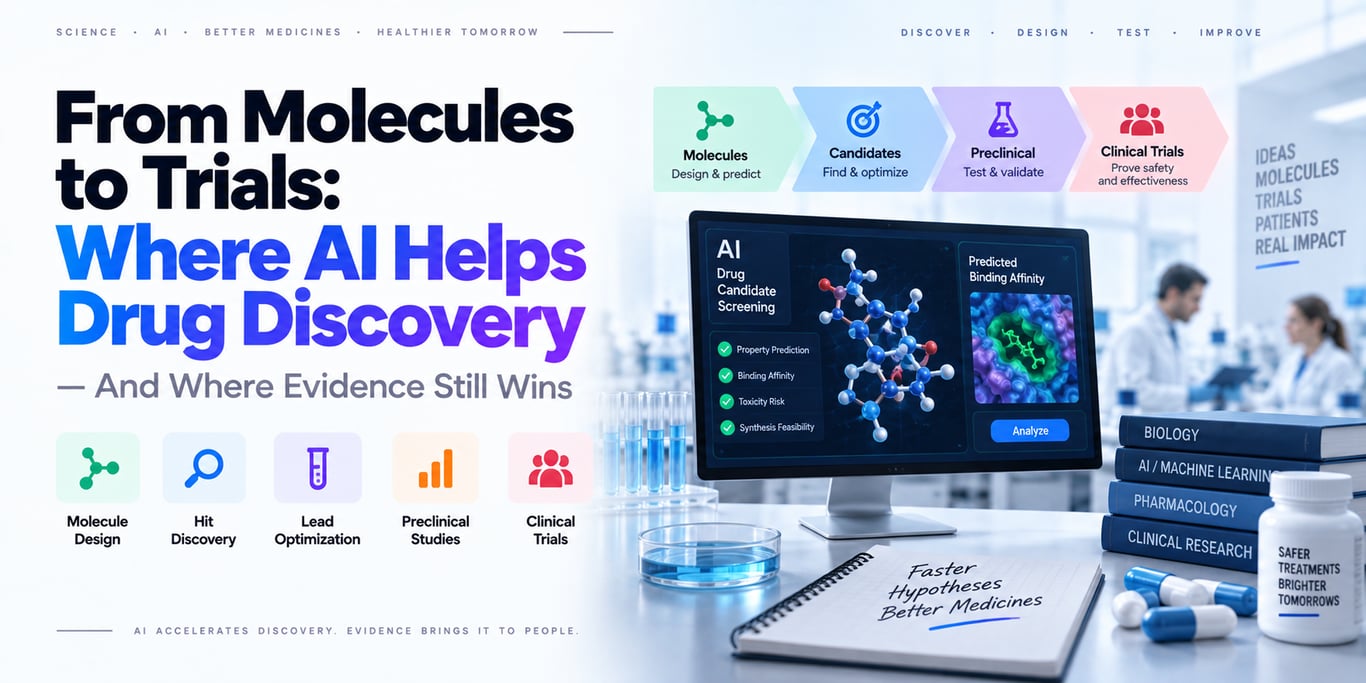
AI is changing drug development, but not in the way hype often suggests.
It does not replace biology, chemistry, toxicology, clinical trials, or regulatory evidence. What it can do is improve search, prediction, prioritization, design, and evidence generation across parts of the drug-development lifecycle.
That distinction is now reflected in regulatory thinking. In January 2026, the FDA and European Medicines Agency published joint principles for good AI practice in drug development. Those principles emphasize human-centric design, clear context of use, risk-based validation, data governance, lifecycle management, and transparent documentation.
The useful mental model is:
AI proposes / predicts / prioritizes
        ↓
experiments generate evidence
        ↓
scientists validate
        ↓
regulated decisions use documented evidence
AI can make the search space smaller and smarter. It does not make the need for evidence disappear.
Drug discovery is a search problem at enormous scale
A pharmaceutical program may need to reason across:
biology
protein structure
chemical space
toxicity
pharmacokinetics
clinical data
manufacturing constraints
AI is useful because many of these stages involve finding patterns or ranking possibilities among huge numbers of candidates.
But different stages require different models and different evidence standards.
1. Target identification
The first question is often:
Which biological target is worth pursuing?
AI can help integrate evidence from:
genomics
proteomics
scientific literature
pathway data
clinical observations
and prioritize relationships worth investigating.
The output is not “the correct drug target.”
It is a ranked hypothesis set for scientists to test.
Association is not causation
Large biomedical datasets contain correlations.
A model can identify that gene X is strongly associated with disease Y.
That does not prove that manipulating gene X will produce a safe therapeutic effect.
Good workflows separate:
predictive signal
→ mechanistic hypothesis
→ experimental validation
AI can improve hypothesis generation; biology decides whether the hypothesis survives.
2. Protein structure prediction changed the starting point
Modern structure-prediction systems have made high-quality predicted protein structures available at unprecedented scale.
This can help researchers reason about:
binding pockets
protein interactions
mutation effects
structure-guided design
But a predicted structure is still a model output.
Experimental structures, biochemical assays, and context-specific validation remain important—especially when fine structural details determine binding behavior.
3. Virtual screening reduces the candidate space
Traditional screening can involve testing huge compound libraries.
AI/ML can rank compounds before physical testing using features such as:
molecular structure
predicted binding
chemical properties
prior assay data
A useful workflow is:
millions of candidates
→ computational filtering / ranking
→ smaller high-priority set
→ laboratory assay
The value is not that the model eliminates experiments.
It makes experiments more focused.
Screening models need realistic negatives
One common dataset problem is that training data contains many known successful compounds and poorly characterized failures.
A model trained on biased examples may learn shortcuts that look excellent on benchmarks but fail when screening novel chemistry.
Evaluation should include:
scaffold splits
out-of-distribution chemistry
temporally newer compounds
truly held-out targets where relevant
Random train/test splits can overestimate real discovery performance.
4. Generative chemistry proposes new molecules
Generative models can propose structures optimized toward objectives such as:
predicted potency
selectivity
solubility
synthetic accessibility
ADMET properties
This sounds like an optimization problem, but the objectives often conflict.
A molecule can be:
potent but toxic
selective but impossible to synthesize
stable but poorly absorbed
Drug design is therefore a multi-objective optimization problem.
Generated does not mean synthesizable
A model can generate a chemically plausible structure that is impractical in the lab.
Production systems should include constraints for:
synthetic feasibility
known problematic groups
chemical stability
manufacturing considerations
and still route promising candidates through medicinal chemists.
Human chemistry expertise remains a critical filter.
5. ADMET prediction is valuable—but uncertainty matters
Before clinical trials, teams care deeply about:
absorption
distribution
metabolism
excretion
toxicity
Models can estimate some of these properties and help prioritize compounds.
The key production requirement is uncertainty awareness.
A prediction should not simply say:
toxicity risk = low
without information about whether the molecule resembles the model's training domain.
Out-of-domain molecules deserve caution
A model can be highly accurate on familiar chemistry and unreliable on a new scaffold class.
Useful checks include:
applicability domain
similarity to training data
confidence / uncertainty estimates
model agreement
Low-confidence predictions should trigger more—not fewer—experiments.
6. AI can help optimize experimental design
AI can assist researchers in deciding:
which compound to test next
which dose range is informative
which experiment reduces uncertainty most
Active-learning loops can look like:
model proposes next experiment
→ lab runs experiment
→ result updates dataset
→ model retrains / re-ranks
This is one of the most compelling patterns because the model and laboratory continuously inform each other.
Keep the experimental loop auditable
Track:
model version
training dataset version
candidate ranking
experiment selected
result
This lets teams understand whether model-driven prioritization actually improved discovery efficiency.
7. Clinical-development AI is a different problem
Once a candidate enters clinical development, the data and risks change.
AI may help with:
patient stratification
biomarker discovery
site selection
protocol analysis
safety-signal detection
But clinical evidence requires clear context of use and validation.
A model that helps identify possible trial participants is not the same as a model making a treatment decision.
Context of use is a core regulatory concept
The FDA/EMA good-AI principles explicitly emphasize defining why the AI is being used and what role it plays.
A good context-of-use statement might say:
Model ranks compounds for laboratory follow-up.
It does not determine candidate advancement independently.
or:
Model identifies potential safety signals for human pharmacovigilance review.
Vague “AI-powered platform” descriptions are not enough for validation.
8. Model-informed drug development already has formal guidance
In June 2026, FDA finalized the ICH M15 guidance on model-informed drug development.
MIDD includes quantitative models used to integrate knowledge and generate evidence around drug development decisions.
The guidance emphasizes planning, model evaluation, documentation, and regulatory communication.
Not every MIDD model is AI, but the broader lesson is important: model-derived evidence needs an explicit assessment framework.
9. Manufacturing is another AI use case
Drug manufacturing produces data from:
process sensors
quality systems
batch records
maintenance systems
AI can support:
anomaly detection
predictive maintenance
process optimization
quality-risk detection
But manufacturing controls should remain deterministic and validated where required.
Do not let a probabilistic model silently change a regulated process without governance.
10. Pharmacovigilance can benefit from language models
Post-market safety teams process large volumes of:
case reports
clinical narratives
literature
safety signals
LLMs can assist with extraction, summarization, and prioritization.
A safe architecture keeps humans responsible for consequential safety decisions while AI reduces the document-processing burden.
Data quality is the center of drug-development AI
Models inherit the limitations of their datasets.
Important concerns include:
assay inconsistency
missing values
measurement error
site differences
selection bias
historical protocol changes
A larger dataset is not necessarily a better dataset.
Data provenance matters.
Preserve scientific provenance
For each important model input, teams should know:
where it came from
how it was measured
how it was transformed
which version was used
This is critical for reproducibility and regulatory-quality evidence generation.
Leakage can make biomedical models look unrealistically good
Common leakage patterns include:
same molecule family in train and test
same patient in multiple splits
future information accidentally included
highly similar assay conditions duplicated
Split strategy should reflect the real future deployment question.
Validation should be risk-based
The FDA/EMA principles explicitly recommend proportionate validation based on model risk and context of use.
A model that proposes literature to read has a different risk level from one generating evidence used directly in a regulatory decision.
Controls should scale accordingly.
Lifecycle management matters because models change
A production model may need updates due to:
new data
new chemistry
new assay technology
new clinical population
software changes
Track:
model version
training data version
validation results
change reason
A model update is part of the scientific lifecycle, not just a software deployment.
Human review is not a weakness
Drug discovery is an excellent example of humans and AI solving different parts of the problem.
AI is strong at:
search
pattern recognition
ranking
generation
high-dimensional optimization
Scientists are responsible for:
mechanistic interpretation
experimental design
causal reasoning
risk judgment
clinical relevance
The best systems combine both.
A realistic AI-assisted discovery loop
Biological hypothesis
      ↓
Target / structure analysis
      ↓
Virtual screening / generation
      ↓
Medicinal-chemistry review
      ↓
Lab assay
      ↓
ADMET / safety models
      ↓
Experimental validation
      ↓
Iterate
The loop continues until evidence supports advancement—or shows the program should stop.
Common mistakes
Treating benchmark accuracy as scientific validation
Deployment questions are harder than benchmark questions.
Using random splits for highly related molecules
This can inflate performance.
Optimizing one molecular property
Drug candidates must satisfy many constraints simultaneously.
Ignoring applicability domain
Predictions far outside training data deserve caution.
Treating generated molecules as discoveries
Generation creates hypotheses; experiments create evidence.
No data/model provenance
Reproducibility becomes impossible.
Production checklist
Before using AI in a drug-development workflow, verify:
- Context of use is clearly defined
- Model risk matches validation rigor
- Training data provenance is documented
- Train/test splits reflect realistic generalization
- Applicability domain / uncertainty is evaluated
- Scientific experts review consequential outputs
- Laboratory / clinical evidence remains authoritative
- Model and dataset versions are traceable
- Lifecycle monitoring and change control exist
- Regulatory documentation requirements are considered early
Final takeaway
AI can improve drug discovery by narrowing search spaces, prioritizing experiments, generating hypotheses, and extracting patterns that humans would struggle to process manually.
But medicine is not approved because a model is confident.
> AI can decide what is worth testing next. Experiments and clinical evidence decide what is true enough to act on.
That distinction is what makes AI useful without confusing prediction with proof.
References and further reading
- FDA — Guiding Principles of Good AI Practice in Drug Development
- EMA — Artificial Intelligence in Medicines
- FDA — Artificial Intelligence for Drug Development
- FDA — ICH M15 General Principles for Model-Informed Drug Development
This article discusses research and engineering practices, not medical or regulatory advice.

Discussion (0)