

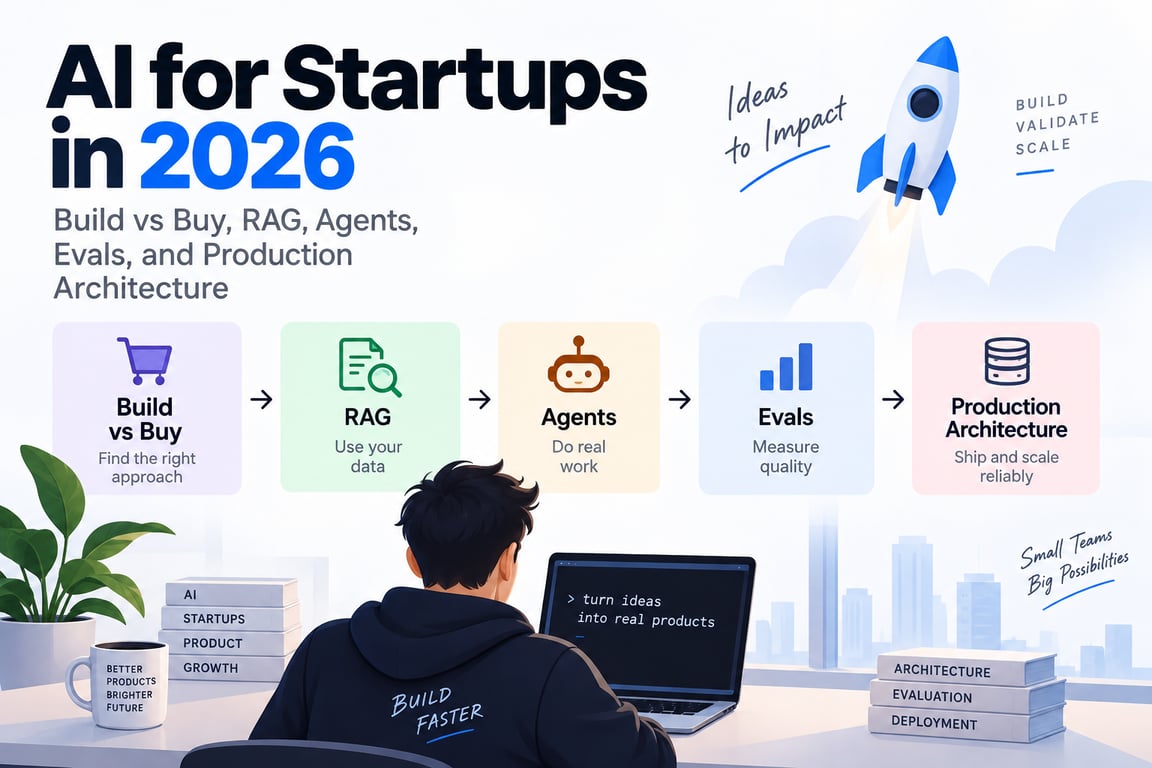
The fastest way for a startup to waste six months in AI is to start with the technology instead of the customer problem.
“Let’s add an agent,” “we need our own model,” or “we should build a RAG platform” are architecture decisions—not product strategies.
A startup wins when AI removes a painful step from a workflow well enough that customers pay for the outcome. The underlying system may be one model call, a retrieval pipeline, a tool-using agent, or a larger workflow. The customer usually does not care.
That leads to a much better starting question:
> What valuable user outcome is currently too slow, too expensive, too manual, or previously impossible—and what is the smallest AI architecture that can improve it reliably?
In 2026, model APIs and agent infrastructure are capable enough that startups can reach sophisticated behavior without training a foundation model or building a giant platform first. The hard parts have shifted toward product workflow, context, tools, evaluation, reliability, distribution, and economics.
Start with the workflow, not the model
Weak startup idea:
AI agent for restaurants
Better product definition:
Turn a restaurant's supplier invoices into verified inventory entries
without staff manually typing line items.
The second statement gives you something measurable.
You can test:
extraction accuracy
time saved
human correction rate
cost per processed invoice
It also helps you decide whether the solution needs an agent at all.
Maybe the correct MVP is:
PDF/image input
→ multimodal model
→ structured output
→ deterministic validation
→ human review
No autonomous agent required.
Find the smallest valuable AI loop
Many useful AI products can start with this:
User input
    ↓
Context / application data
    ↓
Model
    ↓
Structured output
    ↓
Validation
    ↓
Product action / UI
Before adding orchestration, memory, multiple models, vector databases, or subagents, prove that this loop creates value.
Anthropic’s production guidance consistently recommends simple, composable patterns and adding agentic complexity only when the problem benefits from it.
The startup advantage is speed. Do not voluntarily build enterprise architecture before product-market evidence demands it.
Build vs buy: separate differentiation from infrastructure
A startup has limited engineering attention.
Use it where customers can tell the difference.
A useful split is:
Usually buy/use managed APIs first
frontier model inference
speech transcription
image generation
commodity embeddings
basic content moderation
commodity hosted search where appropriate
Usually own in your application
customer workflow
business rules
multi-tenancy
permissions
product UX
domain integrations
evals
proprietary data pipeline
billing/unit economics
Build infrastructure only when it creates real leverage
custom agent runtime at significant scale
specialized retrieval
self-hosting for compliance/economics
proprietary model serving
unique sandbox/execution layer
Owning infrastructure is not the same thing as owning product value.
Do not train a foundation model unless that is truly the company
For most application startups, training a base model is the wrong starting point.
Hosted frontier models let small teams ship capabilities that would have required enormous research organizations only a few years ago.
Your differentiation can live in:
workflow
context
tools
proprietary data
evals
UX
integration depth
trust/reliability
If the model provider improves next month and your product gets better automatically, that can be an advantage—not a weakness.
Pick the smallest model that passes your evals
Using the strongest model for every request is simple but often economically lazy.
OpenAI’s 2026 builder guidance for startups emphasizes smarter model selection and reasoning controls: cheaper model tiers and lower reasoning effort can deliver much better price-performance when the task does not require maximum intelligence.
A startup might route workloads like:
simple classification    → small/cheap model
normal product workflow  → balanced model
hard exception           → stronger reasoning model
The exact provider/model will change over time.
The principle will not:
> Pay for intelligence only where additional intelligence improves the outcome.
Measure cost per successful task, not cost per token
Suppose Model A costs half as much as Model B.
But Model A causes:
2x retries
more human corrections
more failed tool calls
lower conversion
Then it may be the more expensive model for the business.
A better metric is:
Total model + infrastructure + human-review cost
------------------------------------------------
Successfully completed customer tasks
For a support product:
cost per correctly resolved conversation
For document automation:
cost per correctly processed document
For a coding agent:
cost per accepted/verifiable task
Unit economics should reflect the product outcome.
Cache stable context
Many AI applications repeatedly send the same information:
system instructions
tool schemas
company policies
workspace context
Provider prompt caching and application-level caching can materially reduce repeated input cost and latency.
OpenAI’s current GPT-5.6 startup guidance specifically highlights longer prompt-cache lifetimes and deterministic cache breakpoints as useful production economics tools.
But cache only content whose freshness semantics are understood.
Do not cache:
current account balance
current inventory
live authorization state
as if they were stable instructions.
RAG: add it when the model needs private or changing knowledge
RAG is useful when answers depend on information such as:
customer documents
internal knowledge
product documentation
policies
contracts
code repositories
The model should retrieve that information at request time instead of pretending it knows it from training.
Basic architecture:
Documents
→ parse/chunk/index

Question
→ retrieve
→ rerank
→ LLM
→ answer/citation
Do not add RAG by default
If the model already has everything needed in the user request, RAG adds latency and another failure mode.
If the entire knowledge base is small enough to fit economically in context, long-context + caching can sometimes be simpler.
Use retrieval because the data problem requires retrieval—not because every AI architecture diagram has a vector database.
Keep the canonical data outside the vector index
A startup may begin with:
upload document
→ chunks
→ embeddings
→ vector database
Very quickly customers will ask:
Can I edit this document?
Delete it?
Restrict it by team?
See which source produced this answer?
That is why source documents and permission metadata should have a canonical store.
The vector index is usually a derived search structure.
This makes deletion, versioning, and embedding-model migration much easier later.
Tools: use them for live state and actions
RAG answers:
“What does our cancellation policy say?”
A tool answers:
“Is this customer’s subscription currently cancelled?”
A write tool can perform:
“Cancel the subscription now.”
This distinction is crucial for SaaS startups.
Do not embed transactional data every few minutes and pretend the index is your source of truth.
Use narrow tools backed by the real application services.
Good tools are product infrastructure
A tool should represent a useful business capability:
get_order(order_id)
get_invoice(invoice_id)
create_refund_proposal(...)
update_ticket(...)
Avoid giving an application agent broad primitives such as:
execute_any_sql(query)
call_any_url(url, body)
Narrow tools are:
- easier for models to choose
- easier to authorize
- easier to test
- easier to audit
- safer under prompt injection
Your tool surface can become a durable moat because it captures real workflow integration—not just prompting tricks.
Agents: add autonomy only when the next step is genuinely unknown
A normal workflow knows its next step:
extract invoice
→ validate fields
→ save record
Use code.
An agent is valuable when the next step depends on what it discovers:
investigate production incident
→ inspect logs
→ decide which dependency looks suspicious
→ query traces
→ inspect recent changes
→ form/verify hypothesis
That is adaptive reasoning.
A strong startup rule is:
> If you already know the workflow, orchestrate it with code. If the path depends on understanding an ambiguous situation, give the model bounded autonomy.
Single agent before multi-agent
Multi-agent systems are useful when work has real independent boundaries:
parallel research
separate permissions
specialist context
different organizations
But they also multiply:
tokens
latency
traces
prompts
coordination failures
Start with one agent plus good tools.
Add specialists only when your evals show that separation improves quality, speed, security, or context management.
“Multi-agent” is not a product feature customers should pay for by itself.
Memory: only persist information with future value
Startups often add “memory” because it makes demos feel intelligent.
Naive memory:
save every conversation
embed everything
retrieve top 10 every turn
quickly becomes:
- noisy
- stale
- privacy-sensitive
- expensive
Persist things such as:
explicit stable preference
important project decision
durable task state
previous relevant outcome
not every transient tool result.
Your memory system needs:
scope
provenance
expiry
correction
deletion
before it becomes a trustworthy product feature.
Fine-tuning should come after measured failure
Do not fine-tune simply because your product is domain-specific.
First determine whether the problem is:
missing knowledge → RAG
live state       → tools
unclear prompt   → better instructions/examples
bad tool design  → redesign tools
stable repeated behavior failure → fine-tuning candidate
Fine-tuning becomes compelling when the same desired behavior repeats at high volume and prompting has plateaued.
Examples:
proprietary classification taxonomy
stable extraction format
specialized transformation
repeated domain response style
Build an eval set before training so you can prove the fine-tune is actually better.
Evals should exist before scale
Without evals, every model/prompt change is a production experiment on customers.
Start with a small set of real tasks:
20–50 representative cases
covering:
- happy paths
- hard cases
- known failures
- authorization/security cases
- tool failures
Then measure actual task outcomes.
A support agent might track:
correct resolution
correct escalation
correct tool usage
A document extractor might track exact field correctness.
A coding agent might run tests.
The more deterministic the outcome, the less you should rely on subjective LLM graders.
Every production failure should strengthen the eval suite
Suppose a user discovers:
agent created duplicate refund after timeout
Fix the runtime and add a regression case:
ambiguous mutation timeout
→ verify state
→ do not duplicate action
Over time, this becomes one of the strongest startup moats: an eval suite derived from real product usage that competitors do not have.
Reliability is part of the product
AI does not remove ordinary backend failure modes.
You still need:
timeouts
bounded retries
idempotency
cancellation
queues
rate limits
backpressure
fallback UX
For mutations, distinguish:
confirmed success
confirmed failure
unknown outcome
If a payment/refund request times out after the downstream system committed it, retrying blindly can create duplicate effects.
Agents amplify the importance of correct distributed-systems semantics because they may attempt retries on their own.
Asynchronous work belongs in queues/workers
Do not keep a user HTTP request open for a 30-minute agent job if the product does not require it.
Long work can use:
API creates run
→ durable queue
→ worker executes
→ progress events
→ result persisted
→ notification/UI update
This improves:
- resilience
- retry handling
- concurrency control
- deployment safety
AI does not make queues obsolete.
Context is a cost and reliability budget
Do not send everything the application knows into every model call.
Context may include:
system instructions
recent conversation
retrieved docs
memory
tool schemas
tool results
Select what the current decision actually needs.
Too much context means:
- higher cost
- higher latency
- more contradictory information
- lower signal-to-noise
Context engineering is product infrastructure, especially for long-running agents.
Multi-tenant AI requires real isolation
A SaaS startup cannot rely on prompts such as:
“Only access the current tenant’s data.”
Enforce tenant scope in:
RAG query filters
database tools
memory store
object storage
API authorization
agent credentials
The model is not a security boundary.
Cross-tenant retrieval is a data breach, not a hallucination.
Prompt injection should influence architecture early
If your agent reads:
web pages
emails
uploaded documents
support tickets
code
then it processes untrusted natural-language instructions.
Assume some content will try to manipulate the model.
Reduce blast radius with:
- least-privilege tools
- scoped credentials
- deterministic authorization
- approval for high-impact writes
- sandboxed execution
- restricted network/filesystem access when relevant
Do not wait until enterprise customers ask for security architecture.
Privacy becomes harder after you add AI copies everywhere
A single user document may turn into:
object
parsed text
chunks
embeddings
cache
prompt context
trace
Design stable IDs and lifecycle rules early so deletion can propagate later.
If your first enterprise customer asks:
“Delete all data for this workspace.”
and you do not know where the derived embeddings live, you have a product architecture problem.
Do not over-abstract model providers too early
A startup may want:
OpenAI ↔ Anthropic ↔ Gemini ↔ Mistral
behind one universal interface from day one.
A small provider layer is useful, but pretending every model has identical capabilities can hide what makes them valuable:
native tools
structured outputs
reasoning controls
multimodal inputs
sandbox capabilities
Abstract stable application concepts:
provider call
usage accounting
stream events
model capability metadata
while allowing provider-specific features when they create real value.
Fallbacks must be eval-tested
“Provider A failed, send the request to Provider B” sounds easy.
But if the workflow depends on:
specific tool behavior
strict output schema
reasoning mode
provider-hosted tools
the fallback may behave differently.
Test each fallback on the same critical evals.
A fallback that returns an answer but breaks the workflow is not reliability.
Your moat is rarely the prompt
Prompts can be copied.
Model access is available to everyone.
Stronger defensibility usually comes from combinations such as:
proprietary workflow integration
high-quality domain data
human feedback/corrections
production eval dataset
trust/security/compliance
customer distribution
switching costs
reliable automation
An agent connected deeply to the customer’s real workflow can be much harder to replace than a generic chat interface using a clever system prompt.
Data moat does not mean “collect everything”
More customer data is not automatically better.
Useful proprietary data is data that improves a specific outcome and can be used lawfully and safely.
Examples:
human corrections to extraction
resolved support outcomes
workflow success/failure labels
approved domain knowledge
These can improve:
- evals
- retrieval
- ranking
- future fine-tuning
while still following minimization and retention rules.
Build human review into the early product
Human review is not embarrassing in an AI MVP.
It gives you:
- safer launch
- labeled failure data
- insight into customer expectations
- a path for ambiguous cases
A useful rollout is:
Phase 1: AI drafts, human approves
Phase 2: low-risk cases automate
Phase 3: read-only tools
Phase 4: reversible writes
Phase 5: higher-impact automation with explicit policy
Do not grant full autonomy before you understand the failure distribution.
A sensible startup architecture
For many AI SaaS products, a strong early architecture looks like:
Web / App
   │
   ▼
Product Backend
- auth
- tenants
- billing
- business state
   │
   ▼
AI Runtime / Service
- provider client
- context builder
- structured outputs
- tool dispatch
- budgets
   │
   ├── RAG (only if needed)
   ├── Memory (only if needed)
   └── Domain tools
          │
          ▼
   Existing authoritative services

Async queue / workers for long tasks
Observability + eval pipeline around everything
You can build this as one deployable service initially if scale is small.
Logical separation does not require microservices on day one.
MVP roadmap
Stage 1 — Prove the user outcome
one model
one workflow
manual review
basic structured output
Measure whether customers care.
Stage 2 — Make it reliable
Add:
evals
validation
timeouts
logging/tracing
failure UX
Stage 3 — Connect real systems
Add read-only tools and RAG where evidence shows they are needed.
Stage 4 — Add safe actions
Use narrow write tools, authorization, idempotency, approvals, and postcondition verification.
Stage 5 — Optimize economics
Tune model routing, reasoning effort, prompt caching, context size, batching/background execution.
Stage 6 — Add advanced architecture only after measurement
Potentially:
long-term memory
fine-tuning
multi-agent orchestration
self-hosted inference
dedicated vector infrastructure
Complexity should arrive because the product earned it.
Metrics founders should actually watch
Task success rate
Did the user’s requested outcome complete correctly?
Human correction rate
How often does someone need to fix AI work?
Time to successful outcome
Not merely model latency.
Cost per successful task
Include retries and human review.
Failure taxonomy
Track categories such as:
retrieval miss
wrong tool
invalid arguments
hallucinated fact
provider failure
policy block
user correction
Retention / product value
Does the AI capability make customers return or pay?
A technically brilliant agent with no retention is still a bad startup product.
Common startup mistakes
Building an AI platform before building a product
You do not need your own general-purpose agent framework to validate one workflow.
Using the frontier model everywhere
Route by task difficulty and measure successful-task economics.
Adding a vector database because RAG is fashionable
Only add retrieval if external knowledge is actually missing.
Adding multi-agent before one agent works
Coordination complexity will hide product problems.
Fine-tuning too early
Fix prompts, context, retrieval, tools, and evals first.
No eval suite
Then every deployment is guesswork.
Allowing unrestricted tools
Agent autonomy without permissions is a security incident waiting for a trigger.
Treating AI provider choice as the moat
Customers care about outcomes and workflow integration, not which logo is behind the API.
Founder / engineering checklist
Before scaling an AI startup, verify:
- One specific user outcome is clearly defined
- The simplest model workflow has been tested before agent complexity
- Build-vs-buy decisions prioritize differentiation
- Real workload evals exist
- Model tier/reasoning effort is optimized from data
- Cost per successful task is measured
- RAG exists only for a real knowledge-retrieval need
- Live operational data comes from authoritative tools
- Business invariants remain deterministic
- Long-running work has durable execution/queue semantics
- Tool permissions are least-privilege
- Multi-tenant isolation exists below the prompt layer
- Human review/escalation paths exist
- Privacy/deletion includes AI-derived copies
- Provider fallbacks are actually eval-tested
- Production failures become regression evals
- Advanced features are added because metrics justify them
Final takeaway
The best AI startup architecture is rarely the most sophisticated one.
Start with a painful workflow and the smallest model loop that creates measurable value. Use hosted models instead of training infrastructure unless model ownership is truly core. Add RAG for external knowledge, tools for live state, agents for adaptive multi-step work, memory for proven continuity needs, and fine-tuning for stable behavior that evals show cannot be solved well enough otherwise.
Then optimize around the things customers actually experience:
correctness
speed
trust
workflow integration
reliability
unit economics
> Your startup should own the customer problem and the learning loop around it—not every layer of the AI stack.
Models will keep changing. A product with deep workflow integration, proprietary evals, trusted data boundaries, and measurable customer outcomes can get stronger every time they do.
References and further reading

Discussion (0)