

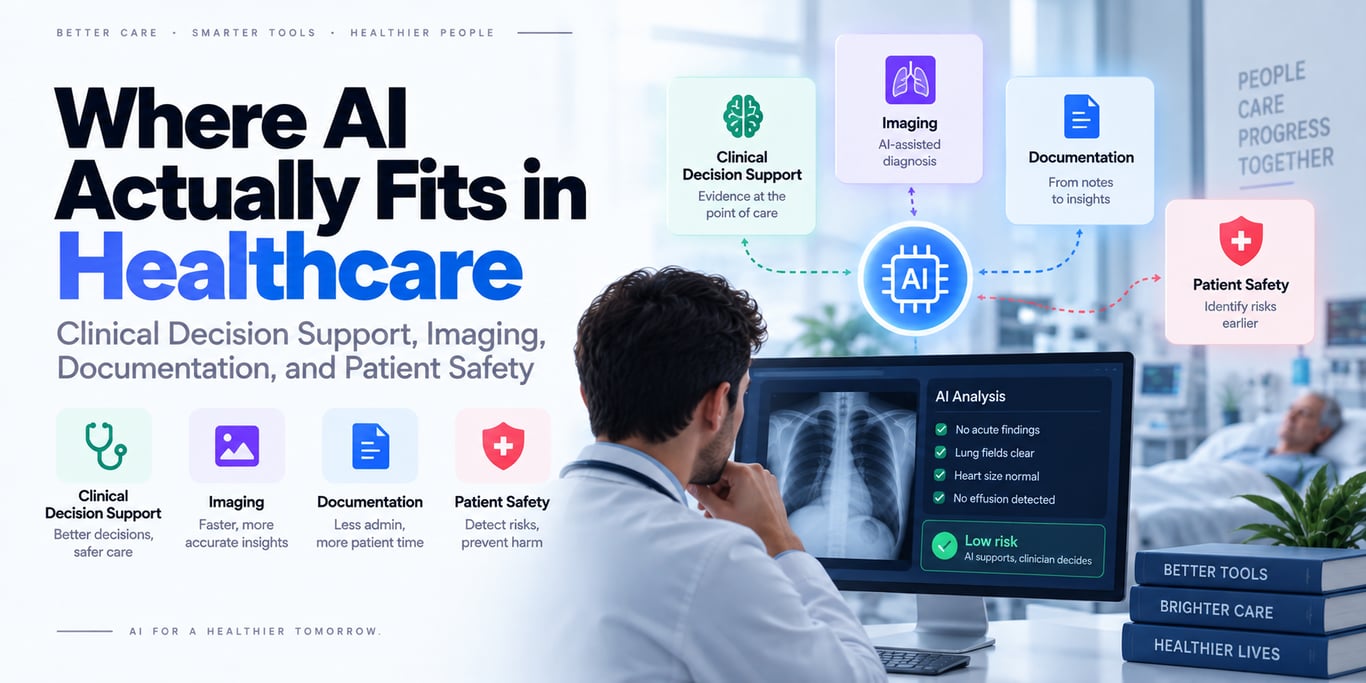
Healthcare AI is easiest to understand when you stop treating it as one category.
A radiology model that detects findings in an image, a clinical documentation assistant, a patient-facing chatbot, and an autonomous workflow agent all use AI—but they have very different evidence requirements, failure modes, regulatory exposure, and acceptable levels of autonomy.
That matters because the wrong architecture can turn a useful assistant into a safety problem.
A practical way to map the space is:
prediction / detection
→ medical imaging, risk scoring, signal analysis

language / multimodal understanding
→ documentation, summarization, extraction

retrieval
→ policies, guidelines, patient education

tools
→ live patient / scheduling / operational data

agents
→ multi-step workflows with explicit controls
The strongest healthcare systems usually combine these layers rather than asking one general-purpose model to do everything.
Start with the clinical or operational job
Do not begin with:
Where can we add an LLM?
Begin with:
Which workflow is slow, error-prone, repetitive, or information-heavy?
Examples:
- radiology prioritization
- clinical documentation
- discharge-summary preparation
- patient scheduling
- coding and administrative review
- inbox triage
- research / guideline retrieval
- patient education
Each one deserves a different risk and architecture decision.
1. Medical imaging is already a major AI category
The FDA maintains a public list of AI-enabled medical devices authorized for marketing in the United States. The list includes many radiology products, along with devices in areas such as cardiology, neurology, anesthesiology, and other specialties.
The important lesson is not simply that “AI is being used in medicine.”
It is that medical AI becomes a product only when its intended use, evidence, performance, and regulatory pathway are clear.
A model that assists image segmentation is fundamentally different from a general chatbot discussing symptoms.
Medical-device AI needs lifecycle thinking
Model performance is not a one-time number.
Production concerns include:
input distribution changes
scanner / device variation
population differences
software updates
model updates
workflow integration
FDA guidance on AI-enabled device software reflects this lifecycle reality: manufacturers need to think about planned changes, validation, cybersecurity, monitoring, and how updates affect the intended use.
A model that passed an evaluation two years ago can still regress when the operating environment changes.
2. Clinical decision support should support—not obscure—judgment
Decision-support systems can help clinicians:
surface relevant evidence
flag possible risk
prioritize cases
summarize longitudinal data
But the system should make clear what information supports the recommendation and what the model cannot know.
A useful design avoids:
model says “high risk”
→ clinician sees no evidence
and instead provides:
risk signal
+ source data
+ relevant history
+ explanation of what the system evaluated
The goal is to improve decision quality, not replace accountability with an opaque score.
3. Documentation is one of the clearest generative-AI opportunities
Clinicians spend enormous time producing and cleaning up text.
AI can assist with:
visit summaries
draft notes
handoff summaries
problem-list extraction
patient instructions
coding support
This is a strong use case because the output can often be reviewed before it becomes part of the authoritative record.
The safest pattern is:
conversation / source record
→ AI draft
→ structured validation
→ clinician review
→ final record
AI reduces typing; the clinical team still owns the record.
Documentation systems should preserve provenance
A generated note should not make it impossible to tell:
what came from the source conversation
what came from structured EHR data
what the model inferred
what the clinician edited
For higher-risk systems, auditability matters.
Keeping source references or change history can make review far easier.
4. Patient-facing assistants need narrower scope than most demos imply
A health chatbot can be useful for:
appointment preparation
administrative FAQs
medication reminders
patient education
navigation to the right service
But the moment the system starts giving diagnosis-like or treatment-specific advice, risk increases dramatically.
WHO's guidance on large multimodal models in health emphasizes governance, safety, equity, human oversight, and careful evaluation rather than assuming that general-purpose models are clinically reliable by default.
Separate education from diagnosis
A patient assistant can answer:
What does this hospital's colonoscopy preparation guide say?
by retrieving an approved source.
That is different from:
Based on my symptoms, what disease do I have?
The second question asks the model to perform clinical reasoning over incomplete information.
Product boundaries should make this distinction explicit.
5. RAG is useful for approved healthcare knowledge
Retrieval-Augmented Generation can ground answers in:
hospital policies
patient education materials
approved clinical pathways
formulary information
internal SOPs
A good architecture is:
user / clinician question
→ permission-aware retrieval
→ approved sources
→ answer with citations
The model should not quietly mix retrieved evidence with old model memory when the question requires an authoritative source.
Source freshness matters
Healthcare guidance changes.
Your retrieval layer should track:
source owner
version
publication / effective date
status = active / retired
An old policy that is semantically relevant can still be dangerous.
Retrieval quality includes authority and freshness, not only embedding similarity.
6. Live patient state belongs in tools, not RAG
RAG is not the right way to answer:
Has this patient's lab result posted?
What is the latest appointment time?
Is this prescription currently active?
Those questions require current transactional systems.
Use narrow, authorized tools against systems of record.
Example:
get_latest_lab_result(patient_id, test_code)
rather than giving the model direct database access.
Minimize tool output
If the model needs one lab result, do not expose the complete medical record.
Narrow tool output reduces:
- privacy exposure
- token use
- model confusion
- accidental disclosure
A healthcare agent should receive the minimum necessary context for the current task.
7. Healthcare agents need bounded autonomy
An agent can coordinate multiple steps:
review referral
→ check missing documents
→ retrieve relevant policy
→ prepare scheduling recommendation
→ request human action
This can be valuable operationally.
But write-capable healthcare agents need much stronger controls than a summarization assistant.
Useful controls include:
read/write permission separation
human approval
idempotency
audit trail
postcondition verification
Human oversight should happen at the right boundary
Do not make a clinician approve every low-risk text transformation.
Do require human authority for decisions where the consequence is material.
Examples:
clinical diagnosis / treatment change
high-risk patient communication
medication-related action
sensitive record modification
The exact boundary depends on the product and jurisdiction.
8. Hallucination is only one failure mode
Healthcare AI can fail because of:
wrong source
stale source
missing patient context
incorrect extraction
unsafe confidence
cross-patient data leakage
wrong tool call
population shift
A hallucination test alone does not prove the system is safe.
Evaluate the complete workflow.
Clinical-quality evals should be task-specific
For an extraction system, measure:
field-level accuracy
missing-value behavior
For a retrieval assistant:
retrieval recall
citation accuracy
answer groundedness
For a tool-using agent:
correct tool
correct arguments
correct permissions
safe stop / escalation
For a medical device, evidence and evaluation must match its intended use and regulatory expectations.
9. Bias and health equity require population-aware testing
Healthcare datasets can underrepresent populations, devices, sites, or disease presentations.
A system should not only report one overall accuracy score.
Where relevant, test performance across meaningful subgroups and deployment settings.
The important question is:
Who does this system work well for—and where does it fail?
WHO's guidance repeatedly emphasizes equity and governance as core health-AI concerns.
Deployment context can matter as much as model accuracy
A tool that works well in a tertiary hospital may not transfer cleanly to a small clinic with:
different equipment
different workflows
different patient population
lower data quality
External validation and monitoring matter.
10. Privacy architecture must include derived AI data
One clinical note can turn into:
raw source
parsed text
embedding
retrieval cache
prompt context
trace
model output
Privacy and deletion policies need to account for those derived copies.
Do not assume an embedding or prompt log is outside the patient-data lifecycle.
Raw prompt logging should be a deliberate choice
Clinical prompts can contain highly sensitive data.
Often, observability can work with metadata such as:
run_id
model
latency
tool name
status
error class
without retaining complete patient content.
If full content is logged for debugging or evaluation, access and retention should be much stricter.
11. Cybersecurity matters because AI is connected software
Healthcare AI may connect to:
EHRs
imaging systems
cloud APIs
MCP / external tools
patient portals
A prompt-injection or tool-abuse issue can become a security event if the agent has broad privileges.
Security architecture should include:
least privilege
network controls
input/output validation
secrets isolation
approval gates
12. Start assistive before autonomous
A safe maturity path is:
1. summarization / draft
2. read-only retrieval
3. read-only live tools
4. proposed action
5. bounded write with approval
This gives the organization real evidence about quality before expanding authority.
A practical architecture
Clinician / Patient
        │
        ▼
Authenticated Application
        │
        ▼
Context Builder
 ├── approved RAG
 ├── narrow live tools
 └── minimum necessary data
        │
        ▼
AI Model / Agent
        │
        ▼
Validation + Policy
 ├── schema checks
 ├── authorization
 ├── risk boundary
 └── human review when needed
        │
        ▼
Clinical / Operational System of Record
        │
        ▼
Audit + Monitoring
The model assists reasoning. The healthcare system remains responsible for truth, authority, and accountability.
Production checklist
Before shipping healthcare AI, verify:
- Intended use is explicit
- Product is classified correctly as assistive, decision-support, device, or operational workflow
- Authoritative knowledge sources are versioned
- Live patient state comes from trusted systems
- Data access follows least privilege
- Output is structured where machines consume it
- Human review boundaries are explicit
- Relevant subgroups / deployment settings are evaluated
- Hallucination, retrieval, tool, and privacy failures are tested separately
- Sensitive prompt / trace retention is minimized
- Model and software updates trigger regression evaluation
- Incident and rollback procedures exist
Final takeaway
Healthcare AI is most useful when each system has a specific role.
Use specialized models for prediction and detection. Use language models for synthesis and documentation. Use RAG for approved knowledge. Use tools for live patient state. Use agents only when adaptive multi-step workflow control creates real value.
The more authority the system receives, the more deterministic controls, evidence, monitoring, and human oversight it needs.
> The goal is not maximum automation. It is reliable assistance at the right clinical or operational boundary.
References and further reading
- FDA — Artificial Intelligence-Enabled Medical Devices
- FDA — Digital Health Guidance Documents
- WHO — Ethics and Governance of AI for Health: Large Multimodal Models
- WHO — Artificial Intelligence for Health
This article discusses software architecture and governance, not medical advice.

Discussion (0)