

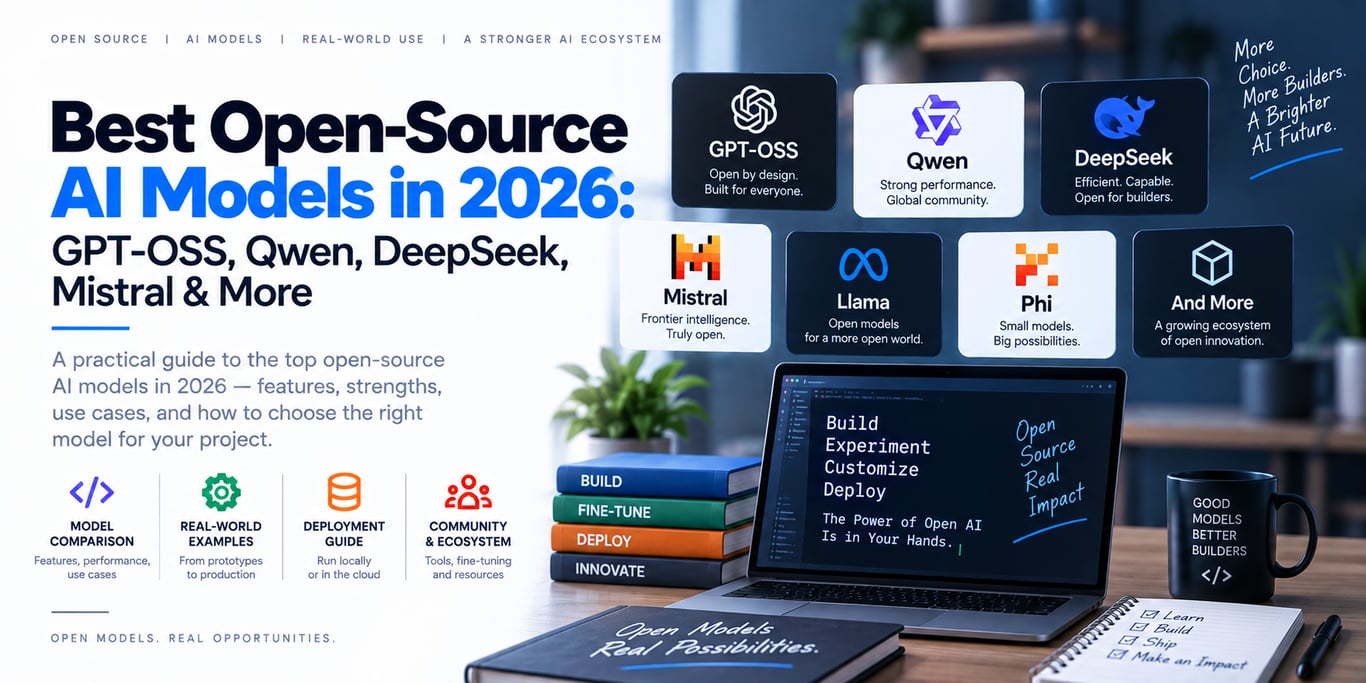
Updated September 2026
Open AI models have changed from an interesting alternative into a serious production option.
Today you can run capable reasoning, coding, multimodal, agentic, and domain-specific models on infrastructure you control. You can keep sensitive prompts inside your own network, fine-tune models for a specific workflow, serve them behind an OpenAI-compatible API, run smaller models on laptops or edge devices, and avoid tying every AI feature to one hosted provider.
But there is a problem with the phrase “open-source AI model.”
The industry uses it loosely.
Some models publish weights under Apache 2.0 or MIT. Some publish weights under custom community licenses. Some expose inference code but not the training recipe or data information. And according to the Open Source Initiative's Open Source AI Definition, merely allowing someone to download model weights is not automatically enough to make an entire AI system open source.
So this guide does two things:
- explains what “open” actually means in AI;
- compares the model families that matter to developers in 2026 and shows how to choose, deploy, evaluate, fine-tune, and operate them without turning your infrastructure into a science project.
The short version
If you just need the practical answer:
| Model family | License posture | Strong fit | Important caveat |
|---|---|---|---|
| OpenAI gpt-oss | Apache 2.0 open weights | Reasoning, tool use, agents, self-hosting | Text-only; large variant needs serious hardware |
| Qwen | Apache 2.0 for open-weight releases | Coding, multilingual work, agents, broad model-size choice | Many variants exist; evaluate the exact checkpoint you plan to serve |
| Mistral | Many releases under Apache 2.0; some under modified MIT | Enterprise self-hosting, multimodal, coding, efficient inference | License differs by model, so check the exact card |
| Gemma | Gemma 4: Apache 2.0 | Compact multimodal deployments, laptops, servers, edge | Smaller models trade capability for lower compute |
| DeepSeek | R1 and V3.2-Exp weights/code under MIT | Reasoning, research, long-context experimentation | V3.2-Exp is explicitly experimental |
| Llama 4 | Meta Llama 4 Community License | Large ecosystem, multimodal apps, long context | Custom license; do not assume Apache/MIT-style freedom |
| Kimi K2 | Modified MIT | Agentic and coding workloads | Extra attribution requirement applies at very large commercial scale |
There is no universal “best” open model.
The best production choice is the model that passes your evals at an acceptable latency, memory footprint, throughput, license, and operating cost.
What does “open-source AI” actually mean?
Traditional open-source software is relatively straightforward: source code is available under a license that gives people meaningful rights to use, inspect, modify, and redistribute it.
AI adds more pieces:
training data / data information
        ↓
training + filtering code
        ↓
model architecture
        ↓
model parameters / weights
        ↓
inference code
        ↓
post-training / alignment
        ↓
serving stack
A company can publish only the weights and still call the result “open.” That is useful, but it is not the same thing as publishing the information and artifacts necessary to study and reproduce how the system was created.
The Open Source Initiative's Open Source AI Definition 1.0 says an open-source AI system should grant the freedoms to use, study, modify, and share the system, while providing the preferred form for modification—including relevant code, parameters, and sufficient data information.
That gives us a much more useful vocabulary.
Open source
The strongest meaning: the system provides the freedoms and materials needed to use, study, modify, and share it under appropriate open terms.
Open weights
The trained weights are downloadable and can usually be run on your own infrastructure.
This is what many popular “open-source LLMs” actually are.
Source-available or community-licensed
Weights and/or code are available, but a custom license adds restrictions or conditions that differ from standard permissive licenses such as Apache 2.0 or MIT.
For engineering decisions, the exact license matters more than the marketing label.
The major open model families in 2026
1. OpenAI gpt-oss: strong open-weight reasoning for self-hosted systems
OpenAI released gpt-oss-120b and gpt-oss-20b as open-weight reasoning models under the Apache 2.0 license.
They are designed for workloads such as:
- multi-step reasoning
- tool use
- structured outputs
- agentic workflows
- local or private-cloud inference
- fine-tuning and adaptation
OpenAI states that gpt-oss-120b can run on a single 80 GB GPU, while gpt-oss-20b is designed to run with roughly 16 GB of memory, making the smaller model practical for substantially more developers.
The models are text-only, so they are not a direct replacement for multimodal models when your application needs native image, audio, or video understanding.
Good fit
Use gpt-oss when you want a self-hosted reasoning model with a permissive license and your workload benefits from structured reasoning or tool use.
Examples:
coding agents
internal research agents
private enterprise assistants
tool-using automation
structured extraction
reasoning-heavy backend workflows
Do not choose it only because it is free to download
The weights may be free, but serving is not.
You still pay for:
GPU capacity
idle capacity
storage
networking
monitoring
redundancy
engineering time
model upgrades
The right comparison is total cost of ownership, not “API token price versus zero.”
2. Qwen: one of the broadest open-weight ecosystems
Alibaba's Qwen family has become especially useful because it spans many sizes and workloads instead of forcing every problem onto one giant model.
By 2026, the public Qwen line has progressed through Qwen3 into newer Qwen3.5, Qwen3.6, and Qwen3.8 releases. Qwen's official repositories make open-weight variants available for local or server deployment, with Apache 2.0 used across the open-weight line.
Qwen is particularly relevant for:
- coding
- multilingual applications
- tool use
- long-context workloads
- agentic systems
- compact local models
- large MoE deployments
The Qwen ecosystem also includes specialized work such as embeddings, reranking, speech recognition, safety models, and agent research.
Why Qwen is interesting architecturally
A production team often does not need one model for every request.
You might instead route work like this:
simple classification      → small Qwen model
normal chat / extraction   → medium model
coding                     → coding-focused checkpoint
complex reasoning          → larger reasoning model
embeddings                 → embedding-specific model
safety                     → guard model
That can be more economical than sending every request to the largest available checkpoint.
Good fit
Qwen is worth evaluating when you want a broad range of model sizes, strong coding/multilingual capability, and flexibility to build a multi-model serving architecture.
3. Mistral: open models built with enterprise deployment in mind
Mistral remains one of the most important open-model vendors because it combines model releases with serious deployment tooling and enterprise positioning.
Mistral 3 introduced open models across several sizes, including Mistral Large 3 and smaller dense models under Apache 2.0.
In 2026, Mistral Small 4 brought reasoning, multimodal input, coding, and agentic capability into one Apache 2.0 model family.
Mistral also releases specialized models such as Devstral for software engineering and Shieldstral for safety classification. However, licensing is model-specific: most Mistral open models use Apache 2.0, while certain releases use a modified MIT license.
Good fit
Mistral is especially interesting for:
- enterprise self-hosting
- private deployments
- multimodal assistants
- coding agents
- European data-sovereignty requirements
- teams that want both open models and commercial support paths
License lesson
Never write this in an architecture document:
Vendor: Mistral
License: open source
Write the exact model and exact license instead:
Model: Mistral Small 4
License: Apache 2.0
Model families change faster than legal assumptions.
4. Gemma 4: compact multimodal models from Google DeepMind
Google DeepMind's Gemma 4 is a family of open models released under Apache 2.0.
Gemma 4 includes multiple dense and Mixture-of-Experts sizes and supports multimodal input. Google documents text and image support across the family, with audio support on selected variants, plus context windows up to 256K tokens and multilingual support across more than 140 languages.
This makes Gemma especially interesting when you need useful capability without automatically jumping to a massive data-center model.
Good fit
Consider Gemma for:
- local assistants
- compact multimodal applications
- document/image understanding
- on-device or edge-oriented experiments
- developer tools that need a smaller footprint
- applications where a 100B+ model would be operationally absurd
Bigger is not always better
If a 12B or 31B model solves the task reliably, deploying a huge MoE model may increase cost and complexity without improving the user experience.
Production model selection should optimize for task success per unit of latency and cost, not parameter count.
5. DeepSeek: reasoning and architecture research with permissive model releases
DeepSeek changed the open-model conversation by showing how competitive reasoning capability could be released with permissive licensing.
DeepSeek-R1 code and model weights are available under MIT terms, including commercial use and derivative work.
DeepSeek has also published DeepSeek-V3.2-Exp, an explicitly experimental model focused on sparse attention and more efficient long-context inference. Its repository and weights are also MIT licensed.
Good fit
DeepSeek models are interesting for:
- reasoning research
- coding and technical workloads
- distillation experiments
- teams studying MoE architectures
- long-context inference research
- organizations that want permissive model licensing
Experimental means experimental
Do not read “newer” as “safer production default.”
If a model is labeled experimental, validate:
- output quality
- serving stability
- memory behavior
- tokenizer compatibility
- tool-call reliability
- quantization support
- framework support
- regression behavior
before putting it on a critical production path.
6. Llama 4: huge ecosystem, but understand the license
Meta's Llama family remains one of the largest model ecosystems in the world.
Llama 4 Scout and Maverick provide multimodal capabilities and Mixture-of-Experts architectures. Meta advertises Llama 4 Scout with a very large context window and distributes the models under the Llama 4 Community License Agreement.
That last sentence matters.
Llama is widely described as “open source,” but its model license is a custom community license rather than Apache 2.0 or MIT.
This does not make Llama unusable. Far from it—the ecosystem is enormous.
It means your legal and engineering teams should treat “downloadable weights” and “permissively open licensed” as separate questions.
Good fit
Llama is worth evaluating when ecosystem maturity matters:
- broad inference-engine support
- quantized model availability
- fine-tuning ecosystem
- community checkpoints
- multimodal applications
- integration examples and tooling
Just check the actual license before building commercial assumptions around it.
7. Kimi K2: powerful open-weight agentic model with a modified MIT license
Moonshot AI's Kimi K2 is another important open-weight family for agentic and coding-style workloads.
Its code and model weights use a Modified MIT License.
The modification is important: if a product using Kimi K2 exceeds specified very-large-scale thresholds—more than 100 million monthly active users or more than $20 million in monthly revenue—the license requires prominent “Kimi K2” display in the product UI.
Most startups will never hit that threshold, but it illustrates an important rule:
> Never infer commercial rights from the words “open model.” Read the license.
Dense models vs Mixture-of-Experts: the difference matters
A dense model activates essentially all model parameters for each token.
A Mixture-of-Experts model may contain a very large total parameter count while activating only a subset of experts for each token.
Example conceptually:
Dense 32B
→ roughly all 32B parameters participate per token

MoE 200B total / 20B active
→ router selects a subset of experts
→ compute resembles a much smaller active model
→ storage and memory architecture can still be substantial
This is why comparing models only by total parameter count is misleading.
For infrastructure planning, care about:
- total weight memory
- active parameters
- KV-cache size
- context length
- quantization format
- tensor/pipeline/expert parallelism
- tokens per second
- concurrent requests
How much memory does an open model need?
A useful first approximation for raw weight storage is:
memory ≈ parameter_count × bytes_per_parameter
Typical raw formats:
| Format | Approx. bytes per parameter |
|---|---|
| FP32 | 4 |
| FP16 / BF16 | 2 |
| INT8 | ~1 |
| 4-bit | ~0.5 |
So a 20B model at 4-bit is roughly 10 GB of raw weight data before runtime overhead.
A 70B model at 4-bit is roughly 35 GB before overhead.
Real serving memory is higher because you also need room for:
- KV cache
- temporary activations
- CUDA/runtime allocations
- batching
- tokenizer and server processes
- multimodal encoders where applicable
And context length can dramatically change KV-cache requirements.
That is why the sentence “the model fits in VRAM” does not automatically mean “the model can serve production traffic in that VRAM.”
Quantization: how smaller hardware runs bigger models
Quantization stores model weights at lower numerical precision.
Instead of FP16/BF16, you may serve a model in 8-bit, 6-bit, 5-bit, 4-bit, or even lower formats depending on the inference engine and model.
Benefits:
- lower memory use
- cheaper GPUs
- easier local inference
- higher deployment density
Trade-offs:
- possible quality degradation
- model-specific sensitivity
- slower kernels for some formats/hardware
- reduced numerical headroom
- tool/reasoning regressions that generic benchmarks may miss
Do not select a quantization because somebody on a leaderboard said “Q4 is basically the same.”
Run the same production eval suite on the quantized checkpoint you intend to ship.
The serving stack: Ollama, llama.cpp, vLLM, SGLang, or Transformers?
The model is only half the system.
You also need an inference runtime.
Ollama
Good for:
- local development
- fast experimentation
- desktop workflows
- developers who want minimal setup
It is excellent for proving a product idea locally before building a production serving layer.
llama.cpp
Excellent for:
- CPU inference
- Apple Silicon
- GGUF quantized models
- CPU/GPU hybrid inference
- laptops and edge devices
- environments where a heavy Python/CUDA serving stack is unnecessary
The project supports a wide variety of backends and quantization levels.
vLLM
A strong production choice for high-throughput GPU serving.
vLLM exposes OpenAI-compatible APIs, including modern chat and response-style interfaces, which makes it easier to swap a self-hosted model behind an application already designed around an OpenAI-like client abstraction.
One security detail is worth noting: current vLLM documentation warns that its built-in API-key option does not protect every endpoint, so internet-facing deployments should be placed behind a properly configured reverse proxy/API gateway instead of assuming one CLI flag has secured the whole server.
SGLang
Worth evaluating for high-performance serving, structured generation, tool-heavy workloads, and newer reasoning/MoE models that receive early runtime support.
Transformers
Best when you need maximum flexibility for:
- research
- custom model code
- fine-tuning
- training workflows
- experimentation
For high-concurrency production inference, a specialized serving engine is usually more appropriate than a raw research loop.
A simple production architecture
A clean self-hosted architecture can look like this:
Clients
   │
   ▼
API Gateway / Auth / Rate Limits
   │
   ▼
AI Router
   │
   ├── small fast model
   ├── reasoning model
   ├── embedding model
   └── external API fallback
   │
   ▼
Tool / RAG / Agent Runtime
   │
   ├── vector or search layer
   ├── application APIs
   └── protected tools
The important part is that the model should not own the application architecture.
Keep authentication, rate limits, permissions, audit logs, tool authorization, retries, and business logic outside the model.
Open model vs hosted API: which is actually cheaper?
Open models can be cheaper—but not automatically.
Consider two workloads.
Workload A: small startup, unpredictable traffic
low request volume
bursty usage
small engineering team
no GPU operations experience
A hosted API is often cheaper overall because you pay only when requests arrive and the provider operates the infrastructure.
Workload B: large predictable internal workload
constant inference traffic
sensitive data
stable model requirement
high monthly token volume
GPU/platform team already exists
Self-hosting may become economically and operationally attractive.
A realistic cost model is:
Open-model TCO =
GPU compute
+ idle capacity
+ redundancy
+ storage
+ networking
+ inference engineering
+ observability
+ upgrades
+ security
+ incident response
Compare that with:
Hosted-model TCO =
API usage
+ provider dependency
+ data/compliance constraints
+ rate limits
+ switching cost
The cheapest token is not necessarily the cheapest system.
Why companies self-host open models
1. Data control
Prompts, retrieved documents, and outputs can stay inside infrastructure you control.
This can matter for:
- internal company data
- private code
- legal documents
- regulated workloads
- customer isolation
- regional data residency
2. Predictable model behavior
A hosted provider may update a model behind the same product name.
Self-hosting lets you pin:
exact weights
exact tokenizer
exact prompt template
exact quantization
exact runtime version
That is valuable for reproducibility.
3. Fine-tuning
Open weights allow teams to adapt the model directly using techniques such as LoRA or full/partial fine-tuning where appropriate.
4. Offline or edge inference
Factories, private networks, developer laptops, mobile devices, and remote environments may need inference without a permanent external API dependency.
5. Avoiding provider lock-in
An OpenAI-compatible internal serving layer can make it easier to route between multiple model families instead of coupling product code to one vendor.
When you should NOT self-host
Self-hosting is the wrong answer when:
- you have low volume
- your team has no GPU operations experience
- you need the strongest frontier model more than infrastructure control
- model quality changes rapidly and you always want the newest managed release
- uptime requirements exceed what your team can operate
- compliance is easier with an established managed provider
- the workload is too bursty to keep GPUs utilized
Do not build an AI platform team just to avoid a small API bill.
RAG or fine-tuning?
This is one of the most commonly confused decisions.
Use RAG when the problem is knowledge
If the model needs information that is:
- private
- frequently changing
- tenant-specific
- document-based
- too large to place permanently in the prompt
then retrieval is usually the first tool to reach for.
Example:
User question
    ↓
Search private docs
    ↓
Retrieve relevant passages
    ↓
Model answers from retrieved context
Fine-tune when the problem is behavior
Fine-tuning is useful when you need the model to learn patterns such as:
- domain-specific output style
- classification behavior
- structured response patterns
- specialized task execution
- preferred terminology
- tool-use behavior
Do not fine-tune a model simply to teach it this month's company documentation. That knowledge will become stale.
A useful rule:
> RAG changes what the model knows at request time. Fine-tuning changes how the model behaves.
Many strong systems use both.
How to evaluate an open model correctly
Public benchmarks are useful for discovery.
They are not your production acceptance test.
Build an evaluation set from the work your users actually perform.
For a coding assistant:
real repository bugs
multi-file edits
test failures
refactoring tasks
tool calls
long-session consistency
For a support assistant:
real policy questions
ambiguous tickets
retrieval quality
citation correctness
refusal cases
customer-specific terminology
Measure at least:
| Metric | Why it matters |
|---|---|
| Task success | Did the user actually get the correct result? |
| Hallucination/error rate | Is the model inventing facts or actions? |
| Tool-call success | Can it reliably use your functions? |
| Structured-output validity | Does JSON/schema output stay valid? |
| Latency | Does the product feel fast? |
| Tokens/second | Is serving efficient? |
| Memory | How much hardware is required? |
| Concurrency | What happens under real traffic? |
| Cost/request | Does the architecture make financial sense? |
Evaluate the exact serving configuration:
model
+ quantization
+ runtime
+ prompt template
+ tool schema
+ context size
+ decoding settings
Changing any of these can change production behavior.
Choosing the right model: a practical framework
Do not start with a leaderboard.
Start with requirements.
Step 1 — Define the workload
Is it:
- chat
- coding
- reasoning
- document extraction
- image understanding
- voice
- embeddings
- classification
- tool use
- agentic automation
Step 2 — Define the constraints
maximum latency
minimum accuracy
available VRAM/RAM
expected concurrency
context length
commercial license requirements
data residency
monthly budget
Step 3 — Shortlist 2–4 models
Do not benchmark twenty models forever.
Choose a small set that actually fits the hardware and license.
Step 4 — Test on real tasks
Create repeatable evals and include failure cases.
Step 5 — Measure serving economics
Run realistic concurrency—not single-request demos.
Step 6 — Choose the smallest model that reliably passes
A smaller model that succeeds consistently is usually a better production component than a giant model that is slightly smarter but three times slower and five times more expensive.
Security: open weights move responsibility to you
When you self-host a model, you gain control.
You also gain responsibility.
A serious production checklist should include:
- verify model source and license
- pin model and runtime versions
- protect inference endpoints behind proper authentication
- isolate tenants where required
- encrypt sensitive data in transit and at rest
- avoid logging raw private prompts by default
- sandbox model-triggered code execution
- require explicit authorization for destructive tools
- apply rate limits and resource budgets
- evaluate prompt-injection attacks
- treat retrieved web/document content as untrusted input
- monitor tool calls, failures, latency, and anomalous usage
- maintain rollback paths for model upgrades
An open model is not a security boundary.
If the model can call a database-delete tool with unrestricted credentials, the problem is your tool architecture—not the model license.
Model upgrades should look like software releases
Do not replace a production model because a new checkpoint appeared on Hugging Face yesterday.
Treat model changes like application releases:
new model
   ↓
offline evals
   ↓
load / latency tests
   ↓
shadow traffic
   ↓
small canary
   ↓
compare quality + cost + failures
   ↓
gradual rollout
   ↓
rollback available
Version everything:
- model ID
- model hash/revision
- quantization
- inference runtime
- system prompt
- tool catalog
- embedding model
- reranker
- retrieval settings
Otherwise you will eventually know that “the AI got worse” without knowing what changed.
What open models are genuinely changing
The biggest change is not that everyone can download a chatbot.
It is that AI infrastructure is becoming modular.
A team can now choose separate components for different jobs:
reasoning model
coding model
multimodal model
embedding model
reranker
safety model
speech model
Then route requests dynamically.
That is much closer to how mature backend systems are built than the early pattern of sending every request to one giant model endpoint.
The result can be:
- lower cost
- lower latency
- better privacy
- clearer failure isolation
- less vendor lock-in
- more control over model behavior
But only if the architecture stays simple enough to operate.
Do not build a ten-model router when one small model and one fallback API already solve the product.
Frequently asked questions
Are open-source AI models free?
The weights may be free to download, but compute, storage, serving, engineering, monitoring, and redundancy cost money.
Can I use open models commercially?
Often yes, especially with Apache 2.0 or MIT releases, but licensing is model-specific. Custom licenses can include additional conditions. Always check the exact checkpoint license before commercial deployment.
Can open models run locally?
Yes. Small and quantized models can run on laptops, desktops, workstations, and edge hardware. Larger models may require one or many data-center GPUs.
Is a 4-bit model as good as the original?
Sometimes it is close enough for the target workload; sometimes important behavior degrades. Test the exact quantized model on your own eval suite.
Should I fine-tune or use RAG?
Use RAG primarily for changing/private knowledge. Use fine-tuning primarily to change task behavior, style, or specialized patterns.
Are open models better for privacy?
They can be, because inference can stay inside infrastructure you control. But privacy still depends on your logs, storage, network security, observability, tool permissions, and data-handling design.
Which open-source model is best in 2026?
There is no universal winner. gpt-oss, Qwen, Mistral, Gemma, DeepSeek, Llama, and Kimi all occupy different trade-off points. The correct choice is the smallest and simplest model that satisfies your quality, latency, hardware, license, and reliability requirements.
Final takeaway
Open AI in 2026 is no longer just about downloading weights and running a demo on a gaming GPU.
It is a real infrastructure decision.
The strongest reason to use an open model is control:
control over deployment
control over data
control over versions
control over customization
control over cost architecture
control over vendor dependency
But control comes with responsibility.
You must evaluate the exact model, read the exact license, secure the serving layer, measure real concurrency, test quantization, build task-specific evals, and operate model changes like production releases.
If you do that, open models can become one of the most useful building blocks in a modern AI stack.
If you do not, “self-hosted AI” can quickly become an expensive GPU running an impressive demo that nobody knows how to maintain.
The smartest approach is simple:
> Choose the smallest model that passes your real workload, use a permissive license you actually understand, and add infrastructure only when the product genuinely needs it.
Official references
- Open Source Initiative — Open Source AI Definition 1.0
- OpenAI — Introducing gpt-oss
- OpenAI — Open Models
- Qwen — Official GitHub
- Qwen3 — Official Repository
- Qwen3.8 — Official Repository
- Mistral AI — Mistral 3
- Mistral AI — Mistral Small 4
- Mistral AI — Open Model Licensing
- Google DeepMind — Gemma 4 Model Card
- DeepSeek — DeepSeek-R1
- DeepSeek — DeepSeek-V3.2-Exp
- Meta — Llama Models
- Moonshot AI — Kimi K2
- vLLM — OpenAI-Compatible Server
- llama.cpp — Official Repository

Discussion (0)