

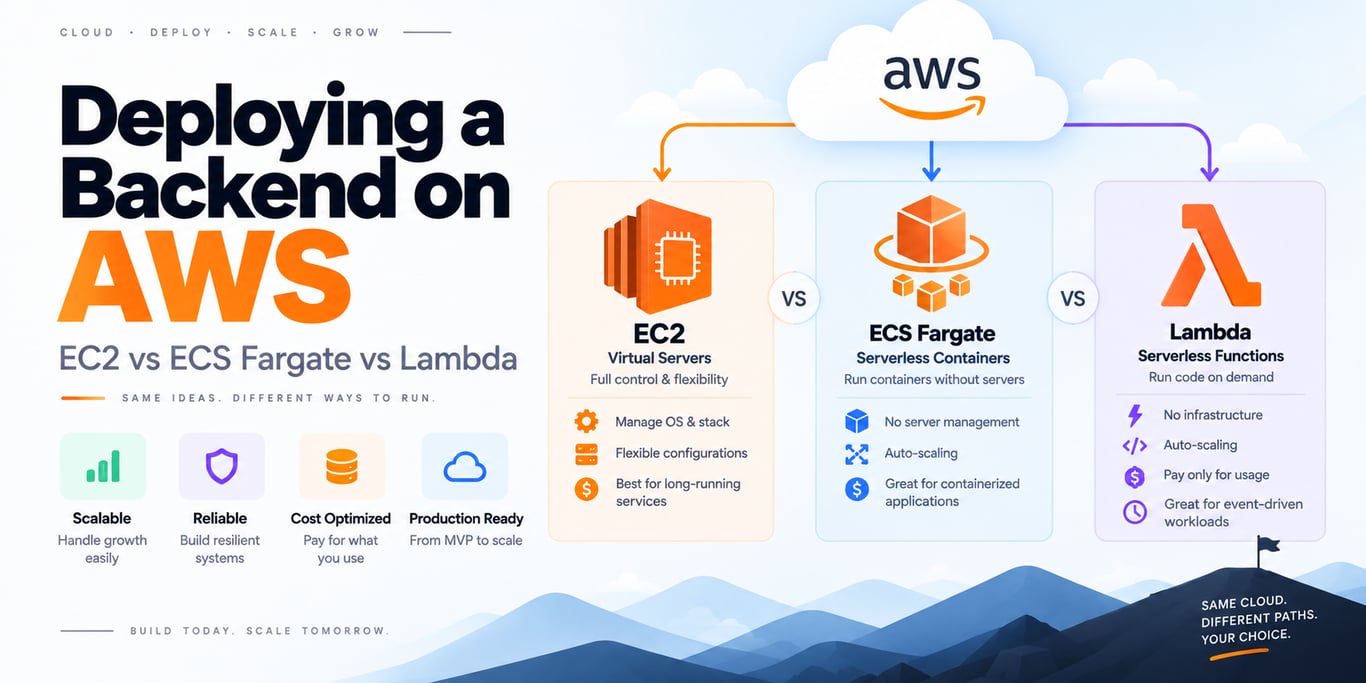
Deploying a Backend on AWS: EC2 vs ECS Fargate vs Lambda
AWS gives you several valid ways to run a backend. The right choice depends mainly on how much infrastructure you want to manage and what execution model the application needs.
EC2
Choose EC2 when you want direct VM control: OS packages, custom networking, long-running processes, specialized software, or predictable always-on capacity.
You also own more:
- patching
- instance replacement
- autoscaling configuration
- process management
- base-image maintenance
For production, run multiple instances across Availability Zones behind a load balancer rather than treating one VM as the whole architecture.
ECS + Fargate
For containerized APIs, ECS on Fargate is often a strong middle ground. ECS handles orchestration while Fargate provides managed compute, so you deploy containers without managing EC2 worker instances.
Use it for long-running APIs, workers, and microservices that fit naturally inside containers.
Lambda
Lambda fits event-driven and bursty functions where the platform should scale per invocation.
Current AWS guidance positions Lambda strongly for HTTP/event processing and Fargate for persistent containerized applications. Standard Lambda function invocations still have a 15-minute maximum execution time; newer durable workflow capabilities address longer wait-heavy workflows separately.
A Typical Production Backend
Route 53 / CDN
      ↓
ALB or API Gateway
      ↓
EC2 / ECS Fargate / Lambda
      ↓
RDS / DynamoDB + S3 + SQS
Keep databases in private network paths where practical, store files in S3 instead of instance disks, and use SQS for slow background work.
Security and Operations
- Use IAM roles instead of embedding AWS access keys in application code.
- Store secrets in Secrets Manager or an appropriate managed secret system.
- Restrict security groups to required traffic only.
- Add health checks, logs, metrics, alarms, and deployment rollback.
- Use multiple Availability Zones where the workload's reliability target requires it.
Which Should You Pick?
| Workload | Good starting point |
|---|---|
| Simple VM-hosted backend needing OS control | EC2 |
| Long-running Docker API without server management | ECS + Fargate |
| Event-driven / bursty functions | Lambda |
| Kubernetes platform requirement | EKS |
Do not choose EKS simply because the application uses containers; ECS/Fargate is often operationally simpler when Kubernetes-specific capabilities are unnecessary.
Final Takeaway
For a new AWS backend, choose the simplest compute model that satisfies the workload. EC2 gives control, ECS/Fargate gives managed container execution, and Lambda gives event-driven serverless execution. Reliability, data, IAM, observability, and recovery matter more than the compute logo.
References

Discussion (0)