

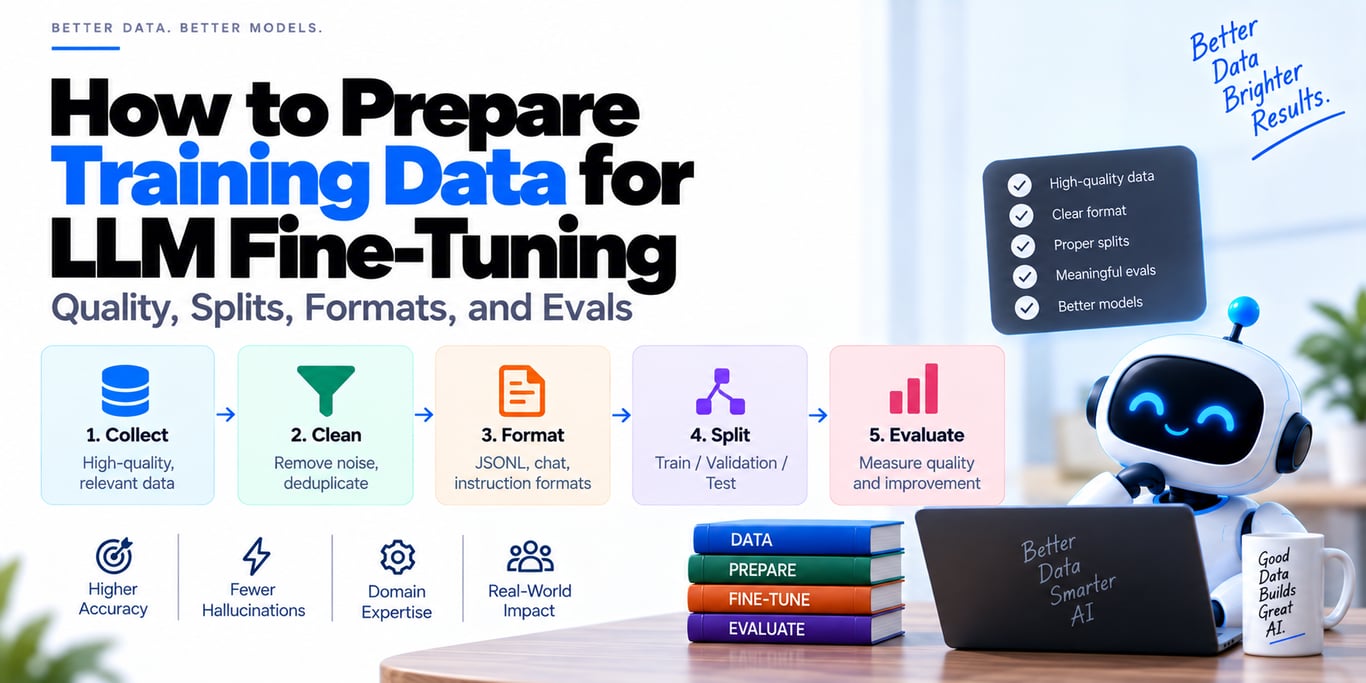
Fine-tuning quality is capped by the quality of the examples you train on.
A large dataset full of inconsistent labels, duplicated conversations, stale policies, leaked evaluation cases, or low-quality synthetic examples can make a model less reliable—not more specialized.
That is why dataset preparation should begin before you export thousands of production conversations.
The first question is not:
> “How much training data do we have?”
It is:
> What exact behavior are we trying to teach, and how will we prove the fine-tuned model learned that behavior without simply memorizing the examples?
A production-grade dataset is a versioned behavioral specification: it defines what good inputs look like, what correct outputs look like, which edge cases matter, and which examples must remain completely unseen for evaluation.
Start with the task, not the data lake
Fine-tuning works best when the target behavior is specific.
Weak objective:
Make the model better at customer support.
Better objective:
Given a support ticket and allowed account context,
classify the issue into one of 12 internal categories
and return the required JSON schema.
Or:
Given an invoice document,
extract 18 defined fields
without inventing missing values.
The clearer the task, the easier it is to decide:
- which examples belong in training
- what a correct label/output looks like
- which mistakes should fail an eval
- whether fine-tuning is even the right solution
If the real problem is missing current knowledge, use retrieval or tools instead of trying to encode the knowledge into model weights.
Build the eval set before you build the training set
This sounds backwards, but it prevents a common failure mode.
If you prepare all available examples as training data first, you may later discover that you have no clean held-out cases left to measure improvement.
Start by defining representative evaluation cases for:
normal requests
important edge cases
known production failures
ambiguous inputs
rare but high-risk cases
negative/refusal cases
Then keep those cases isolated from training.
Anthropic's current agent-evaluation guidance makes the same broader point: real product requirements and real failures are excellent sources for high-signal eval tasks.
Fine-tuning should be measured against a baseline before and after training using the same held-out evaluation set.
Training, validation, and test data have different jobs
The three-way split exists for a reason.
Training set
Used to update the model.
Validation set
Used during development to compare training runs, tune choices, detect overfitting, or monitor whether the model generalizes beyond the examples it directly learned from.
Test / final eval set
Kept separate for the final unbiased comparison.
Conceptually:
all curated examples
       │
       ├── training
       ├── validation
       └── held-out test/eval
Do not evaluate the model only on examples it trained on.
A model that reproduces its training set perfectly may still fail on new customer inputs.
Avoid split leakage
A random row-level split is not always enough.
Imagine you have ten messages from the same customer conversation.
If eight go to training and two go to validation, the validation examples may contain almost the same context and wording the model already saw.
The score looks great, but the test is weak.
Depending on the dataset, split by a higher-level unit such as:
conversation/thread
customer or account
source document
project/repository
entity
incident
calendar/time period
Example:
all messages from ticket T-100
→ training OR validation OR test
→ never spread across all three
For time-sensitive domains, a chronological split can sometimes better approximate production:
older examples → training
newer examples → validation/test
The right split should model how future unseen data will differ from historical data.
Collect data from sources you are allowed to use
Useful training examples can come from:
- expert-written demonstrations
- corrected production outputs
- approved support interactions
- internal labeled datasets
- existing structured workflows
- public/licensed datasets
- carefully generated synthetic examples
But availability does not automatically mean permission.
Before training, establish:
Who owns this data?
Do we have the right to use it for model training?
Does it contain customer or employee information?
Are there retention or regional requirements?
Does a provider receive the training data?
Dataset governance is part of model engineering, not a legal cleanup step after the experiment works.
Remove secrets and unnecessary personal data
Production logs and conversations often contain things that should never become training examples:
API keys
access tokens
passwords
private URLs
customer addresses
payment data
internal credentials
personal identifiers
Build a redaction/sanitization stage before examples enter the curated dataset.
Where identity is not necessary for the task, replace it with synthetic stable placeholders:
real email → user_42@example.invalid
real order ID → ORDER_001
Be careful not to remove information the task genuinely depends on. Privacy cleaning should preserve the behavioral structure needed for training.
Define one canonical example schema
Do not let training examples drift between ten ad-hoc JSON formats.
Create a canonical internal representation first.
Example:
{
  "example_id": "ex_001245",
  "task": "support_triage",
  "input": {
    "message": "I was billed twice after upgrading"
  },
  "expected": {
    "category": "duplicate_charge",
    "needs_human_review": false
  },
  "metadata": {
    "source": "human_corrected_ticket",
    "language": "en",
    "difficulty": "normal",
    "dataset_version": "v7"
  }
}
Then transform this canonical representation into the provider-specific training format.
That keeps data ownership separate from one vendor's API shape.
OpenAI fine-tuning commonly uses JSONL
OpenAI's fine-tuning APIs accept uploaded training files, commonly in JSONL format, with task-specific message structures for chat/model fine-tuning.
JSONL means one JSON object per line:
{"messages":[...]}
{"messages":[...]}
{"messages":[...]}
This is operationally convenient because examples can be streamed and validated independently.
Do not manually produce a 50,000-line JSONL file with text manipulation and hope it is valid.
Generate it from the canonical dataset and validate every row before upload.
Preserve the real inference shape
Training examples should resemble how the model will actually be used.
If production inputs look like:
system instructions
+ user request
+ structured context
then training data should reflect that shape.
If the model will use tools, include representative tool interactions in a format supported by the target fine-tuning method/model.
Do not train only on clean one-turn prompts if production is multi-turn and tool-heavy.
Distribution mismatch between training and inference can undermine otherwise good data.
Tool-use datasets need correct trajectories
For agent fine-tuning, the desired behavior may include deciding whether to call a tool.
A useful example may represent:
user request
→ correct tool choice
→ correct arguments
→ realistic tool result
→ correct next action
Examples should also include cases where the correct behavior is not to use a tool.
Otherwise the model can learn to over-call tools.
Include failure scenarios too:
tool timeout
permission denied
empty search result
invalid resource ID
and demonstrate the desired recovery behavior.
Do not fabricate a tool capability the production system does not actually provide.
Annotation guidelines are part of the dataset
If five annotators would label the same example five different ways, the problem may be your specification rather than the people.
Write annotation rules that explain:
- label definitions
- borderline cases
- priority when multiple labels apply
- allowed assumptions
- how to mark insufficient information
- when human review is required
For example:
duplicate_charge:
Use only when two settled or pending charges represent the same logical purchase.
Do not use for legitimate subscription + add-on billing.
This turns labels into a reproducible system rather than personal judgment.
Measure annotator disagreement
Disagreement is useful evidence.
If experts frequently disagree on a category, the model may also struggle because the underlying task is ambiguous.
A practical workflow is:
independent labels
→ identify disagreements
→ adjudicate
→ update guideline if needed
Do not hide disagreement by silently choosing whichever label arrived first.
Hard examples can expose missing business definitions.
Deduplicate aggressively—but intelligently
Production datasets often contain large amounts of repetition:
same template email
same FAQ answer
same retry log
same synthetic pattern
near-identical tickets
Exact duplicates can overweight one behavior during training.
Near-duplicates can also leak across train and test splits.
Use both:
- exact hashing/normalization
- similarity-based duplicate detection where appropriate
But do not delete genuinely distinct examples merely because they share a common template.
The goal is to remove redundant learning signal, not useful variation.
Remove boilerplate that is unrelated to the task
Support tickets may contain:
email signatures
legal footers
quoted thread history
tracking pixels converted to text
Code datasets may contain generated files or vendored dependencies.
Documents may contain repeated navigation headers.
Remove irrelevant noise where doing so does not destroy the context needed for the target behavior.
Training data should teach the task, not accidental formatting artifacts.
Normalize carefully
Useful normalization can include:
- Unicode normalization
- consistent line endings
- standard date representation
- canonical label names
- whitespace cleanup
- structured field normalization
Avoid over-normalization that changes meaning.
For example, case may matter in:
API keys
code
product identifiers
case-sensitive commands
A preprocessing pipeline should be deterministic and versioned so the dataset can be rebuilt.
Check class and scenario distribution
A training set of 90% easy happy-path examples will teach a different behavior than production if the difficult 10% causes most real failures.
Inspect distributions such as:
label/category
language
customer segment
input length
difficulty
source
positive vs refusal
normal vs error path
tool-success vs tool-failure
Do not blindly force perfect class balance either.
The target distribution should reflect the behavior you want the model to learn and the risks you care about.
High-impact rare cases may deserve deliberate inclusion even if they are uncommon in traffic.
Include negative examples
A good model needs examples of when not to comply, infer, or act.
Examples include:
insufficient information
unauthorized request
unsupported operation
unsafe tool action
ambiguous account identity
missing required field
For structured extraction, teach the model to return a null/unknown value rather than inventing data.
For agents, teach when escalation or refusal is the correct result.
Keep hard examples
It is tempting to clean the dataset until every training case is simple and unambiguous.
That can remove the exact examples that matter most in production.
Retain difficult but correctly labeled cases such as:
- overlapping intents
- long inputs
- misleading context
- similar tool choices
- incomplete information
- recovery after errors
Just make sure the desired output is defensible and consistently annotated.
Use synthetic data carefully
Synthetic data can help create coverage for rare patterns or bootstrap a new task.
But it introduces several risks:
- model-generated sameness
- incorrect labels
- unrealistic phrasing
- hidden artifacts from the generator model
- amplifying the generator's biases
A safer process is:
identify missing scenario
→ generate candidates
→ validate with deterministic rules and/or humans
→ deduplicate
→ mix with real high-quality examples
Track provenance so synthetic examples can be analyzed separately later.
Do not allow a large synthetic batch to silently dominate the training distribution.
Separate synthetic generation from synthetic evaluation
If the same model creates both training examples and evaluation answers, you can accidentally measure how well a model reproduces its own style.
For important evals, prefer:
- human-authored cases
- production-derived failures
- independently validated labels
Synthetic cases are useful, but the evaluation suite should still contain real-world signal.
Keep metadata even if the provider training format does not use it
Your canonical dataset should preserve fields such as:
example_id
source
creation date
annotator/adjudicator
difficulty
language
tenant-safe provenance
synthetic flag
policy/version
You may remove those fields when exporting the provider training file.
But internally they are invaluable for debugging questions such as:
Why did model v4 get worse on Spanish tickets?
Did synthetic examples cause this regression?
Which source produced these bad labels?
Without provenance, dataset debugging becomes guesswork.
Version datasets like code
A fine-tuning run should be reproducible.
Track:
dataset version
source snapshot dates
preprocessing code version
annotation guideline version
split seed/rules
synthetic generator model + prompt
export format version
A simple manifest might look like:
{
  "dataset": "support-triage",
  "version": "v8",
  "train_examples": 12480,
  "validation_examples": 1320,
  "test_examples": 600,
  "split_strategy": "conversation_id",
  "preprocessor": "git:4d91c2a"
}
Then model results can be tied to an exact dataset version.
Store raw, cleaned, and exported data separately
Do not overwrite your only copy of source data during preprocessing.
A practical pipeline is:
raw approved source
      ↓
normalized / redacted records
      ↓
curated canonical examples
      ↓
train / validation / test split
      ↓
provider-specific export
This makes it possible to fix a preprocessing bug without reconstructing the original dataset from an already-transformed file.
Access to raw sensitive data should be tightly controlled.
Validate the dataset automatically
Before uploading a training file, run machine-checkable validation.
Useful checks include:
valid JSON / JSONL
required fields present
valid message roles
known labels only
no empty target outputs
length limits
no duplicate example IDs
no train/validation overlap
no forbidden secrets patterns
valid tool names and argument schemas
encoding is valid
Fail the pipeline instead of silently skipping broken examples.
Inspect length distributions
Very long examples can dominate token usage and training cost.
Measure:
p50 input length
p95 input length
max input length
output length distribution
Then inspect the longest examples manually.
They may be legitimate complex tasks—or simply duplicated email threads, logs, or accidental document dumps.
Do not truncate blindly if the missing tail contains the answer.
Validation data must remain independent
OpenAI’s fine-tuning API supports separate training and validation files.
The same examples should not be used for both.
Validation is useful only when it represents unseen examples from the same task distribution.
If a near-duplicate of every validation sample exists in training, the metric is overly optimistic even though the file IDs are technically different.
This is why deduplication and group-aware splitting need to happen before the export step.
Fine-tuning eval should compare against a baseline
Never evaluate only the new fine-tuned model.
Run the same held-out evals against:
base model + current prompt
vs
fine-tuned model + production prompt
Measure the things the product actually cares about:
- task correctness
- structured-output validity
- tool-use behavior
- refusal/escalation correctness
- latency
- token use
- regressions on unrelated cases
A fine-tune that improves one category while damaging a critical edge case may not be production-ready.
Do not overfit the eval suite
Once an evaluation case becomes famous internally, teams can accidentally optimize directly for it.
Over time, keep:
- a visible development eval set
- a more protected final test set for important releases
- fresh production-derived cases
The same concept used in machine learning applies to agent/prompt development: if you repeatedly tune against the test set, it stops being a true test set.
A practical end-to-end pipeline
Define target behavior
        │
        ▼
Create held-out eval specification
        │
        ▼
Collect approved source examples
        │
        ▼
Redact / normalize / clean
        │
        ▼
Annotate with explicit guidelines
        │
        ▼
Deduplicate + validate
        │
        ▼
Group-aware train / validation / test split
        │
        ▼
Version canonical dataset
        │
        ▼
Export provider format (e.g. JSONL)
        │
        ▼
Fine-tune
        │
        ▼
Run same held-out eval vs base model
        │
        ▼
Canary + monitor production failures
        │
        └────────→ new curated examples / eval cases
The dataset should evolve from real evidence, not from continuously generating more examples because “more data” sounds better.
Example: preparing support-triage data
Suppose the target is:
Customer message
→ category
→ urgency
→ whether human review is required
A good process could be:
1. Define labels
billing_duplicate
billing_failed
account_access
technical_bug
feature_question
cancellation
other
2. Write annotation rules
Clarify overlapping cases.
3. Pull approved historical tickets
Redact personal information.
4. Use corrected human outcomes
Do not use the old AI’s raw answer as truth.
5. Group split by conversation
All turns in one ticket stay in one split.
6. Add hard cases
Include mixed-intent and ambiguous examples.
7. Hold out production-like eval cases
Never train on them.
8. Fine-tune and compare
Measure per-category precision/recall plus end-to-end workflow outcomes.
That is substantially more reliable than exporting “all support chats from last year” and starting a training job.
Common mistakes
Training before defining success
You cannot prepare good examples without a clear target behavior.
Random row splits on correlated data
This creates leakage across conversations, documents, projects, or customers.
Using production model outputs as labels without review
You may train the model to reproduce yesterday’s mistakes.
No negative examples
The model learns to answer or act even when it should stop.
Synthetic data with no provenance
You cannot later measure whether synthetic examples helped or hurt.
One giant unversioned JSONL file
You lose reproducibility and debugging ability.
Mixing current policies with obsolete examples
Fine-tuning can teach behavior that is no longer valid.
Evaluating on training examples
Memorization is not generalization.
Production checklist
Before starting an LLM fine-tuning job, verify:
- Target behavior is specific and measurable
- Held-out eval cases exist before training
- Training, validation, and test/eval sets are separate
- Splits prevent conversation/entity/document leakage
- Data rights and provider-training terms are understood
- PII, secrets, and unnecessary sensitive data are removed
- Annotation guidelines are explicit
- Disagreements are reviewed/adjudicated
- Exact and near-duplicates are controlled
- Rare high-risk cases are represented
- Negative/refusal/escalation examples exist
- Tool examples match real production tools
- Synthetic data is validated and provenance-tagged
- Canonical examples are versioned independently of provider format
- Export files pass automated schema checks
- Base vs fine-tuned model is compared on the same held-out eval
- Production failures can flow back into future dataset/eval versions
Final takeaway
Preparing an LLM fine-tuning dataset is not a file-conversion task.
It is the process of turning product behavior into clean, testable examples.
The strongest datasets have:
clear task definitions
high-quality labels
privacy-safe source data
realistic input distributions
hard and negative cases
leakage-safe splits
strong provenance
versioning
held-out evaluations
Do not optimize for raw example count.
> Train on examples you trust, keep evaluation cases genuinely unseen, and make every dataset version reproducible enough that you can explain why the next model got better—or worse.
That discipline matters more than any particular fine-tuning API.
References and further reading

Discussion (0)