

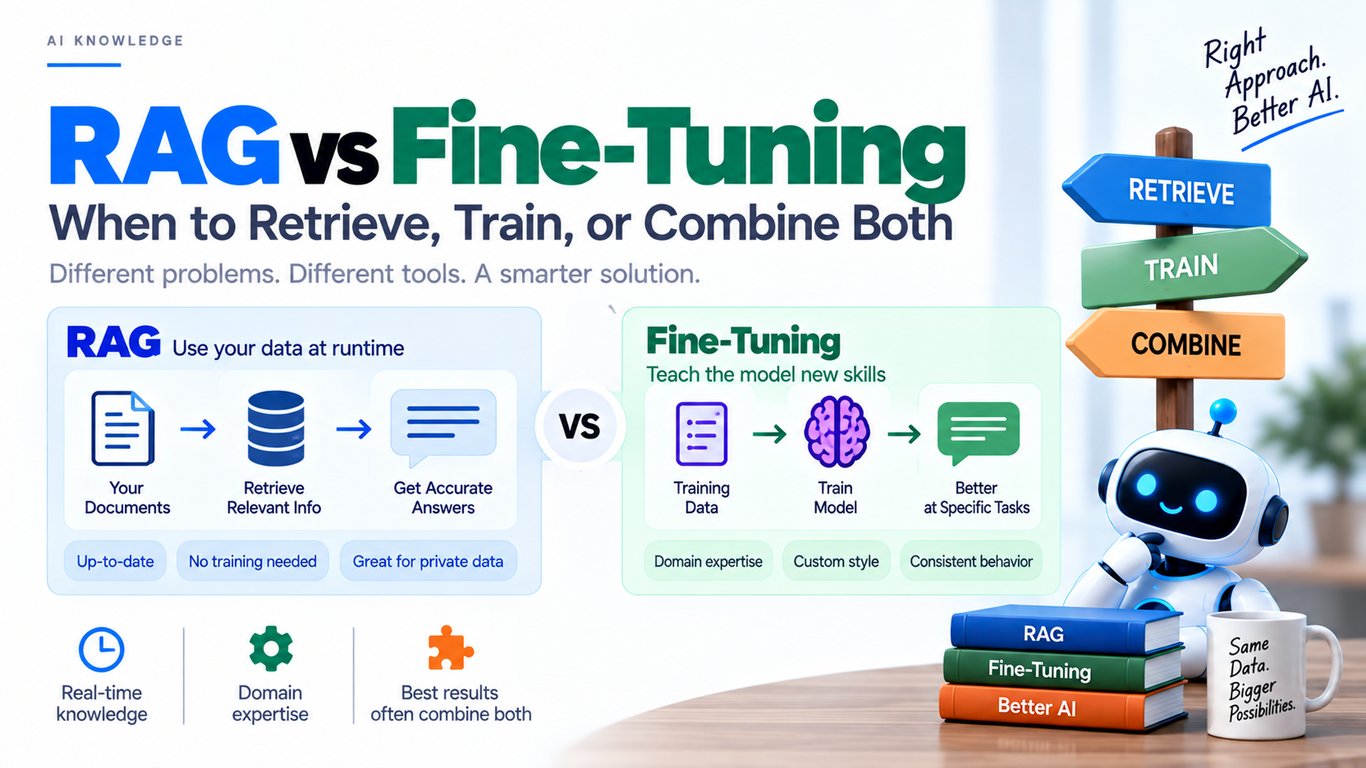
RAG and fine-tuning are often presented as competing ways to make an LLM “know your data.” That framing is misleading.
They change different parts of the system.
RAG changes the information available to the model at request time.
Fine-tuning changes the model's learned behavior.
Once you separate those responsibilities, the decision becomes much easier.
If your support bot needs today's refund policy, retrieve the current policy.
If it consistently formats refunds incorrectly despite clear examples, fine-tuning may help.
If it needs the customer's current balance, call the billing API.
If “refunds above ₹50,000 require approval,” enforce that rule in code.
The best production systems rarely force one technique to solve all four problems.
The one-sentence difference
A useful mental model is:
RAG         → change what the model sees
Fine-tuning → change how the model behaves
Tools       → access current external state/actions
Code        → enforce deterministic rules
That is more useful than asking whether RAG or fine-tuning is “better.”
What RAG does
Retrieval-Augmented Generation adds relevant external information to the prompt before generation.
Conceptually:
user question
   ↓
retrieve relevant documents
   ↓
add evidence to context
   ↓
model answers from evidence
The model weights do not change.
RAG is a strong fit when knowledge is
- private
- frequently changing
- too large to fit in every prompt
- tenant-specific
- document-oriented
- important to cite back to a source
Examples:
company policies
product documentation
contracts
support knowledge bases
customer documents
code repositories
research collections
Why RAG is operationally attractive
If a policy changes, you update the source/index rather than retraining the model.
If a customer deletes a document, you can remove it from retrieval rather than trying to “untrain” the model.
If two tenants have different knowledge, permissions can scope which documents each user is allowed to retrieve.
That makes RAG a natural knowledge layer.
What fine-tuning does
Fine-tuning updates model parameters from examples or reward signals so the model becomes better at a particular behavior.
Modern providers expose several techniques.
OpenAI's current fine-tuning platform, for example, supports methods including:
- supervised fine-tuning (SFT)
- direct preference optimization (DPO)
- reinforcement fine-tuning (RFT) for supported tasks/models
These methods solve different optimization problems.
Supervised fine-tuning: learn from correct demonstrations
SFT teaches the model from input/output examples.
Conceptually:
input → ideal output
input → ideal output
input → ideal output
Over many examples, the model learns the desired task pattern.
Good SFT use cases
- consistent classification behavior
- domain-specific extraction
- structured transformation
- style/tone consistency
- frequently repeated instruction patterns
- specialized tool-use behavior when supported and well represented
Example:
support ticket
→ exact internal triage JSON format
If a long system prompt contains the same fifteen formatting instructions on every request, SFT may eventually make some of that behavior more native to the model.
DPO: learn which output is preferred
Direct Preference Optimization uses preference pairs rather than only one ideal answer.
Conceptually:
prompt
  ├→ preferred response
  └→ rejected response
This is useful when quality is relative rather than captured by one exact target.
Examples:
- preferred tone
- better summary style
- choosing concise vs verbose responses
- response-format preferences
- domain-specific quality judgments
It is still not a replacement for live knowledge.
A model fine-tuned to prefer a particular answer style will not magically know yesterday's product change.
Reinforcement fine-tuning: optimize against a grader
Reinforcement fine-tuning can optimize model behavior using a grader/reward signal on supported models and tasks.
This is most interesting when the task has a meaningful, repeatable evaluation signal.
Examples might include workloads where outputs can be scored for:
- mathematical correctness
- code/test success
- structured task completion
- domain outcomes with reliable grading
The important requirement is not “we have lots of data.”
It is:
> Can we reliably score whether one output is better than another?
If the reward signal is poor, the optimization target is poor.
Quick decision table
| Requirement | Best starting tool |
|---|---|
| Frequently changing documentation | RAG |
| Private customer documents | RAG |
| Need citations to sources | RAG |
| Large knowledge corpus | RAG |
| Stable output style | Fine-tuning / prompting |
| Repeated classification/extraction behavior | SFT candidate |
| Preference-based response quality | DPO candidate |
| Task has a reliable grader/reward | RFT candidate |
| Current balance/order/inventory | Live tool/API |
| Must enforce financial/security rule | Deterministic code |
| Need both private knowledge and specialized behavior | RAG + fine-tuning |
This table prevents the common mistake of treating fine-tuning as a database and RAG as a behavior trainer.
When RAG is the better first move
Your information changes often
Suppose your SaaS pricing, support policies, and API docs change weekly.
Fine-tuning every change would be slow, expensive, difficult to verify, and bad for source-level deletion.
RAG is designed for this:
source changes
→ re-index affected content
→ next request retrieves new version
You need per-tenant knowledge
A multi-tenant system may have:
Tenant A → its private documents
Tenant B → different private documents
You do not want one fine-tuned model per tenant unless the business genuinely justifies that architecture.
Permission-aware retrieval is usually much cleaner.
You need citations
If users need to verify where a statement came from, retrieval naturally carries provenance.
A fine-tuned answer may be correct, but the model's weights do not provide a simple source link for each fact.
When fine-tuning is worth evaluating
The problem repeats across many requests
If you repeatedly spend prompt tokens explaining the same stable behavior, training may be worthwhile.
Examples:
Convert these reports into our proprietary schema.
Classify tickets using our internal taxonomy.
Write all product descriptions in this exact style.
Generate tool arguments according to this stable domain convention.
Prompting has plateaued
Do not jump directly to fine-tuning after one bad prompt.
First fix:
- unclear instructions
- missing context
- bad examples
- confusing tools
- retrieval failures
Fine-tuning is more compelling when the behavior is stable, data is high quality, and an eval shows the current base model consistently misses the same pattern.
Fine-tuning does not guarantee factual freshness
Suppose you train a model on your product catalog in January.
In March:
- prices change
- products are retired
- new plans launch
The model's weights are now stale.
You could train again, but that is turning model training into an inefficient database synchronization mechanism.
If facts change, retrieve them from an authoritative current source.
RAG does not guarantee good behavior
The opposite mistake also happens.
A team builds excellent retrieval and expects the model to always:
- classify correctly
- use the exact output schema
- follow domain style
- choose the correct reasoning pattern
RAG supplies information. It does not automatically train behavior.
If the model has the right evidence but repeatedly performs the same transformation poorly, prompting, examples, stronger models, or fine-tuning may be the right next layer.
Use tools for live state
Neither RAG nor fine-tuning should own highly dynamic transactional state.
Example:
User: “Has invoice INV-418 been paid?”
Correct source:
billing API / database tool
Not:
vector index from last night
and definitely not:
model fine-tuned on historical invoices
A production architecture should distinguish:
knowledge → RAG
behavior  → model/prompt/fine-tuning
live state/action → tools
invariants → code
Use deterministic code for hard rules
Suppose your policy says:
refund > ₹50,000 requires manager approval
Do not fine-tune that as the only enforcement mechanism.
Do not put it only in RAG and hope the model retrieves it.
Do not rely only on a system prompt.
Enforce it in deterministic code:
if refund_amount > 50000:
    require_manager_approval()
The model may explain the rule. The application owns the rule.
The strongest architecture often combines RAG and fine-tuning
These techniques compose naturally.
Example: enterprise support assistant.
User question
    ↓
RAG retrieves current product + policy knowledge
    ↓
Fine-tuned model applies stable support style/taxonomy
    ↓
Live tools fetch customer/account state
    ↓
Application policy validates any actions
Each layer solves the problem it is best suited for.
Another example: document extraction
RAG / source context
→ supplies exact source document

Fine-tuned model
→ extracts into company-specific schema

Validator
→ checks required fields/types
This is more robust than trying to encode source knowledge inside the fine-tuned weights.
Prompting should come before fine-tuning
A sensible improvement ladder is:
1. choose a capable base model
2. write clear instructions
3. add a few strong examples
4. fix context/retrieval/tooling
5. build evals
6. identify stable repeated failure pattern
7. evaluate fine-tuning
Fine-tuning without an eval suite is risky because you cannot reliably tell whether training improved the target task or created regressions elsewhere.
Build the eval before the training dataset
You need two separate datasets.
Training data
Examples used to teach the model.
Evaluation data
Held-out tasks used to measure whether the model improved.
Do not train on every example and then evaluate on the same examples.
You will measure memorization instead of generalization.
A good eval should contain:
- normal cases
- hard edge cases
- ambiguous inputs
- important failures from production
- high-risk cases
RAG also needs its own evals
If you compare RAG and fine-tuning using only final-answer scores, you will struggle to diagnose failures.
For RAG, measure retrieval separately:
recall@k
precision@k
MRR / ranking quality
citation correctness
Then evaluate generation given the correct evidence.
This tells you whether the bottleneck is search or the model.
Latency and cost trade-offs
RAG adds runtime work
Typical request:
embed/rewrite query
→ search
→ rerank
→ generate
That adds latency and infrastructure.
Fine-tuning adds training/maintenance work
You need:
- training data
- eval data
- training jobs
- model-version management
- rollout/regression testing
A fine-tuned model may reduce prompt size or improve task efficiency, but the total lifecycle still needs engineering ownership.
Compare end-to-end total cost, not only one token price.
Data governance is different
RAG
Because source knowledge remains external, it is easier to:
- remove a document
- update a record
- apply ACLs
- trace provenance
- maintain separate tenant corpora
Fine-tuning
Training data becomes part of a model-optimization process.
That requires careful decisions about:
- sensitive data
- provider terms
- retention
- dataset governance
- model lifecycle
Do not send confidential production data into a training pipeline without understanding those implications.
Example 1: customer support
Problem
Support agent needs current docs and a consistent response structure.
Good architecture
RAG → current documentation/policies
Tool → current account/order state
SFT candidate → stable classification/response format
Code → refund/permission rules
No single technique owns everything.
Example 2: legal knowledge assistant
Problem
Need answers from an evolving document corpus with citations.
Start with
RAG.
Fine-tuning the legal documents into weights would make source updates and citations harder.
Fine-tuning may later help with stable tasks such as classifying clause types or producing a required analysis format.
Example 3: structured data extraction
Problem
Thousands of similar documents must be converted into a proprietary schema.
Start with
- strong prompt
- structured output
- representative examples
- deterministic validation
If the base model repeatedly fails the same stable extraction patterns, SFT becomes a reasonable experiment.
RAG is not automatically needed unless external knowledge must be looked up.
Example 4: coding assistant
A coding assistant may need:
repository search / tools → current source tree
RAG/search               → docs/design knowledge
fine-tuning               → maybe specialized coding behavior
sandbox + tests           → deterministic verification
Again, repository state should not live inside model weights.
Common mistakes
Fine-tuning to teach frequently changing facts
Use retrieval or tools instead.
Adding RAG to fix formatting behavior
Improve prompting/structured output or evaluate fine-tuning.
Assuming fine-tuning removes the need for prompts
Fine-tuned models still need task context and instructions.
Assuming RAG removes hallucinations
The model can still misread or ignore retrieved evidence.
Training before building evals
You will not know whether the model actually improved.
Fine-tuning around a bad tool architecture
If tools are ambiguous, redesign tools first.
Treating business rules as training data
Critical rules should be enforced in code.
A practical decision process
Step 1 — Name the failure
Is it:
missing knowledge?
wrong behavior?
stale live state?
broken deterministic rule?
Step 2 — Fix the right layer
missing knowledge   → RAG
wrong stable behavior → prompting/examples/fine-tuning
live state          → tool/API
hard rule           → code
Step 3 — Build eval cases
Measure current performance before adding complexity.
Step 4 — Run the smallest experiment
Do not build a full RAG platform or fine-tuning pipeline if ten representative tests can tell you the idea is wrong.
Step 5 — Compare total system quality
Measure:
- task success
- latency
- cost
- maintainability
- freshness
- auditability
Production checklist
Before choosing RAG, fine-tuning, or both, verify:
- The problem is clearly classified as knowledge vs behavior vs live state vs rule
- A baseline eval exists
- Dynamic/private knowledge is not being forced into model weights
- Live transactional facts come from authoritative tools
- Critical business rules are enforced outside the model
- RAG retrieval quality is measured separately from generation
- Fine-tuning uses high-quality representative data
- Evaluation data is held out from training
- Fine-tuned model versions are tracked and regression-tested
- RAG sources preserve permissions and provenance
- Combined RAG + fine-tuning is considered when both knowledge and behavior need improvement
Final takeaway
RAG and fine-tuning are not substitutes for the same layer.
Use RAG when the model needs the right knowledge now.
Use fine-tuning when the model needs to behave differently across many similar future requests.
Use tools when it needs current operational state or actions.
Use deterministic code when something must always be enforced.
> Retrieve facts. Train behavior. Query live state. Encode hard rules in code. Combine the layers only when the product actually needs them.
That is a much more reliable architecture than asking one technique to solve every LLM problem.
Official references

Discussion (0)