

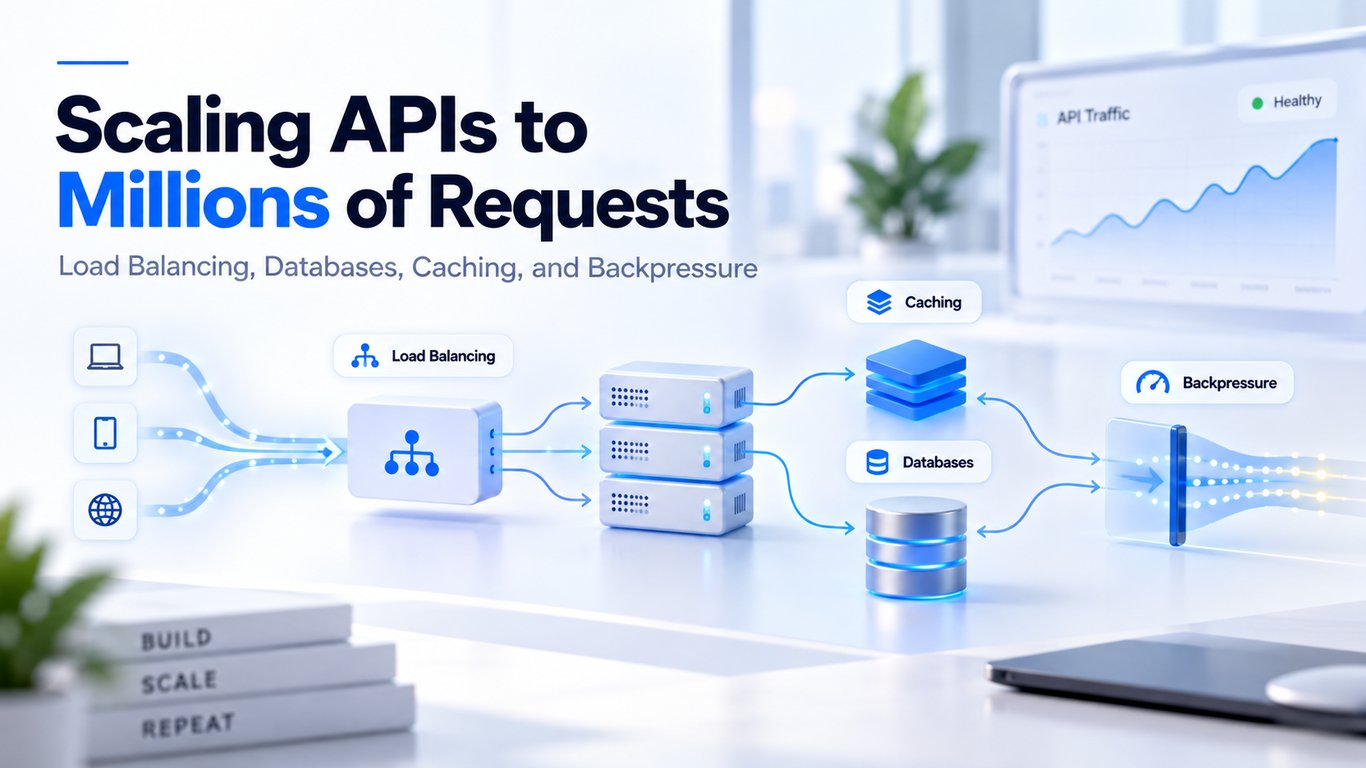
Scaling APIs to Millions of Requests: Load Balancing, Databases, Caching, and Backpressure
High API traffic is rarely solved by one trick. The goal is to keep the request path horizontally scalable while protecting stateful dependencies from too much concurrency.
Keep API Instances Stateless
Any healthy replica should be able to handle any request. Move durable sessions/files/business state to shared stores instead of relying on one instance's local disk or memory.
AWS and Azure both recommend stateless application tiers because they can scale horizontally and recover from node replacement more easily.
Scale Behind a Load Balancer
Use health-aware load balancing across multiple instances and failure domains. Scale based on real demand signals such as concurrency, request rate, latency, or CPU where appropriate.
Avoid unnecessary sticky sessions; they make traffic distribution uneven and make instance replacement harder.
The Database Usually Becomes the Real Limit
Before adding more API replicas:
- fix slow queries and indexes
- use bounded connection pools
- monitor locks and transaction latency
- cache repeated reads where useful
- introduce read replicas only when the consistency trade-off is acceptable
If every new API replica opens 100 database connections, autoscaling can make the outage worse.
Move Slow Work Out of HTTP Requests
Email, exports, AI jobs, media processing, and other slow independent tasks should often flow through a durable queue:
API → enqueue → fast response
worker → perform expensive job
This absorbs bursts and lets background capacity scale separately.
Use Backpressure While Autoscaling Catches Up
Autoscaling takes time. During spikes, protect the system with:
- per-user/key/tenant rate limits
- concurrency limits
- bounded request/body sizes
- queue limits
- graceful feature degradation
- HTTP
429with sensible retry guidance
Microsoft's current throttling guidance explicitly treats throttling as a self-preservation mechanism that works alongside autoscaling.
Watch Tail Latency
Average latency can look healthy while a meaningful share of users experience very slow requests. Track p95/p99 latency, error rate, saturation, queue age, DB connections, and dependency timeouts.
Final Takeaway
To scale APIs, make compute stateless and horizontally replaceable, then protect the database and other finite dependencies with pooling, caching, queues, rate limits, and backpressure. Scaling the front end of the request path is easy; scaling the whole dependency chain is the real engineering problem.
References
BUILDING A SAAS PRODUCT?
Explore Lofingo’s end-to-end SaaS platforms, multi-tenant cloud architecture, and high-concurrency backend engineering.
EXPLORE SAAS SERVICES →