

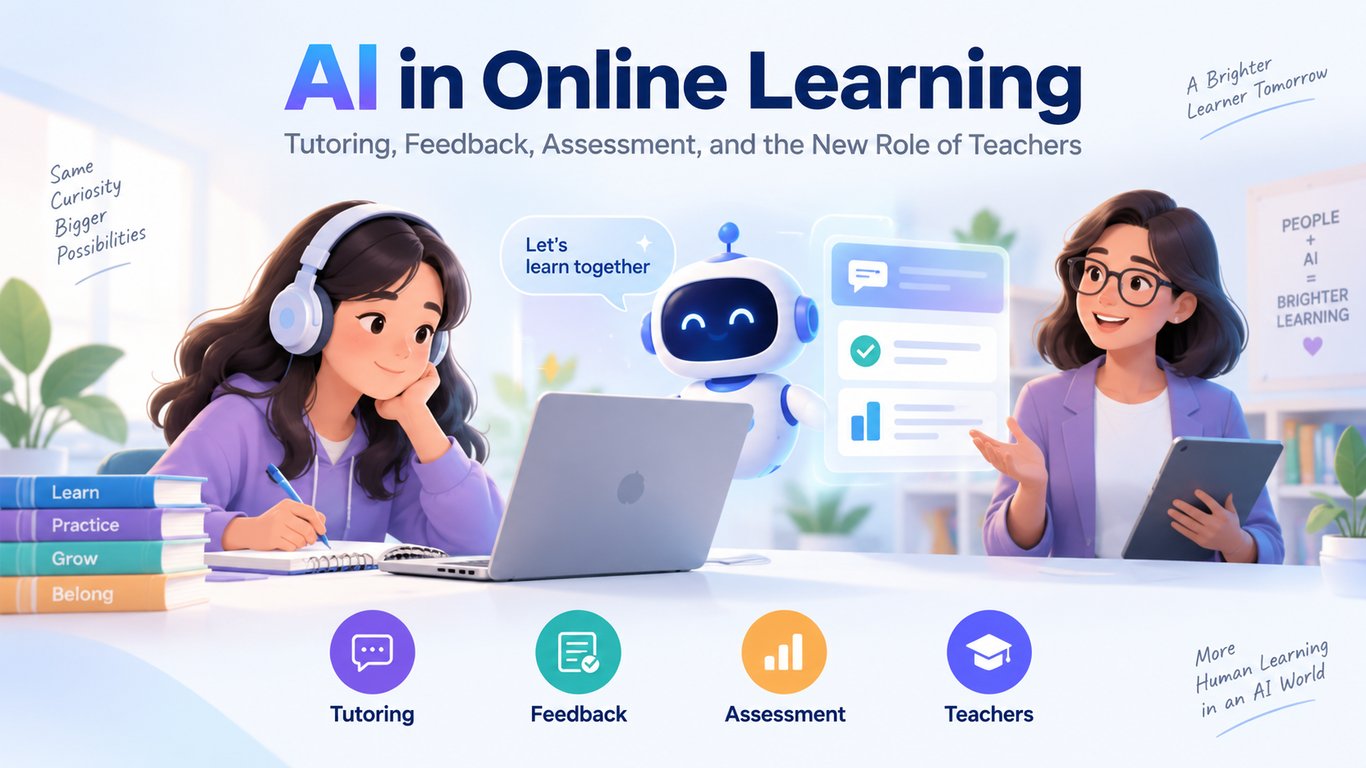
AI can make online learning more personalized, interactive, and responsive—but only if the system is designed around learning, not around generating answers as quickly as possible.
A useful education architecture separates several roles:
AI tutor
→ explains, asks questions, gives hints

retrieval
→ brings approved course material into context

assessment engine
→ measures what the learner can actually do

teacher / instructor
→ defines goals, reviews progress, handles exceptions
The model can accelerate feedback and support practice. It should not quietly become the curriculum, the grader, and the teacher at the same time.
UNESCO's AI competency frameworks reinforce this human-centered approach. Its student framework organizes 12 competencies across human-centered thinking, AI ethics, AI techniques/applications, and AI system design. Its teacher framework adds pedagogy and professional learning, emphasizing that educators need to understand both the opportunities and limits of AI.
Start with the learning objective
Weak product requirement:
Add an AI chatbot to the course.
Better requirement:
Help a learner understand why their SQL join is wrong,
without immediately giving the final answer.
or:
Give students targeted practice based on concepts they repeatedly miss.
The learning objective determines whether you need tutoring, retrieval, assessment, analytics, or simple content assistance.
1. AI tutors should teach, not just answer
A normal assistant is optimized to be helpful.
A tutor often needs a different behavior:
ask what the learner already knows
→ identify misconception
→ give a hint
→ ask learner to try
→ explain only what remains unclear
If the model immediately produces the perfect solution, the learner may complete the task without learning the concept.
Good tutoring is an interaction design problem, not just a better prompt.
Use a pedagogical policy
A tutoring agent should know when to:
ask a diagnostic question
provide a hint
show a worked example
request another attempt
reveal a final solution
This policy can be partly deterministic.
Example:
first mistake → hint
second similar mistake → targeted explanation
third attempt → worked example
Do not let every teaching decision be improvised from scratch by the model.
2. Ground course answers in approved material
For course-specific questions, the tutor should retrieve from:
lectures
textbook excerpts
instructor notes
rubrics
course FAQs
rather than relying only on pretrained model knowledge.
Architecture:
student question
→ retrieve approved course sources
→ answer / hint
→ cite source section
This makes the assistant more consistent with what the course actually teaches.
Course RAG needs version control
A course can change between semesters.
Track:
course_id
term
module
content_version
status = active / archived
Otherwise a tutor may retrieve last year's assignment instructions or an outdated rubric.
3. AI feedback is strongest when it is specific
Generic feedback such as:
Good job! Try to be more clear.
has little instructional value.
Better feedback points to the exact problem:
Your argument identifies the cause, but the second paragraph does not provide evidence for it.
or:
Your loop works for positive numbers but fails when the list is empty.
The system should connect feedback to a rubric, learning objective, or test result whenever possible.
Deterministic evidence should beat subjective grading
For coding exercises:
run tests
→ show which case failed
→ let AI explain the failure
For mathematics:
check final result / symbolic steps where possible
→ use AI for explanation
The model should not be asked to judge objectively verifiable outcomes when code can verify them exactly.
4. AI-generated quizzes can help—but need review
Models are useful for generating:
practice questions
variations
flashcards
examples
But generated questions can contain:
ambiguous wording
wrong answer keys
content outside the syllabus
unintended clues
Use a review pipeline for high-stakes assessments.
For low-stakes practice, automated generation can be more flexible if errors are monitored.
Assessment and tutoring should not leak into each other
If the AI tutor has access to hidden answer keys during a graded test, it may reveal them.
Separate permissions and context:
practice tutor
→ can use worked solutions

assessment assistant
→ cannot access hidden answer key during test
This is a security boundary, not just an honor-code statement.
5. Personalization should be based on observable learning signals
A learning platform may adapt using evidence such as:
concepts missed
attempt count
response time
quiz results
completed lessons
Avoid speculative labels like:
student is lazy
student is bad at math
Personalization should describe current learning state—not make permanent judgments about a learner.
Keep learner models editable
If the system stores:
weak_topic = fractions
that value should change as the learner improves.
Do not create stale long-term memory that keeps routing advanced students back to beginner material.
Use evidence, expiry, and update rules.
6. Teachers need visibility into why the system adapted
A dashboard should be able to explain:
why this student received extra practice
which concepts were missed
which evidence triggered intervention
A black-box “risk score” is much less useful to educators.
The teacher should be able to override the recommendation.
AI should reduce teacher workload without removing teacher agency
Useful teacher-facing tasks include:
summarize discussion themes
cluster common misconceptions
draft feedback
prepare lesson variations
create practice material
The instructor remains responsible for the learning goals and student context.
UNESCO's teacher framework explicitly emphasizes human agency, pedagogy, and ethical use rather than treating AI competence as merely technical skill.
7. Assessment integrity needs redesign, not only detection
Generative AI makes traditional take-home assignments easier to outsource.
Trying to solve this entirely with AI detectors is unreliable and can create false accusations.
A stronger assessment design may use:
oral explanation
process artifacts
iteration history
personalized datasets
in-class checkpoints
project defense
The goal is to assess understanding, not merely detect tool use.
Ask students to show process
For a programming project, require:
problem explanation
design decisions
tests
reflection on failures
A student can still use AI, but must demonstrate that they understand the result.
This is more resilient than banning every new tool.
8. AI literacy is becoming part of the curriculum
UNESCO's student framework treats AI competence as more than prompt writing.
Students should learn:
how AI systems work at a basic level
how outputs can be wrong
ethical and social implications
how to evaluate evidence
how to build / use AI responsibly
That is a much stronger educational goal than “learn to use ChatGPT.”
9. Privacy matters because learners are often minors
Education systems can contain sensitive data:
grades
behavioral history
writing samples
disability accommodations
personal conversations
AI features should minimize what they send to external providers.
Ask:
Does the model need the student's full profile?
Can an identifier be pseudonymous?
How long are prompts retained?
Do not log full student conversations forever because they may be useful someday.
Separate analytics from conversational content
You may need metrics such as:
session length
concept mastered
attempt count
without storing every raw message indefinitely.
Operational analytics and content traces can have different retention policies.
10. Accessibility can improve dramatically
AI can help with:
simplifying language
translation
captioning
alternative explanations
image descriptions
voice interaction
This can make online learning more accessible.
But accessibility features need real user testing. Generated descriptions or translations can still be wrong or confusing.
11. Multilingual learning needs subject-quality checks
A model may translate ordinary language well but mishandle domain terminology.
Examples:
medical terminology
legal concepts
mathematical vocabulary
programming keywords
For important courses, maintain approved terminology or bilingual glossaries.
12. Learning analytics can help teachers prioritize attention
Instead of replacing the teacher, AI can surface patterns:
40% of class missed concept X
students are stuck on step 3
question 7 may be ambiguous
This helps educators decide where to intervene.
The model's analysis should be evidence-linked so teachers can inspect the underlying responses.
Do not optimize for engagement alone
A tutoring system could maximize:
messages sent
session time
without improving learning.
Better metrics include:
pre/post assessment improvement
concept mastery
retention over time
reduction in repeated misconception
teacher correction rate
The product objective should be learning, not chatbot usage.
Evals should test pedagogy as well as answer accuracy
A tutor may give a correct answer in the wrong pedagogical way.
Test whether it:
reveals solution too early
asks useful diagnostic questions
matches learner level
uses approved terminology
correctly escalates to teacher
This is different from ordinary chatbot evaluation.
A practical architecture
Learner
   │
   ▼
Learning App
   │
   ├── course RAG
   ├── deterministic assessment engine
   ├── learner state
   └── approved tools
   │
   ▼
AI Tutor
   │
   ├── hint / explain
   ├── ask question
   └── recommend practice
   │
   ▼
Teacher / Instructor Dashboard
   ├── evidence
   ├── override
   └── intervention
The AI supports the learning loop. The curriculum and teacher remain the control plane.
Common mistakes
Giving final answers too quickly
Helpful is not always educational.
Using generic model knowledge instead of course material
Ground the tutor in approved sources.
Letting tutor access assessment answer keys
Separate permissions.
Treating AI detection as the whole academic-integrity strategy
Redesign assessment around demonstrated understanding.
Building permanent learner labels
Learning state changes.
Measuring engagement instead of learning
Optimize mastery and outcomes.
Production checklist
Before deploying AI in online learning, verify:
- Learning objectives are explicit
- Tutor behavior follows a pedagogical strategy
- Course answers are grounded in current approved material
- Practice and graded-assessment permissions are separated
- Objective outcomes use deterministic grading where possible
- Teachers can inspect and override recommendations
- Student models update as performance changes
- Privacy and retention are appropriate for learner data
- Accessibility and multilingual outputs are tested
- Evaluation measures learning outcomes, not only model accuracy
- Students are taught AI literacy and critical evaluation
Final takeaway
The best AI tutor is not the one that gives the fastest answer.
It is the system that helps a learner make progress while preserving teacher agency, assessment integrity, privacy, and the ability to demonstrate real understanding.
> Use AI to increase the amount and quality of feedback a learner receives—not to automate away the learning process itself.
References and further reading
- UNESCO — AI Competency Framework for Students
- UNESCO — AI Competency Framework for Teachers
- UNESCO — Guidance for Generative AI in Education and Research
Education policies, privacy requirements, and assessment rules vary by institution and jurisdiction.

Discussion (0)