

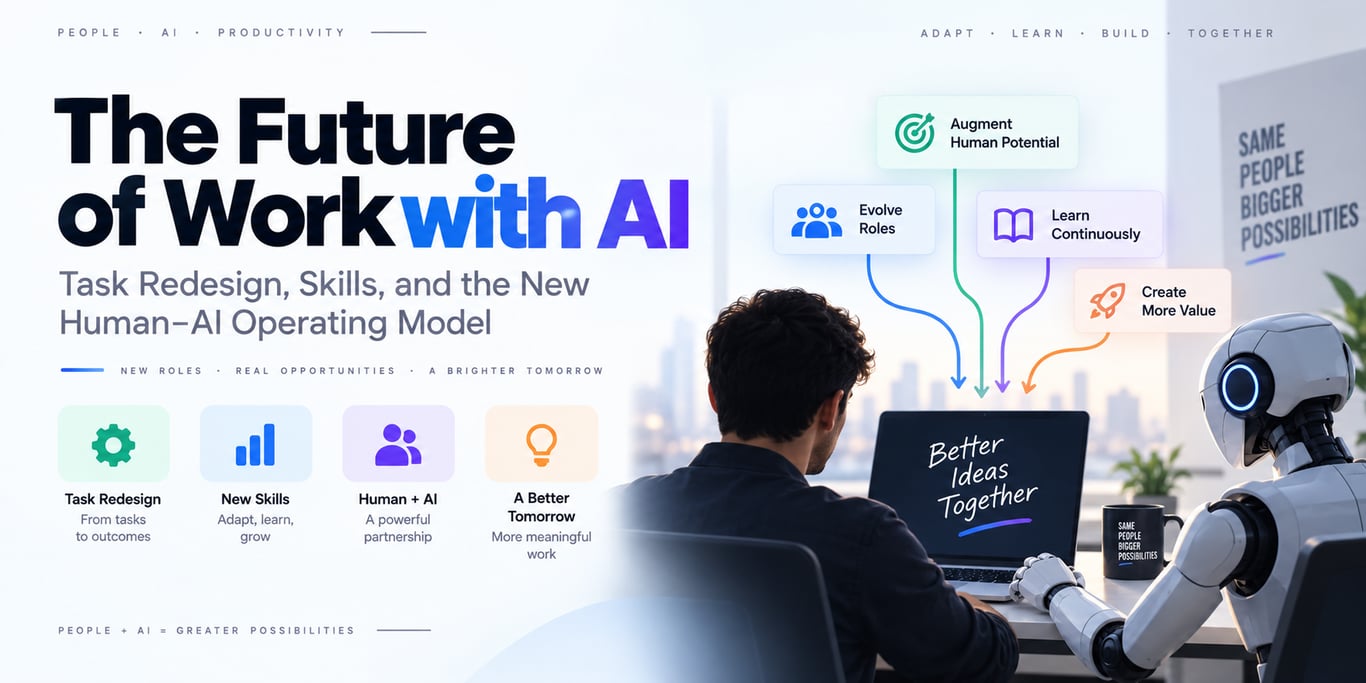
The most useful way to think about AI and jobs is not “Which professions disappear?”
It is:
> Which tasks inside each job can be automated, which become easier with AI, and which still require human judgment, accountability, relationships, or physical presence?
That distinction matters because jobs are bundles of tasks.
A customer-support role may contain:
read ticket
find policy
check account
write response
handle angry customer
approve exception
AI may automate or accelerate several of those tasks without removing the entire role.
That is consistent with the International Labour Organization's current global analysis. Its 2025 task-level study estimates that roughly one in four workers worldwide are in occupations with some degree of generative-AI exposure, while concluding that transformation is more likely than complete job redundancy because many occupations still require substantial human input.
The future of work is therefore less about a clean “human vs AI” split and more about redesigning workflows around what each side does well.
Exposure is not the same as automation
These three statements are different:
AI can help with part of a job.
AI can perform most tasks in the job.
The job will disappear.
Public discussions often collapse them into one claim.
They should be separated.
An occupation can have high AI exposure while still needing people for:
judgment
exception handling
physical work
accountability
relationship management
Think in tasks, not titles
Suppose a financial analyst spends time on:
data collection
spreadsheet cleanup
research
scenario analysis
presentation
stakeholder discussion
AI may automate much of data collection and accelerate research.
The analyst may then spend more time on:
interpretation
risk judgment
communication
The job changes even if the title remains the same.
Task decomposition is the first workforce skill
For every role, map:
repetitive task
information-heavy task
judgment task
relationship task
physical task
accountability task
Then decide which bucket each belongs in:
automate
augment
keep human-owned
This produces a far more useful workforce strategy than “deploy copilots everywhere.”
Automation and augmentation are different designs
Automation
AI completes the task with minimal human work.
Example:
classify routine support ticket
Augmentation
AI helps a person perform the task.
Example:
summarize customer history before support rep responds
Both can improve productivity.
But their risk, training, and job-design implications are different.
Use automation when the outcome is observable
Strong automation candidates often have:
clear input
clear output
high repetition
low ambiguity
cheap verification
Examples:
extract invoice fields
categorize email
create meeting summary
If you can verify the result cheaply, automation becomes easier to trust.
Use augmentation when context and judgment dominate
Good augmentation cases include:
strategy
negotiation
complex support
architecture review
medical decision support
legal analysis
AI can gather evidence or draft options.
The human remains responsible for the consequential decision.
AI may remove tasks before it removes jobs
This is one reason productivity effects can appear before large employment effects.
A role may shrink from:
20 hours administrative work
+ 20 hours judgment / communication
to:
5 hours administrative work
+ 25 hours judgment / communication
+ 10 hours higher-value work
What the organization does with the saved capacity is a business decision.
Companies can use saved capacity in several ways
Possible outcomes include:
serve more customers
increase quality
reduce headcount
launch new services
shorten turnaround time
Technology alone does not determine which outcome happens.
Management strategy does.
Current employer surveys show large expected skill change
The World Economic Forum's Future of Jobs 2025 survey covers more than 1,000 employers representing over 14 million workers across 55 economies.
Those surveyed employers expect 39% of workers' core skills to change by 2030.
In the same survey, AI and big data are among the fastest-growing skill categories, followed by networks/cybersecurity and technological literacy.
These are employer expectations—not guaranteed future outcomes—but they show why continuous reskilling is becoming a normal operating requirement.
Technical skills are only half the story
The same WEF research highlights continued importance of skills such as:
analytical thinking
creative thinking
resilience
leadership
collaboration
AI increases access to information and generation.
That can make judgment and coordination more important because more work can be produced faster.
The value of “knowing things” is changing
Historically, expertise often meant:
remembering facts
knowing standard procedures
AI makes some information easier to access.
Expertise increasingly includes:
knowing what to ask
recognizing bad output
understanding context
choosing trade-offs
The expert still matters—but the shape of expertise changes.
Verification becomes a core workplace skill
When AI can produce a draft, plan, analysis, or code patch instantly, workers need to answer:
Is this correct?
Is the source reliable?
Is something important missing?
What happens if this is wrong?
Verification is not only an engineering skill.
It becomes a general professional capability.
“Prompting” becomes embedded in normal work
People will still need to communicate intent to AI systems.
But prompting is likely to become similar to:
search
spreadsheets
email
—a useful general skill inside many professions, rather than the only skill defining a profession.
The durable skill is expressing goals and evaluating outcomes.
Managers need a new kind of workflow literacy
A manager using AI effectively should understand:
what can be automated
where quality must be verified
where human approval remains mandatory
what data the system can access
This is different from simply buying an AI license.
Management becomes partly an architecture job.
New work appears around AI systems
AI deployment itself creates work in areas such as:
AI product engineering
evaluation
security
data quality
workflow design
model governance
This does not prove that total employment will rise in every industry.
It means automation can eliminate some tasks while creating demand for new capabilities.
Workforce forecasts should be presented as scenarios, not destiny
WEF estimates that global structural labor-market change could create 170 million roles and displace 92 million by 2030, for a net increase of 78 million.
These numbers come from employer survey data and the report's modeling assumptions.
They are not a guaranteed forecast of the exact global labor market.
Use them to understand direction and scale of expected change—not as certainty.
Sector effects will differ dramatically
AI affects:
software
finance
healthcare
education
manufacturing
retail
differently.
A clerical workflow with highly digitized inputs is much easier to automate than physical work in an unpredictable environment.
The ILO finds clerical occupations among the most exposed categories in its GenAI analysis.
Physical work is changing too, but through robotics
Warehouse, manufacturing, and field work may be affected more by combinations of:
robotics
computer vision
AI planning
rather than text generation alone.
This usually requires more capital and physical integration than deploying an LLM assistant.
Adoption speed will therefore vary.
Human accountability remains difficult to automate
Many organizations need a person who is responsible for:
final approval
legal sign-off
clinical judgment
financial authorization
safety decision
Even if AI performs much of the analysis.
Accountability is a role in the workflow, not just an intelligence problem.
High-stakes work will likely become “AI-assisted human” for longer
In domains such as:
medicine
law
finance
security
organizations may gain large productivity improvements from:
research
summarization
triage
drafting
while keeping humans in control of consequential actions.
The result is task transformation rather than immediate full autonomy.
Reskilling should follow workflow change
Bad reskilling plan:
Everyone take a generic AI course.
Better:
Our support workflow is changing.
Agents now draft responses and retrieve evidence.
Support reps need skills in exception handling, verification, and escalation.
Train people for the new job design, not for abstract AI literacy alone.
WEF expects large training needs
In its survey, WEF says that if the global workforce were represented by 100 people, employers expect 59 would need training by 2030.
That breaks down into people expected to be upskilled in their current roles, reskilled and redeployed, and some whose required training may not be accessible.
Again, these are surveyed employer expectations, but they illustrate the scale of the capability transition companies anticipate.
Training should be role-specific
Software engineers
Need:
AI-assisted coding
review
architecture
evals
Support teams
Need:
AI-draft verification
exception handling
customer judgment
Managers
Need:
workflow design
risk boundaries
performance metrics
Generic “prompt engineering day” training is unlikely to be enough.
The organization itself has to change
If AI reduces a task from 60 minutes to 10 minutes but the workflow still waits three days for the same approval queue, very little business value appears.
AI transformation requires redesigning:
handoffs
approvals
roles
metrics
systems
not merely adding a model to the old process.
Measure workflow outcomes
Useful company metrics include:
cycle time
quality
error rate
human review time
cost per completed task
customer satisfaction
Weak metric:
number of AI prompts sent
AI activity is not business value.
Productivity gains may be uneven
The strongest gains often go to people who know how to integrate AI into their domain.
That can widen performance differences between:
workers with strong domain judgment + AI skills
and
workers using AI without understanding output
Reskilling therefore needs to combine domain expertise and tool fluency.
Junior work may change significantly
Many entry-level roles historically contain tasks such as:
research
first draft
basic analysis
simple code
These are also tasks where AI can help strongly.
Organizations need to think carefully about how juniors will develop expertise if AI performs much of the traditional apprenticeship work.
Apprenticeship needs deliberate redesign
A junior engineer who receives a complete AI-generated patch may ship faster but learn less.
A better development workflow can require:
explain the change
review diff
run tests
identify risks
Companies should optimize both immediate productivity and future talent development.
Senior workers are not automatically safe from change
AI can also accelerate senior work such as:
strategy research
architecture exploration
contract analysis
The difference is that experienced workers may be better positioned to evaluate model output.
AI changes the leverage of expertise rather than only replacing routine work.
Job descriptions should evolve
Old description:
Prepare weekly operations report manually.
New description:
Own weekly operational insight process;
AI generates first-pass analysis,
human validates anomalies and decides action.
The role shifts from production toward ownership and judgment.
Performance metrics should evolve too
If AI makes document production 5x faster, measuring workers by number of documents produced becomes less meaningful.
Shift metrics toward:
quality
outcome
accuracy
customer impact
Otherwise automation can simply generate more low-value work.
Human–AI teams need explicit responsibility boundaries
For every workflow, document:
AI may do
AI may propose
human must approve
AI must never do
Example:
AI may summarize contract
AI may identify clauses
human must approve legal position
This prevents “AI assistant” from quietly expanding into ungoverned autonomy.
Trust grows when the system shows evidence
Workers will not trust AI merely because management mandates it.
Good systems show:
source documents
calculations
changes made
confidence / uncertainty where useful
Trust should come from inspectability and reliable outcomes, not branding.
Workers need a way to report bad AI behavior
Feedback channels should capture:
wrong answer
unsafe suggestion
missing context
wrong action
Then teams can turn real failures into regression tests.
The workforce becomes part of the product-quality loop.
Avoid “shadow AI” through usable approved tools
If official tools are too restrictive or useless, workers may paste sensitive company data into consumer AI products.
Organizations need both:
clear policy
and
usable approved alternatives
Security works better when the safe path is also the convenient path.
A practical workforce-redesign method
Step 1 — Map the role
List important tasks.
Step 2 — Classify each task
automate
augment
human-owned
Step 3 — Define the new workflow
Where does AI enter? Where does a human verify?
Step 4 — Pilot with a small team
Measure real outcomes.
Step 5 — Identify new skills
Train against the changed workflow.
Step 6 — Update role and performance metrics
Make the new operating model explicit.
Step 7 — Monitor unintended effects
Quality, workload, employee experience, and customer outcomes all matter.
Example: customer support
Old workflow:
read ticket
→ search docs
→ inspect account
→ write reply
New workflow:
AI classifies + retrieves
→ account tool fetches live state
→ AI drafts response
→ human handles exception / emotion / approval
The role shifts toward judgment and complex resolution.
Example: software engineering
Old workflow:
read ticket
→ explore repo
→ write patch
→ test
AI-assisted workflow:
agent explores and proposes patch
→ engineer reviews architecture / security
→ tests verify
→ engineer owns merge
The engineer spends less time typing and more time validating system behavior.
Example: finance operations
AI extracts invoice
→ deterministic checks validate math
→ agent investigates mismatch
→ human approves exception
AI handles repetitive interpretation while authority remains explicit.
Common mistakes
Talking only about jobs disappearing
Tasks change first.
Calling exposure “replacement”
They are not equivalent.
Buying AI before mapping workflows
Technology should follow the work.
Generic AI training for every employee
Training should map to changed responsibilities.
Measuring AI usage rather than outcomes
Prompts are not productivity.
Removing entry-level work without replacing apprenticeship
Organizations still need future experts.
Keeping old management processes
Workflow bottlenecks can erase AI gains.
Workforce checklist
Before redesigning work around AI, verify:
- Roles have been decomposed into real tasks
- Automation and augmentation are distinguished
- Human-owned decisions are explicit
- Workflow outcomes are measurable
- Employees receive role-specific training
- Quality and accountability do not disappear with automation
- Junior learning pathways are preserved
- Approved AI tools have appropriate data/security controls
- Worker feedback reaches the AI/product team
- Job descriptions and performance metrics reflect the new workflow
Final takeaway
AI will not affect every job in the same way, and exposure to AI does not automatically mean a job disappears.
The more practical change is happening one task at a time.
Routine information work becomes easier to automate. Complex work becomes easier to augment. Human value shifts toward judgment, verification, relationships, creativity, accountability, and the ability to design good workflows around increasingly capable machines.
> The future of work is not humans or AI. It is deciding which parts of work should belong to each—and redesigning jobs so the combination is actually better.
Sources and further reading
- International Labour Organization — Generative AI and Jobs: A 2025 Update
- World Economic Forum — Future of Jobs Report 2025
- World Economic Forum — Skills Outlook
Workforce forecasts are estimates based on specific methodologies, employer surveys, and assumptions. They should be interpreted as scenarios and directional evidence rather than guaranteed outcomes.

Discussion (0)