

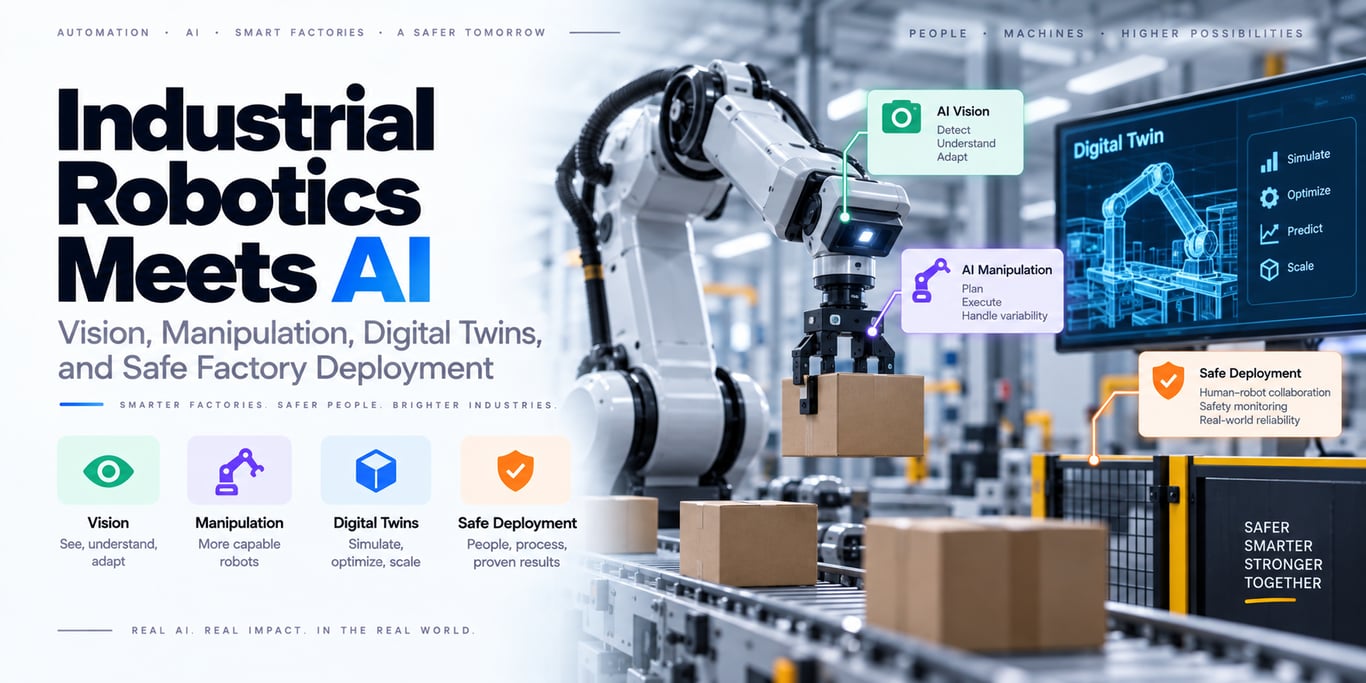
Industrial robotics is moving from rigid, repeatable automation toward systems that can perceive more, adapt more, and handle more variation.
That shift is being driven by AI in several layers:
computer vision
→ understand parts, defects, people, and workspace

learning-based control
→ handle variation in manipulation

planning
→ choose actions around changing conditions

simulation / digital twins
→ train and test before touching the real line

predictive analytics
→ detect maintenance and process anomalies
But AI does not replace the fundamentals of industrial automation. Safety interlocks, deterministic control, cycle-time guarantees, quality systems, and fail-safe behavior still matter.
The useful production rule is:
> Use AI to increase flexibility. Keep safety and critical process invariants deterministic.
Industrial robots are already deployed at massive scale
The International Federation of Robotics reported 542,000 industrial robots installed worldwide in 2024, more than double the annual number a decade earlier. Asia accounted for 74% of new deployments that year.
That scale matters because factory AI is not a greenfield research problem. It has to integrate with existing:
PLCs
robot controllers
MES / ERP systems
machine vision
safety systems
quality control
The challenge is often integration, not simply model accuracy.
Traditional industrial robotics is deterministic by design
A classic industrial robot may execute a carefully programmed sequence:
move to point A
close gripper
move to point B
place part
repeat
This works extremely well when:
- parts are consistent
- fixtures are precise
- environment is controlled
- task rarely changes
For high-volume manufacturing, deterministic automation can be exactly the right architecture.
AI becomes valuable when the world is less predictable.
1. Vision gives robots flexibility
Computer vision can help robots detect:
part pose
orientation
defects
missing components
workspace obstacles
This is useful for tasks such as:
bin picking
quality inspection
random-part handling
visual alignment
Instead of assuming every part arrives in exactly the same orientation, the system estimates the scene and adapts.
Perception uncertainty must reach the control layer
A vision system should not simply output:
object at x=14.2, y=7.8
with no indication of confidence.
If the camera view is occluded or the part is ambiguous, the control system should be able to:
retry perception
move camera
ask for human intervention
reject the part
A robot that acts confidently on uncertain perception is dangerous.
2. Learning-based manipulation helps with variation
Traditional motion planning works well for known geometry.
Learning-based policies can help with tasks where contact and object variation are harder to model exactly:
flexible material handling
irregular objects
fine insertion
complex grasping
The benefit is adaptability.
The cost is harder verification.
Keep learned control inside bounded operating envelopes
A production system should define constraints such as:
allowed workspace
speed limits
force limits
forbidden zones
safe recovery states
A learned policy may choose motion within that envelope.
It should not redefine the safety envelope itself.
3. Digital twins make experimentation cheaper
Simulation is increasingly central to robotics development.
A digital twin can model:
robot kinematics
factory layout
sensors
conveyors
parts
workers
Teams can use simulation to:
- test reachability
- validate cell design
- generate training data
- evaluate policies
- reproduce edge cases
before changing the real line.
Simulation is powerful—but reality still wins
The simulation never perfectly matches reality.
Differences can include:
friction
lighting
sensor noise
motor response
part tolerance
wear
This is the classic sim-to-real gap.
Production robotics therefore needs staged validation:
simulation
→ hardware-in-the-loop
→ controlled real cell
→ limited production
→ full rollout
4. Synthetic data can help train perception
Factories often do not have millions of labeled images for every defect or part orientation.
Synthetic scenes can generate variation in:
lighting
camera angle
background
part position
rare defects
This can accelerate model development.
But synthetic data should complement—not completely replace—real production data.
Rare failures deserve targeted data collection
A vision model may be 99.9% accurate and still fail on exactly the rare case that causes a line stop.
Keep a dataset of:
production misses
hard reflections
occlusions
rare part variants
new suppliers
and turn them into regression cases.
5. AI can improve quality inspection
Visual inspection systems can detect:
surface defects
missing components
assembly errors
label problems
The important metric is not only overall accuracy.
Factories care about:
false reject rate
false accept rate
throughput
latency
A model that catches every defect but rejects 20% of good product may be unusable.
Connect model metrics to business metrics
Useful evaluation should answer:
How many defects escaped?
How many good parts were rejected?
How much line time was lost?
rather than only reporting:
model F1 = 0.94
Production quality is the real objective.
6. Predictive maintenance is a different AI workload
Robots and factory machines produce telemetry such as:
vibration
temperature
current draw
cycle count
error codes
Models can help identify abnormal patterns before failure.
This is usually a time-series / anomaly-detection problem, not an LLM problem.
Use the simplest model that solves it.
Do not replace maintenance thresholds blindly
Existing deterministic rules often encode years of engineering knowledge.
A good approach is:
rules
+ anomaly model
+ maintenance history
rather than deleting every threshold because “AI is smarter.”
7. Generative AI can help operators and engineers
LLMs are useful around the robot, even when they are not controlling motion.
Examples:
summarize alarms
search maintenance manuals
explain fault codes
generate setup checklists
assist troubleshooting
This is often a lower-risk, high-value entry point.
Use RAG for manuals and procedures
An operator assistant can retrieve from:
OEM manuals
SOPs
maintenance records
approved work instructions
and answer with citations.
That is much safer than relying on generic model knowledge for machine-specific procedures.
8. Vision-language-action models are pushing toward more general robots
New robotics systems increasingly combine:
vision
language
planning
control
into learned policies.
This can make robots easier to program for variable tasks.
But broad generality creates a harder validation problem: the more situations the robot can handle, the more situations you must test.
Generality increases the need for runtime constraints
A generalist policy should still operate inside:
safe workspace
approved tools
known speed / force limits
emergency stop system
Do not ask a foundation model to become the safety controller.
9. Collaborative robots change the workspace model
Traditional industrial robots are often physically separated from people.
Collaborative applications can bring robots and people into closer shared spaces.
That makes system-level safety engineering critical:
speed / separation monitoring
force / power limits
safe stop behavior
risk assessment
AI perception may help understand the environment, but certified safety behavior should not depend only on a probabilistic model.
10. Edge inference matters in factories
Robotic control cannot always wait for cloud round trips.
Local inference is useful for:
vision
tracking
control-adjacent prediction
Benefits include:
lower latency
less network dependency
better data locality
Cloud infrastructure can still be useful for training, fleet analytics, and heavy offline processing.
Separate real-time control from high-level planning
A strong architecture often looks like:
high-level AI planner
        ↓
validated task command
        ↓
robot controller
        ↓
real-time servo / safety control
The LLM or planner may decide what task to perform.
The deterministic controller decides how motors safely execute it at high frequency.
11. Factory integration matters more than flashy demos
A robot is only useful if it connects to the production system.
Typical integration points include:
MES
PLC
conveyor control
quality database
warehouse system
The AI layer needs clear contracts with those systems.
Avoid direct uncontrolled database or PLC access from a model.
12. Recovery behavior is part of the product
Robots will fail.
The question is whether failure becomes:
safe stop + clear recovery
or:
unknown state + line shutdown
Design explicit recovery for:
dropped part
failed grasp
occlusion
network loss
sensor fault
model uncertainty
A production robotics architecture
Sensors / Cameras
      │
      ▼
Perception Models
      │
      ▼
Task Planner / Policy
      │
      ▼
Constraint + Safety Layer
      │
      ▼
Robot Controller / PLC
      │
      ▼
Physical Robot

Around everything:
telemetry + simulation + regression tests + operator controls
AI improves flexibility. The safety/control plane remains explicit.
Evaluate the full cell, not only the model
Useful metrics include:
cycle time
successful picks
recovery rate
false rejects
line stops
mean time between failures
human interventions
A model can improve while the production cell gets worse because latency increased.
System evaluation matters.
Roll out gradually
A useful deployment path is:
simulation
→ lab cell
→ supervised production
→ narrow shift / SKU
→ broader rollout
Collect failures at every stage.
Do not go from research video to full factory authority in one step.
Common mistakes
Adding AI to deterministic tasks that already work perfectly
Flexibility has a cost.
Benchmarking only model accuracy
Measure production outcome.
Trusting simulation completely
Real-world validation is mandatory.
Letting learned policy own safety
Keep safety constraints independent.
Ignoring failure recovery
Robots need explicit safe states.
Cloud-dependent real-time control
Latency and connectivity matter.
Production checklist
Before deploying AI-enabled industrial robotics, verify:
- AI solves real variability that deterministic automation cannot handle well
- Safety-critical behavior is independent of probabilistic model output
- Perception uncertainty has a safe fallback
- Simulation is followed by staged real-world validation
- Production failures become regression data
- Real-time workloads run on suitable local hardware
- Robot / PLC / MES integrations use explicit interfaces
- Recovery states exist for common failures
- Quality metrics connect to production metrics
- Operators can stop and recover the system safely
Final takeaway
Industrial AI is valuable when it makes robots more flexible without making factories less predictable.
Use AI for perception, adaptation, planning, inspection, anomaly detection, and operator assistance. Keep safety, critical control, and business invariants deterministic.
> The best factory robot is not the most intelligent robot. It is the robot that performs the required task safely, repeatedly, and recoverably under real production variation.
References and further reading
Robot safety requirements depend on application, hardware, workplace, and jurisdiction; this article is not a substitute for a formal safety assessment.

Discussion (0)