

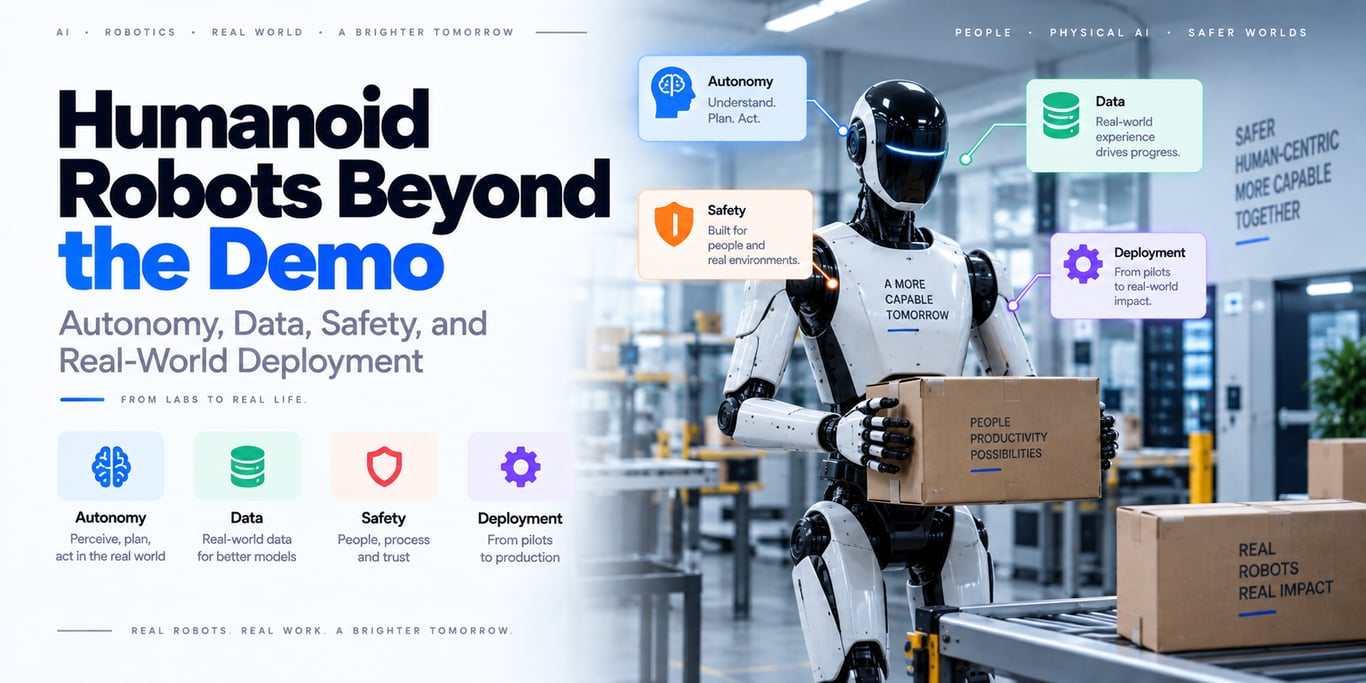
Humanoid robots have moved far enough that the important question is no longer “can a robot walk across a stage?”
The harder question is:
> Can a humanoid perform useful work repeatedly, safely, cheaply, and without a team of engineers standing nearby?
That is a much higher bar.
The current generation of humanoid systems combines several technologies:
vision + touch + proprioception
        ↓
vision-language-action / robot foundation model
        ↓
whole-body planning and control
        ↓
real-time safety and hardware control
In 2026, companies including Figure and Agility are reporting broader real-world deployments, while NVIDIA's Isaac GR00T platform provides open models, data pipelines, simulation, and edge-runtime tooling for humanoid development.
These developments are meaningful—but vendor demonstrations are not the same thing as fleet-level reliability.
Why the humanoid form exists at all
Factories, warehouses, offices, and homes were built for humans.
They contain:
stairs
doors
shelves
carts
tools
human-sized workstations
A humanoid can potentially operate in those environments without rebuilding the entire facility around the robot.
That is the central economic argument for the form factor.
The humanoid shape is also a compromise
Two legs and human-like arms are not always the most efficient engineering solution.
A wheeled mobile manipulator may be:
cheaper
more stable
more energy efficient
for many warehouse tasks.
Use a humanoid when human-compatible mobility and manipulation genuinely create value—not because the shape is impressive.
1. The software problem is becoming a foundation-model problem
Traditional robots are often programmed task by task.
Humanoid developers increasingly want one learned system that can generalize across:
objects
environments
instructions
tasks
NVIDIA describes Isaac GR00T as an open reference platform containing foundation models, data pipelines, simulation tools, middleware, and Jetson-based runtime components for general-purpose humanoids.
The architectural shift is similar to language models: move from one model per narrow behavior toward a general base model that can be adapted.
Vision-language-action models connect instruction to movement
A VLA-style system receives inputs such as:
camera image
language instruction
robot state
and predicts actions.
Example:
“Place the red container on the lower shelf.”
The robot needs to:
understand the instruction
locate the container
plan a grasp
walk / reach
maintain balance
place object
This is much harder than generating text because mistakes become physical.
2. Whole-body control is a major frontier
Manipulation cannot always be separated from locomotion.
A robot carrying an object may need to continuously coordinate:
legs
torso
arms
hands
balance
Figure's Helix 02 announcement in January 2026 describes a unified visuomotor system controlling full-body walking, manipulation, and balance from onboard sensor input.
That is an important technical direction: one task often needs the whole body, not a sequence of isolated controllers.
Vendor demonstrations should be treated as evidence—not universal proof
A four-minute kitchen task or logistics demo can show real progress.
It does not automatically establish:
99.9% fleet reliability
all-day uptime
safe behavior around every worker
positive unit economics
Those require broader operational data.
A strong technical article should distinguish what a company demonstrated from what has been proven across deployment conditions.
3. Data is becoming the scarce resource
Language models can learn from enormous internet text corpora.
Robots need examples connecting observations to physical actions.
Useful robotics data may include:
teleoperation demonstrations
robot fleet trajectories
human video
simulation
synthetic scenes
failed attempts
Physical-action data is harder and more expensive to collect than text.
Teleoperation is often a data engine
A human can remotely operate the robot while the system records:
camera streams
joint states
actions
force / touch
outcomes
Those demonstrations become training data.
The goal is not necessarily to teleoperate forever. It is to teach the autonomous policy what successful behavior looks like.
Failure data matters as much as success data
A dataset full of perfect demonstrations does not teach the robot how to recover from:
slipped grasp
blocked path
fallen object
unexpected person
misaligned container
Real deployment needs recovery behavior.
Fleet systems should capture difficult and failed episodes for retraining and regression testing.
4. Simulation solves part of the data problem
Robotics simulators can generate:
new room layouts
lighting changes
object positions
surface properties
sensor noise
and run thousands of trials without damaging physical hardware.
NVIDIA's GR00T stack combines simulation and synthetic-data tooling with real data specifically to accelerate this cycle.
Sim-to-real remains a hard boundary
No simulator perfectly captures:
friction
motor wear
soft objects
lighting
unexpected contact
human behavior
A policy that works in simulation still needs real-world evaluation.
Use simulation to expand coverage—not as proof of real-world safety.
5. Hands are one of the hardest components
Human hands have extraordinary dexterity and tactile sensitivity.
A humanoid manipulator has to balance:
number of actuators
force
precision
durability
cost
control complexity
More fingers do not automatically mean better production performance.
For a logistics robot, a simpler gripper may outperform a human-like hand if the task is narrow.
Manipulation quality should be measured by task outcome
Useful metrics include:
successful picks per hour
dropped object rate
damage rate
recovery rate
cycle time
A visually impressive hand motion is irrelevant if throughput is too low for the job.
6. Hardware reliability is as important as AI
A humanoid has many moving parts:
actuators
gearboxes
sensors
batteries
compute
joints
A model can improve while hardware failures still dominate downtime.
Commercial systems need maintenance engineering, diagnostics, spare parts, and serviceability—not only better neural networks.
Battery life changes workflow design
A robot that can work for two hours cannot simply replace an eight-hour human shift one-for-one.
Deployment must account for:
charging
battery swap
task scheduling
fleet size
Unit economics depend on complete operating time, not demo duration.
7. Safety must sit below the learned policy
A general robot policy should not be the only component responsible for avoiding harm.
Use independent safety layers for:
emergency stop
speed limits
force limits
workspace constraints
collision monitoring
The AI policy chooses actions inside the permitted envelope.
Shared human environments are especially hard
A home or warehouse may contain:
people
pets
forklifts
moving carts
unexpected objects
The robot needs to understand dynamic scenes, but deterministic fail-safe behavior remains essential.
Probabilistic perception should degrade into a safe state when uncertainty is too high.
8. Industrial deployment will likely lead consumer homes
Structured work environments are easier to constrain.
Factories and warehouses can define:
known tasks
known shift schedule
controlled inventory
restricted work zones
trained operators
Homes are vastly more varied.
A commercial humanoid that moves totes in a controlled facility has a much easier validation problem than a robot expected to safely do “anything” around children and pets.
9. Humanoids need system integration
Useful work requires interaction with business systems.
Example:
warehouse management system
→ assigns tote move
→ robot executes
→ confirms task
→ inventory system updates
Do not make a language model directly mutate enterprise state without validated interfaces.
Use narrow task APIs.
10. Fleet learning creates a software advantage
If every deployed robot collects high-quality experience, the company can improve a shared policy.
Conceptually:
fleet encounters edge cases
→ select useful episodes
→ retrain / fine-tune
→ regression simulation
→ staged rollout
The data flywheel can become more important than the robot chassis itself.
Model updates need canary deployment
Do not push a new policy to an entire physical fleet immediately.
Use:
simulation regression
→ lab robots
→ small canary fleet
→ supervised operation
→ broader rollout
Physical rollback needs to be as deliberate as software rollback.
11. General-purpose does not mean universal
A useful humanoid may support dozens or hundreds of tasks while still operating within a defined domain.
That is very different from human-level general physical intelligence.
Marketing language should not erase the distinction.
12. Economics decides whether a humanoid is useful
A deployment must outperform alternatives on total cost and capability.
Consider:
robot purchase / lease
maintenance
charging
integration
human supervision
throughput
uptime
Compare against:
fixed automation
mobile robots
cobots
human labor
process redesign
The humanoid wins only if its flexibility is worth the cost.
A practical deployment scorecard
Measure:
Task success
How often is the job completed correctly?
Intervention rate
How often does a human need to rescue the robot?
Recovery rate
Can it solve common failures itself?
Throughput
Tasks per hour / shift.
Uptime
How long does it operate before service?
Safety events
Near misses and emergency stops.
Cost per successful task
The most important business metric.
Current ecosystem signals
Several 2026 developments illustrate where the field is going:
- Figure's Helix 02 focuses on full-body learned autonomy.
- Agility announced Digit 5 with an emphasis on cooperatively safe work at scale.
- NVIDIA's Isaac GR00T provides an open robotics foundation-model and simulation stack.
These are signals of increasing technical maturity—not proof that general humanoid labor has already been solved.
Common mistakes
Evaluating by viral demo
Measure repeatability and intervention rate.
Assuming humanoid is always better than wheels
Choose the form for the task.
Ignoring hardware reliability
AI is only one subsystem.
Letting foundation model own safety
Use independent safety controls.
No fleet rollback strategy
Physical model releases need staged deployment.
Measuring only labor replacement
Some value comes from flexibility, ergonomics, or operating in hard-to-staff workflows.
Production checklist
Before deploying humanoids, verify:
- Humanoid form solves a real environment constraint
- Task success and intervention rates are measured
- Learned control operates inside deterministic safety limits
- Failure recovery is explicitly tested
- Real-world data complements simulation
- Battery / charging strategy supports the workflow
- Hardware serviceability is understood
- Enterprise integrations use narrow interfaces
- Model releases use simulation + canary rollout
- Cost per successful task beats realistic alternatives
Final takeaway
Humanoid robotics has made real progress because perception, foundation models, simulation, data collection, and hardware are improving together.
The remaining challenge is not producing another impressive video.
> The commercial milestone is a robot that performs useful physical work with low intervention, predictable safety, high uptime, and economics that make sense.
That is the standard by which humanoids should be evaluated.
References and further reading
- NVIDIA — Isaac GR00T
- Figure — Helix 02: Full-Body Autonomy
- Figure — News and Deployment Updates
- Agility Robotics — Latest Press and Digit Updates
Vendor demonstrations and deployment claims should be interpreted in the context in which they were published; independently measured fleet-level performance may differ.

Discussion (0)