

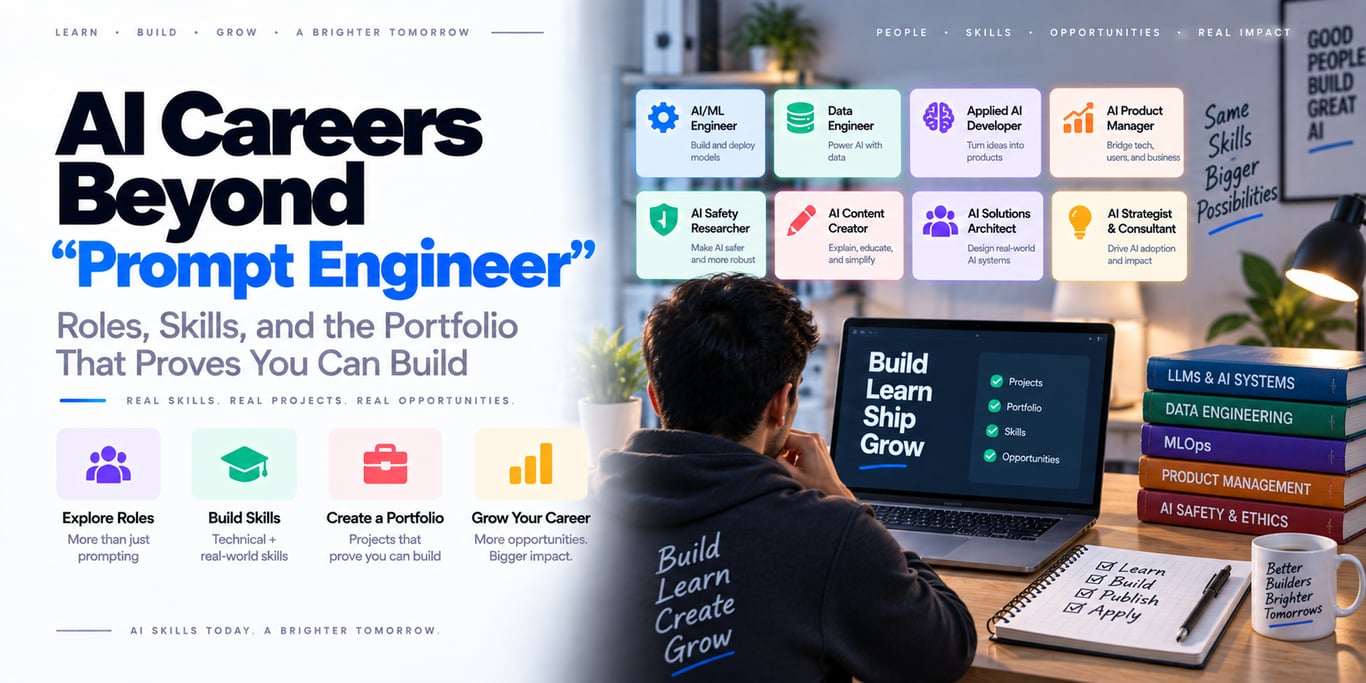
The safest way to build an AI career is not to chase the newest job title.
It is to become useful at a layer of the AI stack that companies will still need when models, APIs, and frameworks change.
That matters because “AI jobs” now cover very different kinds of work:
researching models
building AI products
operating ML infrastructure
designing retrieval and agent systems
evaluating reliability
securing AI workflows
turning business processes into useful products
The market signals are real, but they should be read carefully. In the United States, the Bureau of Labor Statistics currently projects 2024–2034 employment growth of 33.5% for data scientists, 28.5% for information security analysts, 19.7% for computer and information research scientists, and 15.8% for software developers. These are U.S. occupational projections, not guarantees for any individual job seeker.
Globally, the World Economic Forum's Future of Jobs 2025 survey found AI and big data among the fastest-growing skill areas reported by employers, alongside cybersecurity and technological literacy. The same survey also emphasizes analytical thinking, resilience, collaboration, and other human skills.
The practical lesson is simple:
> Do not build your career around one model or one prompt trick. Build durable engineering, data, product, and evaluation skills—and learn how AI changes the way those skills are applied.
“AI career” is not one career
A researcher training a new reasoning model and a backend engineer connecting an LLM to a billing system both work in AI.
Their day-to-day skills can be almost completely different.
A useful map is:
AI / ML Research
      │
ML Engineering
      │
AI Application Engineering
      │
Agent / Runtime Engineering
      │
Data + ML Platform Engineering
      │
Evaluation / Reliability
      │
AI Security / Governance
      │
AI Product / Design / Workflow
You do not need to become expert in every layer.
You need one strong home base and enough adjacent knowledge to build complete systems.
1. AI / ML researcher
This is the most model-centric path.
Typical work includes:
new architectures
training methods
optimization
reasoning research
multimodal learning
alignment
benchmark design
Strong foundations usually include:
linear algebra
probability
statistics
optimization
machine learning
PyTorch / JAX-style frameworks
research methodology
This path often requires deeper mathematics and research experience than ordinary AI application development.
Research roles are not required to build valuable AI products
A common misconception is:
I need to understand transformer training from scratch before I can work in AI.
Most companies are not training frontier foundation models.
They are building products on top of existing models.
If your goal is SaaS, automation, agents, or enterprise software, application and systems engineering may be far more relevant.
2. Machine-learning engineer
ML engineers turn models into reliable software systems.
Typical responsibilities can include:
data pipelines
training jobs
feature pipelines
model serving
experiment tracking
monitoring
model rollout
The role sits between data science and production engineering.
Strong candidates usually understand both:
model behavior
and
software / infrastructure behavior
Production ML is mostly systems work
Training a good notebook model is only one step.
Production needs:
reproducible data
versioned models
serving
latency budgets
rollback
monitoring
A model that cannot be deployed, observed, or updated safely is not a production capability.
3. AI application engineer
This is one of the broadest opportunities for ordinary software engineers.
An AI application engineer builds products around hosted or self-hosted models.
Typical stack:
backend API
LLM provider
structured outputs
RAG
tools
queues
PostgreSQL
frontend / product workflow
This role is closer to backend/product engineering than model research.
Software engineering becomes more important—not less
AI applications still need:
authentication
multi-tenancy
billing
databases
caching
queues
observability
security
The model is one dependency inside a larger system.
A strong backend engineer who learns AI system design can often become productive faster than someone who only knows prompt syntax.
4. Agent / AI runtime engineer
As AI systems gain tools and autonomy, a new systems layer becomes important.
Agent runtime engineers work on things such as:
tool execution
durable runs
streaming
state
memory
approvals
cancellation
retries
budgets
sandboxing
This is deeply related to distributed systems and backend engineering.
Agent engineering is not “write a clever system prompt”
A production agent may need to survive:
provider timeout
tool failure
worker restart
user cancellation
ambiguous write outcome
The difficult work is often normal reliability engineering around probabilistic decisions.
Skills such as idempotency, queues, state machines, and tracing matter enormously.
5. Retrieval / search engineer
RAG has created renewed demand for information-retrieval skills.
Useful knowledge includes:
BM25
embeddings
vector indexes
hybrid search
reranking
metadata filters
retrieval evaluation
The job is not simply “put documents in a vector database.”
Good retrieval systems solve relevance, freshness, permissions, and scale.
Search quality is measurable
Learn metrics such as:
Recall@k
MRR
nDCG
Build labeled query sets.
Compare:
BM25
vs vector
vs hybrid
vs reranked hybrid
This turns RAG work from intuition into engineering.
6. Evaluation / AI reliability engineer
As AI applications become production systems, evaluation is becoming a first-class discipline.
Work may include:
eval datasets
deterministic graders
LLM-as-a-judge
trajectory evaluation
RAG evaluation
red teaming
regression suites
The goal is to answer:
Did the new model actually improve our product?
with evidence rather than demos.
Evals combine QA, data, and product thinking
A useful evaluator understands:
what users need
which failures matter
what can be graded deterministically
where human judgment is required
This makes evaluation a valuable specialization even for engineers who do not train models.
7. AI security engineer
Tool-using agents create new attack surfaces.
Relevant problems include:
prompt injection
excessive agency
sandbox escape
data exfiltration
RAG poisoning
unsafe output handling
third-party tool risk
This role combines application security with AI-specific threat modeling.
Security fundamentals remain the foundation
Learn:
least privilege
authentication / authorization
sandboxing
network isolation
secret management
input validation
AI does not repeal established security principles.
It creates new ways those principles can be violated.
8. Data / ML platform engineer
AI systems depend on data infrastructure.
Typical work includes:
ingestion
warehouse / lakehouse
feature pipelines
training datasets
vector indexes
stream processing
lineage
This can be an excellent AI path for data engineers who already understand large-scale systems.
Data quality becomes model quality
If source data is stale, duplicated, poorly labeled, or unauthorized, better model intelligence cannot fully repair it.
Data engineers increasingly influence AI product quality directly.
9. AI product manager / workflow designer
Companies also need people who can determine where AI should be used.
The work includes:
workflow mapping
user research
risk boundaries
human / AI handoff
success metrics
product rollout
The best AI product people understand both capabilities and limitations.
Product skill is not “write prompts”
A strong product person asks:
Should this be AI at all?
Should this be a workflow or an agent?
What requires human approval?
How do we measure success?
Those decisions often matter more than the exact model provider.
So what about “prompt engineer”?
Prompting is useful.
But it is usually stronger as one skill inside a broader role than as the entire career foundation.
A backend engineer needs good instructions for agents.
An evaluator needs good grader prompts.
A product person needs good prototypes.
A researcher may need prompt-based benchmarks.
The durable value is understanding how to design reliable model interactions—not memorizing one provider's current prompting quirks.
Build one strong technical foundation first
If you are already a developer, do not reset your career to zero.
Map your existing strengths.
Backend developer
Add:
LLM APIs
structured outputs
tool calling
RAG
evals
Data engineer
Add:
embeddings
training datasets
vector search
AI data governance
Security engineer
Add:
prompt injection
agent threat modeling
sandboxing
AI red teaming
Frontend / product engineer
Add:
streaming UX
AI interaction design
human-in-the-loop workflows
AI expertise should compound your existing leverage.
Learn enough ML to reason correctly
Application engineers do not need a PhD, but they should understand basic concepts such as:
training vs inference
overfitting
embeddings
fine-tuning
evaluation
precision / recall
Without these basics, it is easy to use the wrong technique for the problem.
Learn model APIs as systems, not SDK snippets
Do not stop at:
client.responses.create(...)
Understand:
streaming
rate limits
retries
structured output
context limits
usage accounting
These determine production reliability.
Learn tool calling deeply
Tool calling is where AI connects to real software.
Build tools that are:
narrow
typed
authorized
observable
Then learn how to handle:
invalid arguments
ambiguous outcomes
retries
This is far more valuable than another toy chatbot.
Learn RAG as search engineering
A useful portfolio project should include:
hybrid retrieval
metadata filters
reranking
citations
retrieval evals
not only embeddings + cosine similarity.
Show that you understand failure modes.
Learn evals early
If you cannot measure an AI system, you cannot improve it professionally.
Build a small eval suite for every serious project.
Include:
normal cases
hard cases
known failures
security cases
Compare model or prompt versions using the same cases.
Learn deployment and observability
A portfolio app running only in a notebook hides many real problems.
Deploy something.
Track:
latency
errors
model usage
tool calls
Show how the system fails and recovers.
The portfolio that actually proves skill
One strong project is better than ten identical ChatGPT wrappers.
A serious portfolio project might contain:
real user problem
backend API
RAG or tools where justified
structured state
authentication / permissions
evals
tests
observability
deployment
README with architecture and trade-offs
The project should prove that you can build a system—not just call a model.
Example portfolio: support agent
Build:
support chat
→ RAG over docs
→ live mock account tools
→ refund proposal
→ approval
→ postcondition verification
Then include:
retrieval evals
tool-use evals
prompt-injection tests
This demonstrates multiple real skills in one system.
Example portfolio: coding agent
Build a bounded repository agent that can:
search files
edit code
run tests
Add:
sandbox
command timeout
verification
Then publish examples of bugs it solves and failures it still has.
That is much more convincing than a polished landing page.
Publish technical reasoning, not only screenshots
Strong candidates can explain:
why PostgreSQL instead of a vector DB
why the agent has read-only tools
why hybrid search improved recall
why a model upgrade was rejected
Hiring teams want evidence of judgment.
Open-source contributions can prove depth
Contributing to:
SDK
agent framework
eval tool
retrieval library
observability project
can demonstrate your ability to work inside real codebases and specifications.
Even documentation or bug fixes can be useful if they show technical understanding.
Do not build your career around one provider
OpenAI, Anthropic, Google, Mistral, and open-weight ecosystems will keep changing.
Learn transferable concepts:
model capability evaluation
structured interfaces
tool orchestration
retrieval
state
security
Provider-specific knowledge is useful, but it should sit on top of these foundations.
Keep your learning loop short
A good AI learning cycle is:
learn concept
→ build small feature
→ test it
→ observe failure
→ read deeper
→ improve
Do not spend six months watching courses without building.
AI tooling changes too quickly for passive learning alone.
Read primary documentation
Blog posts are useful for discovery.
But become comfortable with:
API docs
research papers
source code
technical RFCs
model cards
That is how you avoid repeating outdated internet advice.
Human skills remain important
The World Economic Forum's employer survey does not show technology skills replacing everything else.
It also highlights demand for:
analytical thinking
creative thinking
resilience
leadership
collaboration
AI can increase the value of people who combine technical execution with problem framing and communication.
Learn to explain uncertainty
Good AI engineers do not say:
This model is 98% accurate, so we're done.
They ask:
98% on which population?
which cases fail?
what happens when it is wrong?
That judgment becomes more valuable as systems become more autonomous.
Current labor-market signals are encouraging—but not promises
The U.S. BLS currently projects strong 2024–2034 growth for several technology occupations associated with AI, including data science, security, research science, and software development.
These projections describe occupational demand in the U.S. economy. They do not mean every AI-labelled role will grow or that hiring will be easy.
Skill depth and market conditions still matter.
The strongest strategy is a T-shaped profile
Build depth in one area:
backend
ML
search
data
security
product
and broad familiarity with adjacent AI layers.
For example:
Deep: backend / distributed systems
Broad: LLMs + tools + RAG + evals + security
This is more resilient than shallow familiarity with every new framework.
A practical 90-day learning plan
Month 1 — Foundations
Learn:
LLM APIs
structured outputs
embeddings
tool calling
basic evals
Build one small app.
Month 2 — Production architecture
Add:
PostgreSQL
RAG or live tools
authentication
streaming
observability
Month 3 — Reliability
Add:
eval dataset
failure injection
security tests
cost / latency measurements
Then publish the architecture and lessons.
Common career mistakes
Chasing every framework
Concepts outlive libraries.
Building only chatbot clones
Demonstrate real system engineering.
Ignoring evaluation
Professional AI work requires measurement.
Learning AI while abandoning your existing expertise
Compound what you already know.
Calling yourself an expert after one API tutorial
Build, debug, deploy, and measure real systems.
Optimizing your résumé around one temporary title
Skills travel better than titles.
Career checklist
A strong AI-builder profile can usually demonstrate:
- Solid programming fundamentals
- Production backend or ML knowledge
- Model API integration beyond simple chat
- Structured outputs and tool calling
- RAG/search fundamentals where relevant
- Evaluation and regression testing
- Security/privacy awareness
- Deployment and observability
- Ability to explain architecture trade-offs
- One or two serious projects with measurable outcomes
Final takeaway
AI careers are broadening, not collapsing into one magical new job title.
Researchers, ML engineers, software engineers, data engineers, security engineers, evaluators, and product builders all have valuable paths into the field.
The most resilient strategy is to combine a real professional foundation with AI-system skills that transfer across models and vendors.
> Do not aim to be the person who knows today's AI tool best. Aim to be the person who can turn changing AI capabilities into reliable software and measurable outcomes.
Sources and further reading
- U.S. Bureau of Labor Statistics — Artificial Intelligence, Information Technology, and Employment, 2024–34
- World Economic Forum — Future of Jobs Report 2025
- World Economic Forum — Skills Outlook
Employment projections are estimates for specific populations and time periods, not guarantees of future hiring outcomes.

Discussion (0)