

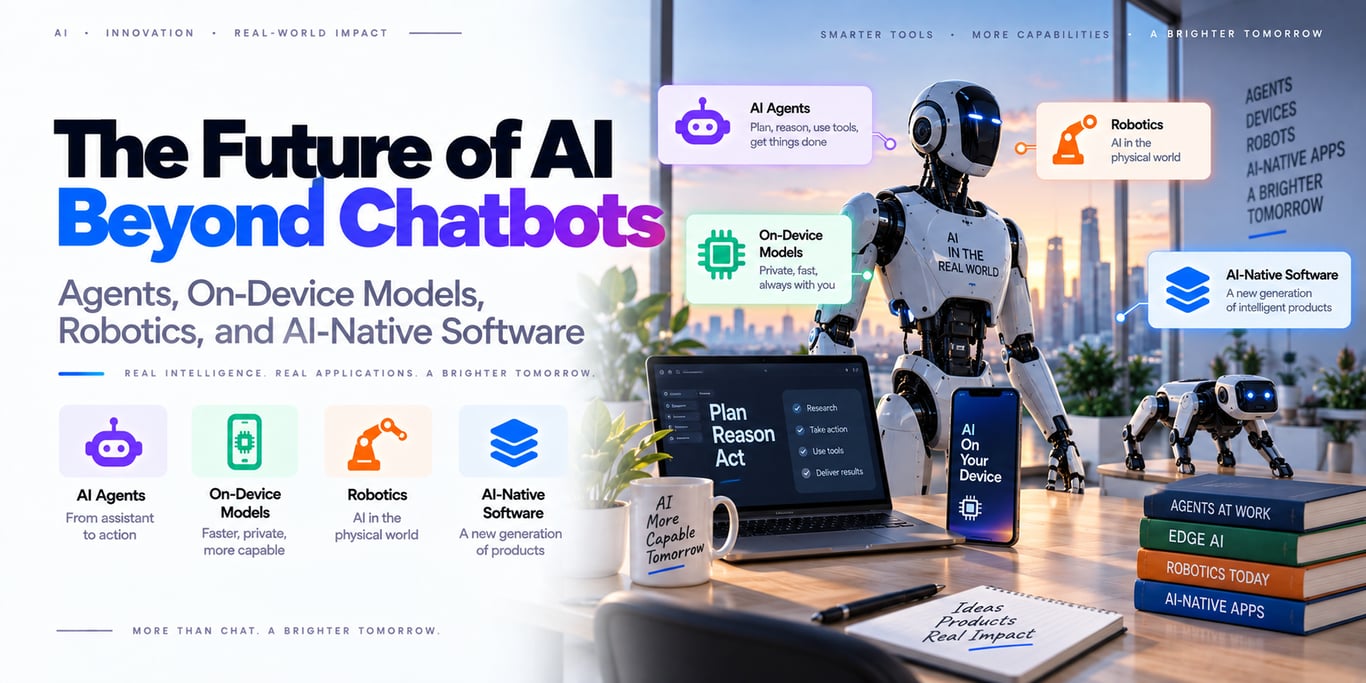
Predicting AI is easy. Predicting it usefully is harder.
The internet is full of confident claims about artificial general intelligence, mass job replacement, humanoid robots in every home, and one model eventually doing everything. Some of those ideas may happen. Some may not. Most cannot be dated honestly.
A better way to think about the future of AI is to start with technologies that are already moving from research into real products, then ask which direction those signals point.
That produces a much more grounded picture:
chat → agents that do work
single model → routed model systems
cloud-only → hybrid cloud + on-device AI
closed API only → hosted + open-weight + private deployment
prompt engineering → context / tool / memory engineering
text generation → multimodal software
AI demo → evals, permissions, observability, and rollback
software intelligence → physical AI and robotics
This article separates three different things:
- Already happening — technologies that are in production or official developer platforms today.
- High-confidence direction — trends supported by multiple current product and infrastructure signals.
- Speculation — ideas that may happen, but where timelines and economics are still too uncertain for confident prediction.
That distinction matters. Good forecasting should help builders make decisions—not just make dramatic headlines.
The biggest shift: AI is moving from answering to doing
The first major wave of generative AI was conversational.
user asks
→ model answers
The next wave is increasingly operational:
user gives goal
→ agent plans
→ uses tools
→ reads results
→ changes state
→ continues
→ asks for approval when needed
→ verifies outcome
This is not theoretical anymore.
OpenAI's Agents API, introduced in September 2026, is explicitly designed for cloud agents that can work with files, execute code, coordinate subagents, preserve intermediate results, and continue working over long time horizons. Anthropic has separately documented production patterns for multi-agent research and long-running coding agents that must carry work across multiple context windows.
High-confidence prediction
AI products will increasingly be designed around delegated tasks, not only conversations.
The interface may still look like chat, but the backend will behave more like a workflow runtime.
Chat will become one interface to a larger execution system
Today, many products expose AI as:
textbox
→ response
A more agentic product might expose:
Goal
→ Running
→ Waiting for approval
→ Completed
Users may care less about every intermediate message and more about:
What is the agent doing?
What changed?
What needs my approval?
Did it actually finish?
This means future AI UX will likely include more:
- progress states
- background execution
- approvals
- artifacts
- history
- rollback
- audit trails
Chat remains useful, but it becomes the control surface, not the entire product.
Long-running agents change the infrastructure problem
A chatbot can often live inside one HTTP request.
A serious agent may need to:
work for 30 minutes
wait for user approval
resume tomorrow
survive deployment
spawn subtasks
save partial artifacts
That requires infrastructure such as:
durable state
queues
cancellation
checkpoints
idempotency
budget tracking
Anthropic's work on long-running coding agents highlights a fundamental limitation: context windows are finite, while useful work can span many sessions. Their solution involves leaving explicit artifacts and state for later agent sessions.
High-confidence prediction
The competitive advantage in agent products will increasingly come from the harness/runtime around the model, not only from the model itself.
The future agent stack will look more like software infrastructure
A production AI runtime increasingly resembles:
Model
+ Context builder
+ Tools
+ Memory
+ State
+ Permissions
+ Retry policy
+ Evals
+ Observability
The model reasons.
The surrounding system determines what the model can see, what it can do, how long it can run, what gets remembered, and whether an action is allowed.
That is why AI engineering is moving away from pure prompt writing.
Prompt engineering is turning into context engineering
Anthropic describes context engineering as the natural progression from prompt engineering.
The question is no longer only:
What system prompt should I write?
It is:
Which instructions belong here?
Which tools should be visible?
Which memories matter?
Which documents should be retrieved?
Which old tool results should be removed?
A capable agent continuously produces more context:
messages
tool results
retrieved documents
plans
artifacts
If everything is kept forever, quality can decline even when the model gets stronger.
High-confidence prediction
Context management will become a core application layer, similar to state management in web applications or query planning in databases.
Memory will become more structured
Early AI memory systems often looked like:
embed every message
→ vector search later
That is too crude for many production systems.
Useful memory has different types:
working memory → current task context
semantic memory → facts/preferences
episodic memory → previous events
procedural memory → reusable instructions/skills
workflow state → current operational truth
These types need different storage and lifecycle policies.
A preference such as:
user prefers concise answers
should not be managed the same way as:
refund approval is pending
High-confidence prediction
Agent memory will move from “vector database feature” toward a versioned data architecture with provenance, scope, correction, and deletion.
AI will become more modular—not one model doing everything
It is tempting to imagine one frontier model handling every request.
In practice, production systems increasingly route tasks among different components.
A future application may use:
small local model
→ fast private tasks

large cloud reasoning model
→ difficult planning

embedding model
→ retrieval

reranker
→ search relevance

speech model
→ voice

vision model
→ image understanding
The architecture becomes a model portfolio, not one model ID.
Model routing will become a normal backend concern
Routing can consider:
task complexity
privacy
latency
cost
modality
device capability
Example:
short text rewrite
→ local model

complex research
→ cloud reasoning model

current order status
→ deterministic API/tool
This is more reliable than asking a huge model to do every job.
High-confidence prediction
AI platforms will increasingly include a capability router that chooses between models, tools, and deterministic software.
Cloud-only AI is giving way to hybrid AI
On-device AI has improved enough that it is now part of mainstream developer platforms.
Apple's Foundation Models framework gives developers access to on-device models with structured output, tool calling, multimodal input, and the ability to switch between local, Private Cloud Compute, and other model providers.
Android's ADK can use Gemini Nano locally and explicitly supports architectures where a cloud agent delegates privacy-sensitive subtasks to on-device agents.
These are strong signals.
High-confidence prediction
Many consumer AI applications will become hybrid by default:
private / fast / offline task
→ device

large-context / high-reasoning task
→ cloud
Cloud AI will not disappear. It will become one tier in a larger system.
Why on-device AI matters beyond privacy
Privacy is only one advantage.
On-device inference also offers:
low latency
offline behavior
zero network round trip
lower marginal cloud cost
access to device sensors
A phone agent can potentially combine:
camera
microphone
local documents
app actions
without sending every intermediate step to a server.
That opens a new class of highly contextual applications.
Smaller models will remain important
Frontier models receive most attention, but small models can win operationally.
A smaller model may offer:
faster response
lower cost
local deployment
predictable workload
If a 3B model reliably performs one narrow task, using a giant reasoning model can be wasteful.
High-confidence prediction
The future AI stack will contain more specialized small models, not fewer.
Frontier models will handle the hardest tasks; smaller models will absorb high-volume repetitive ones.
Open-weight models will coexist with closed APIs
The market is not converging on one distribution model.
OpenAI now offers gpt-oss open-weight reasoning models under Apache 2.0, including 120B and 20B variants that can be run on infrastructure controlled by the user or organization.
Mistral continues to release permissively licensed open models while also investing in regional and sovereign inference infrastructure.
That creates several deployment options:
hosted frontier API
private cloud
self-hosted open weights
regional managed inference
on-device model
High-confidence prediction
Organizations will increasingly choose models based on control requirements, not only benchmark rank.
Important requirements include:
data residency
customization
latency
cost
IP / privacy
hardware availability
Closed and open models will coexist.
AI sovereignty will become an infrastructure concern
Some governments and large enterprises want control over:
where data is processed
which model runs
which hardware serves it
whether model weights are portable
Mistral's 2026 infrastructure strategy explicitly emphasizes regional inference, open models, and sovereign control.
This is not only political positioning. It affects procurement, regulation, reliability, and enterprise architecture.
Medium-to-high confidence prediction
Large organizations will increasingly maintain multi-provider and private-model fallback strategies rather than trusting one external endpoint forever.
Multimodal AI will become ordinary application infrastructure
Text was the first mainstream interface because it was easy to integrate.
The next generation increasingly works across:
text
image
audio
video
sensor data
Apple's latest Foundation Models framework supports text and image understanding. Mistral Small 4 combines reasoning, multimodal input, and agentic capabilities in one model family.
The important shift is not that AI can “see images.”
It is that multimodal input will become a normal application primitive.
Multimodal apps will understand situations, not only messages
Imagine a maintenance assistant that receives:
photo of machine
+ error code
+ maintenance manual
+ live sensor data
or a mobile assistant that uses:
camera
+ screen
+ voice
+ local app state
These systems reason over the situation, not just the sentence.
High-confidence prediction
Many AI features will stop looking like text chat even though language models remain inside the system.
Tool protocols are becoming infrastructure standards
Every AI application used to build custom connectors for every tool.
The Model Context Protocol is turning tool and data access into a reusable interface.
The MCP 2026-07-28 specification moved to a stateless core, added long-running Tasks, improved authorization, formalized extensions, and updated official Tier 1 SDKs including TypeScript, Python, Go, and C#.
The important trend is bigger than MCP itself.
High-confidence prediction
AI applications will increasingly expect standard tool interfaces, just as web applications expect HTTP APIs.
This can reduce integration cost and make tools portable across multiple AI hosts.
But standard protocols do not solve trust automatically
Connecting tools is easy compared with authorizing them safely.
An enterprise agent still needs to know:
which user is acting?
which tenant?
what scope?
which tool is allowed?
what requires approval?
MCP's recent specification work puts significant emphasis on authorization because this is one of the hardest real deployment problems.
High-confidence prediction
Agent identity and delegated authorization will become major infrastructure categories.
Tool connectivity without identity is not enough for enterprise agents.
AI-native software will look different from “software with a chatbot”
Most current products add AI beside existing UI.
Dashboard
+ AI button
AI-native software can redesign the workflow itself.
Example:
Traditional CRM:
user manually opens account
→ reads notes
→ checks emails
→ creates follow-up
AI-native CRM:
agent continuously prepares account state
→ flags opportunity
→ drafts next action
→ user approves / edits
The difference is structural.
Software may move from page navigation to intent execution
Traditional SaaS asks the user:
Which page do you want?
Agentic software asks:
What outcome do you want?
Then the runtime coordinates the required systems.
This will not eliminate dashboards.
People still need:
visibility
manual control
review
configuration
But many workflows may start from intent instead of navigation.
Medium-to-high confidence prediction
The best SaaS products will combine:
traditional deterministic UI
+ agentic intent execution
rather than replacing one with the other.
Coding is one of the clearest early examples
Coding agents already demonstrate what delegated software work looks like.
Instead of:
complete this line
an agent may:
inspect repository
reproduce bug
edit several files
run tests
fix failures
report result
OpenAI's Agents API, Anthropic's long-running harness work, and products from multiple model providers all point toward increasingly asynchronous software work.
High-confidence prediction
Software engineering tools will continue moving from autocomplete → collaborator → delegated worker.
The engineer's role shifts toward specification, review, architecture, and verification.
Evals will become as normal as tests
Traditional software has unit tests.
AI systems need tests plus evaluations for probabilistic behavior.
Anthropic's 2026 agent-evaluation guidance emphasizes that agents require more than final-answer grading because they operate across multiple turns, call tools, change state, and adapt to intermediate results.
Useful agent evals measure:
task success
correct tool
correct arguments
trajectory safety
side effects
latency
cost
High-confidence prediction
Serious AI teams will maintain eval suites as release gates, similar to automated tests.
A model upgrade will increasingly be treated like a production dependency upgrade—not a button that teams press because a leaderboard improved.
AI observability will become its own engineering discipline
Traditional logs answer:
Did the API return 500?
Agent observability needs to answer:
Which model decision failed?
Which tool was called?
Why did the agent retry?
What context did it receive?
What state changed?
This creates demand for:
traces
eval links
version tracking
cost telemetry
human feedback
High-confidence prediction
AI observability will converge with application observability but retain model-specific dimensions.
Security will move from prompt rules to capability control
Early AI safety often focused on:
Don't say X.
Agent safety increasingly asks:
Can this agent call delete_user()?
Can it access another tenant?
Can untrusted web content trigger a tool?
Can it send data externally?
This is a different security problem.
The strongest controls are architectural:
least privilege
sandboxing
authorization
approval gates
network restrictions
idempotency
High-confidence prediction
The more capable agents become, the more important permission architecture becomes relative to prompt-based guardrails.
AI will increasingly move into the physical world
The jump from software agents to physical agents is already underway.
NVIDIA's Isaac GR00T platform includes open robot foundation models, data pipelines, simulation tools, middleware, and Jetson Thor inference infrastructure for humanoid development.
In May 2026 NVIDIA also announced an open humanoid reference design built around the GR00T platform.
This is a real signal that foundation-model ideas are moving into robotics.
Industrial robotics will likely scale before general home robots
Factories and warehouses have advantages:
controlled environments
repeatable tasks
known safety zones
trained operators
clear ROI
Homes contain far more variation:
children
pets
stairs
clutter
unpredictable objects
Medium-confidence prediction
General-purpose robots will make meaningful progress first in structured commercial environments before becoming common household workers.
The exact pace is uncertain.
Physical AI will combine simulation, data, and real-world feedback
Robotics cannot rely on internet text alone.
Training data may come from:
teleoperation
robot fleet experience
simulation
synthetic worlds
human video
Then deployment creates a flywheel:
robot fails
→ collect episode
→ retrain
→ simulate
→ canary deploy
This looks surprisingly similar to software agent evolution—except failures happen in the physical world.
Work will change task by task, not job title by job title
The labor market is another area where prediction is often too dramatic.
The ILO's 2025 task-level global analysis covers nearly 30,000 occupational tasks. It concludes that one in four workers worldwide are in occupations with some degree of GenAI exposure, but that most jobs are more likely to be transformed than made redundant because human input remains necessary.
This is a much more useful framing than:
AI will replace job X.
AI adoption will change the composition of work
A role may contain:
research
first draft
routine analysis
exception handling
client communication
final decision
AI can absorb the repetitive portions while leaving—or even increasing—the importance of:
judgment
verification
relationships
accountability
High-confidence prediction
Many knowledge-worker roles will become AI-assisted workflows before they become fully autonomous workflows.
Verification will become a general professional skill
When AI can produce:
code
analysis
contracts
reports
research
people need to evaluate:
Is it correct?
What evidence supports it?
What is missing?
What happens if it is wrong?
The World Economic Forum's Future of Jobs research points in the same direction: AI and big data are among the fastest-growing skills reported by employers, while analytical thinking, resilience, creative thinking, leadership, and collaboration remain important.
High-confidence prediction
AI literacy will matter, but domain judgment + AI literacy will matter more than tool familiarity alone.
The standalone “prompt engineer” role will probably become less special
Prompting will remain useful.
But it is increasingly becoming one skill inside larger roles:
software engineer
AI evaluator
product manager
researcher
designer
analyst
As tooling improves, much of the value shifts toward:
context design
tool design
evals
workflow design
Medium-confidence prediction
Prompting will become a general workplace skill similar to search or spreadsheets rather than a standalone long-term profession in most organizations.
AI will not remove deterministic software
One of the biggest misconceptions is that agents will replace ordinary code.
They will not.
Known logic should remain known logic.
Example:
if subscription_expired:
    deny_access()
There is no reason to ask a language model whether access should be denied every time.
Future AI-native systems will still contain enormous amounts of:
SQL
APIs
state machines
business rules
validation
The model will handle ambiguity and adaptation around them.
The winning architecture will be probabilistic + deterministic
A strong system may look like:
user intent
   ↓
LLM decides next action
   ↓
structured tool request
   ↓
deterministic authorization
   ↓
business logic
   ↓
tool executes
   ↓
LLM interprets result
The model brings flexibility.
The code keeps hard guarantees.
High-confidence prediction
The future of software is not “LLMs replace code.”
It is LLMs becoming another control layer inside normal software systems.
What probably will NOT happen as quickly as headlines suggest
Useful forecasting also requires saying what remains uncertain.
One universal agent replaces every SaaS application
Unlikely in the near term.
Enterprise software contains permissions, workflows, domain rules, specialized data models, and accountability that general agents still need to integrate with.
Everything moves on-device
Unlikely.
Frontier reasoning and very large context still benefit from cloud infrastructure.
Everything stays in the cloud
Also unlikely.
On-device platforms are already becoming capable enough for meaningful local tasks.
Open models eliminate closed APIs
Unlikely.
Different workloads value different trade-offs.
Humanoid robots become ordinary household appliances immediately
Still highly uncertain.
Hardware cost, safety, reliability, battery life, and real-world variation remain hard.
We can reliably predict an AGI date
No.
Capabilities can be measured. A precise date for broadly defined AGI cannot currently be inferred from today's public product roadmap with scientific confidence.
A confidence map for the next AI era
| Direction | Confidence | Why |
|---|---|---|
| Agents handle more multi-step work | High | Already present in production agent platforms |
| Long-running/background AI work increases | High | Managed agent infrastructure is shipping now |
| Cloud + on-device hybrid AI expands | High | Apple and Android both support it |
| Open-weight and hosted models coexist | High | Major providers support both models of deployment |
| Multimodal becomes common in applications | High | Current frameworks already expose text + image/audio patterns |
| Context/tool/memory engineering grows | High | Agent complexity makes it unavoidable |
| Evals become normal release infrastructure | High | Production-agent guidance increasingly requires them |
| Standard tool protocols grow | High | MCP is already widely implemented and evolving quickly |
| Industrial humanoid deployments expand | Medium | Strong technical progress, but economics/reliability still matter |
| General household humanoids become common soon | Low/uncertain | Environment and hardware challenges remain large |
| Exact AGI timeline can be forecast reliably | Very low | No robust empirical basis for precise date predictions |
What builders should prepare for now
You do not need to guess the exact model that wins in 2028.
You can build architecture that survives model change.
A durable AI application stack should separate:
model provider
model routing
tools
state
memory
retrieval
permissions
evals
observability
This lets you swap models without redesigning the entire product.
Design model providers as replaceable dependencies
Store model choice in configuration.
Evaluate candidates with the same test suite.
Avoid hard-coding core business state into one provider's proprietary conversation object when portability matters.
A provider can be important without becoming the application architecture.
Build narrow, reusable tools
Agents will become more capable.
The safest way to benefit is to expose bounded capabilities such as:
get_invoice(id)
search_docs(query)
create_support_note(...)
rather than:
execute_any_sql()
call_any_url()
Better models make good tools more valuable.
They also make overly broad tools more dangerous.
Separate live state, knowledge, and memory
A resilient AI architecture should know where each fact belongs.
live business state
→ authoritative tools / database

company knowledge
→ RAG / search

user preferences / past experience
→ memory

hard policy
→ deterministic code
This prevents the agent from treating every source as equally trustworthy.
Make evals part of development, not post-launch QA
Create real tasks early.
Test:
normal cases
hard cases
security cases
known failures
Then compare:
model A vs B
prompt v4 vs v5
retrieval pipeline old vs new
The companies that improve fastest will be the ones that can measure improvement quickly.
Build human approval where authority increases
Agents will become more capable.
That does not mean they should automatically receive more permissions.
A mature rollout often looks like:
draft
→ read-only tools
→ reversible write
→ sensitive write with approval
Authority should expand from evidence, not enthusiasm.
Track cost per successful task
Token price is useful but incomplete.
A stronger model may cost more per call but require fewer retries.
A multi-agent system may use more tokens but finish research much faster.
Measure:
model cost
+ infrastructure
+ human review
+ failed attempts
---------------------
successful task
This will matter more as agents perform longer jobs.
The next AI winners may be infrastructure companies—not only model companies
If agentic software grows, valuable infrastructure categories include:
agent runtimes
evals
observability
security
identity
tool protocols
memory
retrieval
model routing
The foundation model remains critical.
But a mature ecosystem forms around every major computing platform.
AI is moving into that phase now.
Final takeaway
The future of AI is unlikely to be one giant model replacing every piece of software and every human role.
The stronger pattern is more modular:
better models
+ long-running agents
+ structured tools
+ hybrid local/cloud inference
+ open and closed deployment options
+ multimodal context
+ physical robotics
+ stronger evals and permissions
The systems that win will not simply have access to intelligence.
Everyone will increasingly have access to intelligence.
The differentiator will be how reliably that intelligence is connected to real work.
> The next AI era is less about getting a model to answer a harder question—and more about building systems that let models act, remember, verify, and collaborate without losing control.
That is a future builders can prepare for today without pretending anyone knows the exact date of AGI.
Primary sources and further reading
- OpenAI — Introducing the Agents API
- OpenAI — Open Models / gpt-oss
- Anthropic — Building Effective Agents
- Anthropic — Effective Context Engineering for AI Agents
- Anthropic — Effective Harnesses for Long-Running Agents
- Anthropic — Demystifying Evals for AI Agents
- Model Context Protocol — 2026-07-28 Specification
- Apple — Foundation Models
- Android — Build ADK Agents for Android
- NVIDIA — Isaac GR00T
- International Labour Organization — Generative AI and Jobs: A 2025 Update
- World Economic Forum — Future of Jobs Report 2025

Discussion (0)